Thornton Park, Santa Ana
Updated · 4,710 residents
Thornton Park is a residential community defined by its mid-century ranch-style homes and the expansive recreational space of its namesake park. The area offers consistent walkability and strong dog-friendly amenities, though residents should expect significant road noise and a dense suburban atmosphere.
Key Highlights
About Thornton Park
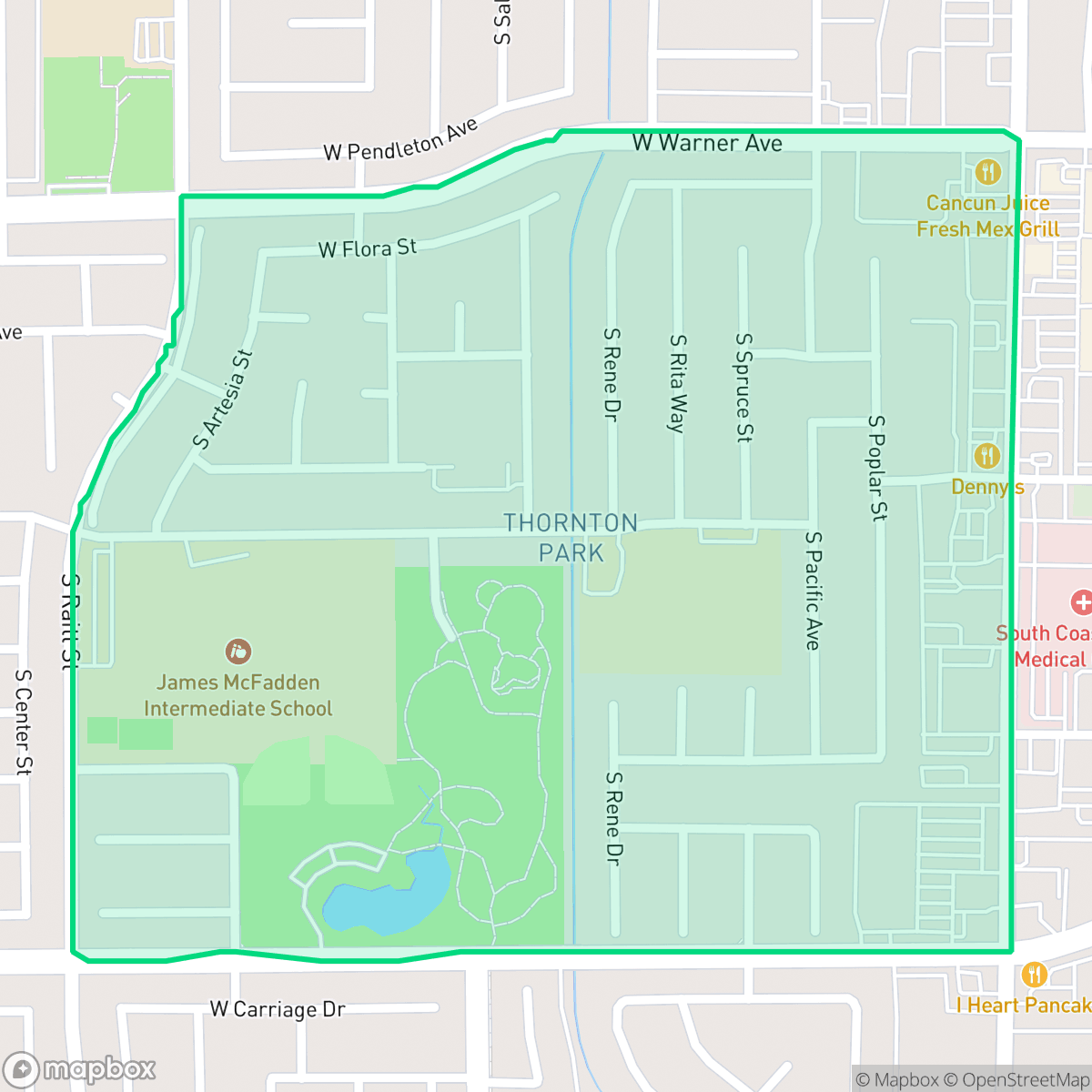
Located in southern Santa Ana, California, the Thornton Park neighborhood is a residential community that developed in the 1960s and 1970s, characterized by quiet, curving streets and mid-century modern ranch-style homes. The neighborhood's centerpiece is the 32.83-acre Carl Thornton Park, named after the city’s long-serving manager, Carl Thornton (1951–1972). The park’s land was originally purchased in the late 1950s for a stadium. After those plans changed, residential development grew around the site, while the vacant land became a marshy landfill due to unstable subsoil. In 1985, the site was transformed into a park designed by Ron Ono, featuring a two-acre lake that doubles as a water retention basin. The project won the California Parks and Recreation Society’s top award for environmental planning as the state's best-designed neighborhood park.
The neighborhood serves as a quiet residential enclave in southern Santa Ana, characterized by its grid-like street layout and well-maintained properties. Residents benefit from consistent sidewalk networks that make local errands and park visits accessible on foot. The presence of the large central park provides a focal point for outdoor activity, contributing to the area's reputation as a pet-friendly community. According to iHuus data, the area maintains a distinct suburban character with a high density of single-family homes.
Living in the area involves specific trade-offs, including elevated noise levels primarily driven by road traffic. The housing density is high, resulting in limited privacy between neighbors, and the proximity to industrial sites, such as the local wastewater treatment plant, is a factor for some residents. While the Santa Ana Unified School District manages local education, families should be aware that local schools currently face challenges with academic performance and student-teacher ratios. The neighborhood is best suited for those who prioritize pedestrian accessibility and park access over complete quiet or expansive private yards.
Neighborhood Scores Across 15 Qualities
Residential layouts feature mixed spacing, ranging from shared walls in apartment complexes to standard suburban setbacks. This level of density is slightly higher than the average for Santa Ana, according to iHuus data.
Pedestrian infrastructure is exceptionally well developed here, featuring continuous sidewalks on both sides of streets and clear crossings at major intersections. This connectivity is notably superior to the Santa Ana average, making it easy to navigate the neighborhood on foot.
Manicured properties and large homes with private pools characterize the area. According to iHuus data, the visual quality of the neighborhood is notably higher than the Santa Ana average.
Extensive public parks and continuous sidewalk networks provide ample space for walking dogs. According to iHuus data, the availability of trails and grassy areas is notably higher than the Santa Ana average.
Dense suburban layouts characterize the area with organized street grids and a mix of single-family homes and commercial centers. This residential structure is largely consistent with the broader Santa Ana area.
Low levels of social activity and a lack of walkable retail define this area, which feels more functional and suburban than the Santa Ana average. Most daily needs require a vehicle, as dining and service options are sparse and often disconnected from residential streets.
Frequent sounds from nearby railroad tracks and heavy freeway traffic characterize the area. According to iHuus data, acoustic comfort in Thornton Park is notably lower than the Santa Ana average.
Air quality fluctuates between acceptable and unhealthy levels, occasionally posing a risk to sensitive groups. According to iHuus data, the air quality in Thornton Park is slightly lower than the Santa Ana average.
Industrial activity is negligible in this area, consisting primarily of residential, educational, and recreational zones. According to iHuus data, this neighborhood maintains a level of separation from heavy industry that is consistent with the Santa Ana average.
Health insurance access is slightly higher than the Santa Ana average, though a significant portion of the population remains uninsured. According to iHuus data, residents may encounter more varied levels of healthcare accessibility than seen in other parts of the city.
Voting patterns and census indicators show a strong liberal leaning that is slightly more pronounced than the Santa Ana city average, according to iHuus data.
A balanced mix of young adults, families, and older residents defines the area. This demographic variety is slightly more pronounced than the average found across Santa Ana, according to iHuus data.
Flood risk in this area is higher than the Santa Ana average, though current FEMA assessments remain undetermined. Residents should note that detailed federal flood studies for this specific neighborhood have not yet been completed.
Address-Level Insights for Thornton Park


iHuus Neighborhood Intelligence Insights
Get address-level neighborhood insights for Thornton Park
- Street-level scores — see how individual blocks compare, not just neighborhood averages
- Micro-zone boundaries — identify quiet pockets, flood boundaries, and walkable clusters before you visit
- 15 dimensions in full — walkability, noise, air quality, school quality, insurance coverage, population age profile, urban/rural index, and more
- Boundary risk alerts — know if your address sits near a block boundary where scores drop, the kind of detail no listing will ever mention
- School insights — individual school ratings and insights, not just district-level data
- Compare before you commit — side-by-side data across neighborhoods, down to block precision
No credit card required
Compare with Any Neighborhood
| Dimension | Thornton Park | Artesia Pilar |
|---|---|---|
| 🚶 Walkabilityavg 9.05 | ||
| 🔊 Acoustic Comfortavg 2.11 | ||
| 🤫 Privacy Indexavg 4.2 | ||
| 🎨 Visual Appealavg 6.18 | ||
| 🐕 Dog Friendlinessavg 5.61 | ||
| 🗺️ Urban-Rural Indexavg 6.4 | ||
| ✨ Neighborhood Vibeavg 4.4 | ||
| 🏥 Health Insurance Coverageavg 5.33 | ||
| 🌿 Air Qualityavg 7.05 | ||
| 🏭 Industrial Proximityavg 8.16 | ||
| 🌊 Flood Safetyavg 3.08 | ||
| 🗳️ Ideological Leanavg 8.63 | ||
| 👥 Population Age Profileavg 4.55 | ||
| 🔥 Fire Safety | ||
| 🏫 School Quality |
Thornton Park Rankings
School Districts Serving Thornton Park
School Insights for Thornton Park
Below average outcomes; significant attendance and academic challenges.
School Insights
See what's really behind every school rating near Thornton Park
- Individual school ratings — each school's own score with outcome context, not just a district average
- Enrollment & class size data — student-to-teacher ratio and how it compares to the state average
- Full demographics breakdown — ethnicity and gender composition for every school in the enrollment zone
- Every school in the district — all schools within the enrollment boundary ranked by rating, not just the closest one
- Grade levels & benchmarks — elementary through high school, with below/above state-average flags
No credit card required