Sandpointe, Santa Ana
Updated · 5,315 residents
Sandpointe is a residential community in Santa Ana defined by its 1970s tract housing and proximity to the South Coast Metro district. Residents benefit from a highly walkable street grid and access to local green space, though the area experiences notable noise levels primarily due to nearby road traffic.
Key Highlights
About Sandpointe
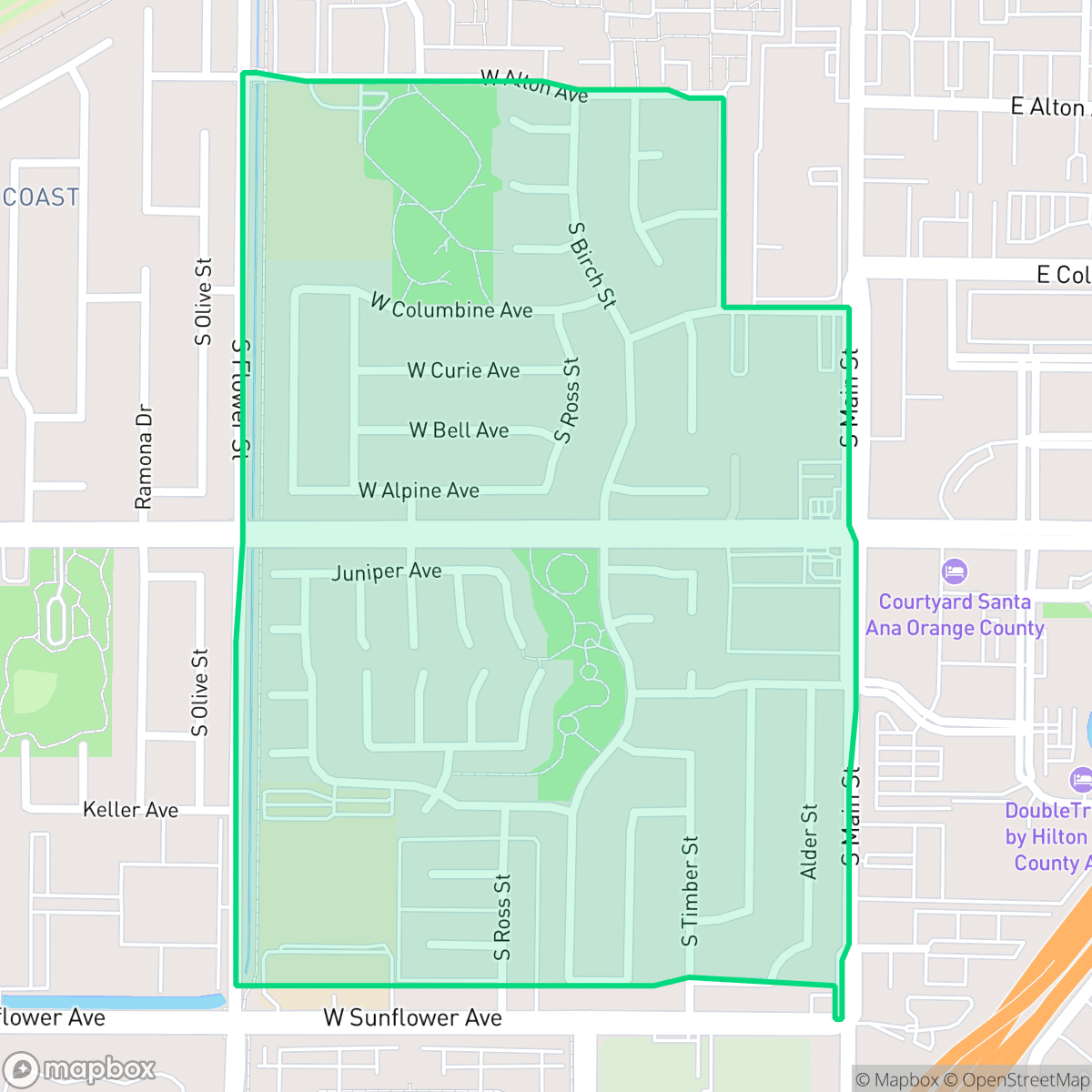
Developed in the early 1970s, the Sandpointe neighborhood in Santa Ana, California, originally consisted of approximately 750 single-family homes, a small four-plex development, and the 42-unit Main Attraction condominium complex. These suburban residences, which initially sold for $24,000 to $36,000, are situated adjacent to Sandpointe Park, a 6.6-acre community green space known for hosting the neighborhood's annual "Keep Sandpointe Beautiful" fair. Located near the South Coast Metro district, Sandpointe has historically navigated the balance between its residential character and surrounding commercial expansion. This includes proximity to the nearby MacArthur Place development and modern adaptive reuse projects converting 1980s-era office campuses along East Sandpointe Avenue into apartments.
The area functions as a dense suburban enclave that balances established single-family homes with modern apartment complexes. While the neighborhood maintains a consistent aesthetic with well-kept properties and private pools, it sits in close proximity to commercial zones and major transit corridors. This location provides residents with easy access to regional retail and employment hubs, though it necessitates navigating the noise and industrial character of the surrounding sectors. According to iHuus data, the neighborhood offers a distinct suburban experience that prioritizes connectivity over total acoustic seclusion.
Prospective residents should consider that the neighborhood is best suited for those prioritizing accessibility and a settled suburban environment. While the street grid is highly pedestrian-friendly, the presence of major arterial roads creates a significant noise profile that defines the daily experience. Families and professionals may find the balance of local park access and proximity to South Coast Metro appealing, provided they can accommodate the trade-offs in noise and privacy inherent to this dense suburban setting.
Neighborhood Scores Across 15 Qualities
Residential spacing varies between suburban setbacks and denser, shared-wall apartment structures. According to iHuus data, privacy levels here are slightly higher than the Santa Ana average.
Continuous sidewalks and clear crosswalks are available throughout the residential grid, making it slightly more walkable than the average Santa Ana neighborhood. While major perimeter roads carry higher traffic, the internal street network remains highly accessible to pedestrians.
Well-maintained homes with large driveways and private pools contribute to a visual landscape that is more attractive than the Santa Ana average. According to iHuus data, the area features consistent architectural lines and frequent access to upscale amenities.
Extensive green belts and large public parks offer plenty of room for exercise; according to iHuus data, these connected walking paths and wide verges make this area significantly more dog friendly than the Santa Ana average.
Residential layouts consist of a dense suburban blend of single-family homes and multi-story apartment complexes. This landscape of developed tracts and retail areas remains largely consistent with the city average.
Active pockets of dining and leisure exist alongside quieter, industrial-adjacent blocks, making the area more vibrant than the Santa Ana average. According to iHuus data, residents will find a variety of social hubs and restaurants positioned near major transit corridors and green spaces.
Persistent noise from nearby freeways and railroad corridors characterizes the area. According to iHuus data, acoustic comfort levels are slightly lower than the Santa Ana average.
Air quality in Sandpointe fluctuates between acceptable and unhealthy levels. According to iHuus data, the air quality here is slightly lower than the Santa Ana city average, which may cause occasional concern for sensitive groups.
Residential life remains largely undisturbed by heavy industry, though some proximity to large warehouses and commercial storage exists near the northern and eastern sectors. According to iHuus data, the area is slightly more influenced by commercial activity than the Santa Ana average.
Health insurance accessibility is notably higher here than the Santa Ana average, according to iHuus data.
Political leanings in Sandpointe align closely with the broader Santa Ana area, characterized by a liberal majority and a small opposing presence according to iHuus data.
Residents experience a diverse demographic spread including young adults, families, and older individuals. This age distribution is slightly more varied than the typical profile found across Santa Ana, according to iHuus data.
Flood risk in this area is higher than the Santa Ana average. According to iHuus data, a detailed FEMA study has not yet been completed for this specific location, resulting in an undetermined risk level.
Address-Level Insights for Sandpointe


iHuus Neighborhood Intelligence Insights
Get address-level neighborhood insights for Sandpointe
- Street-level scores — see how individual blocks compare, not just neighborhood averages
- Micro-zone boundaries — identify quiet pockets, flood boundaries, and walkable clusters before you visit
- 15 dimensions in full — walkability, noise, air quality, school quality, insurance coverage, population age profile, urban/rural index, and more
- Boundary risk alerts — know if your address sits near a block boundary where scores drop, the kind of detail no listing will ever mention
- School insights — individual school ratings and insights, not just district-level data
- Compare before you commit — side-by-side data across neighborhoods, down to block precision
No credit card required
Compare with Any Neighborhood
| Dimension | Sandpointe | Artesia Pilar |
|---|---|---|
| 🚶 Walkabilityavg 9.05 | ||
| 🔊 Acoustic Comfortavg 2.11 | ||
| 🤫 Privacy Indexavg 4.2 | ||
| 🎨 Visual Appealavg 6.18 | ||
| 🐕 Dog Friendlinessavg 5.61 | ||
| 🗺️ Urban-Rural Indexavg 6.4 | ||
| ✨ Neighborhood Vibeavg 4.4 | ||
| 🏥 Health Insurance Coverageavg 5.33 | ||
| 🌿 Air Qualityavg 7.05 | ||
| 🏭 Industrial Proximityavg 8.16 | ||
| 🌊 Flood Safetyavg 3.08 | ||
| 🗳️ Ideological Leanavg 8.63 | ||
| 👥 Population Age Profileavg 4.55 | ||
| 🔥 Fire Safety | ||
| 🏫 School Quality |
Sandpointe Rankings
School Districts Serving Sandpointe
School Insights for Sandpointe
Below average outcomes; significant attendance and academic challenges.
School Insights
See what's really behind every school rating near Sandpointe
- Individual school ratings — each school's own score with outcome context, not just a district average
- Enrollment & class size data — student-to-teacher ratio and how it compares to the state average
- Full demographics breakdown — ethnicity and gender composition for every school in the enrollment zone
- Every school in the district — all schools within the enrollment boundary ranked by rating, not just the closest one
- Grade levels & benchmarks — elementary through high school, with below/above state-average flags
No credit card required