Morrison-Eldridge Park, Santa Ana
Updated · 1,164 residents
Morrison-Eldridge Park is a dense, mid-century suburban enclave defined by its proximity to major highway infrastructure and community-focused landmarks. While the area offers a stable residential environment, residents face significant noise levels from nearby traffic and limited pedestrian connectivity.
Key Highlights
About Morrison-Eldridge Park
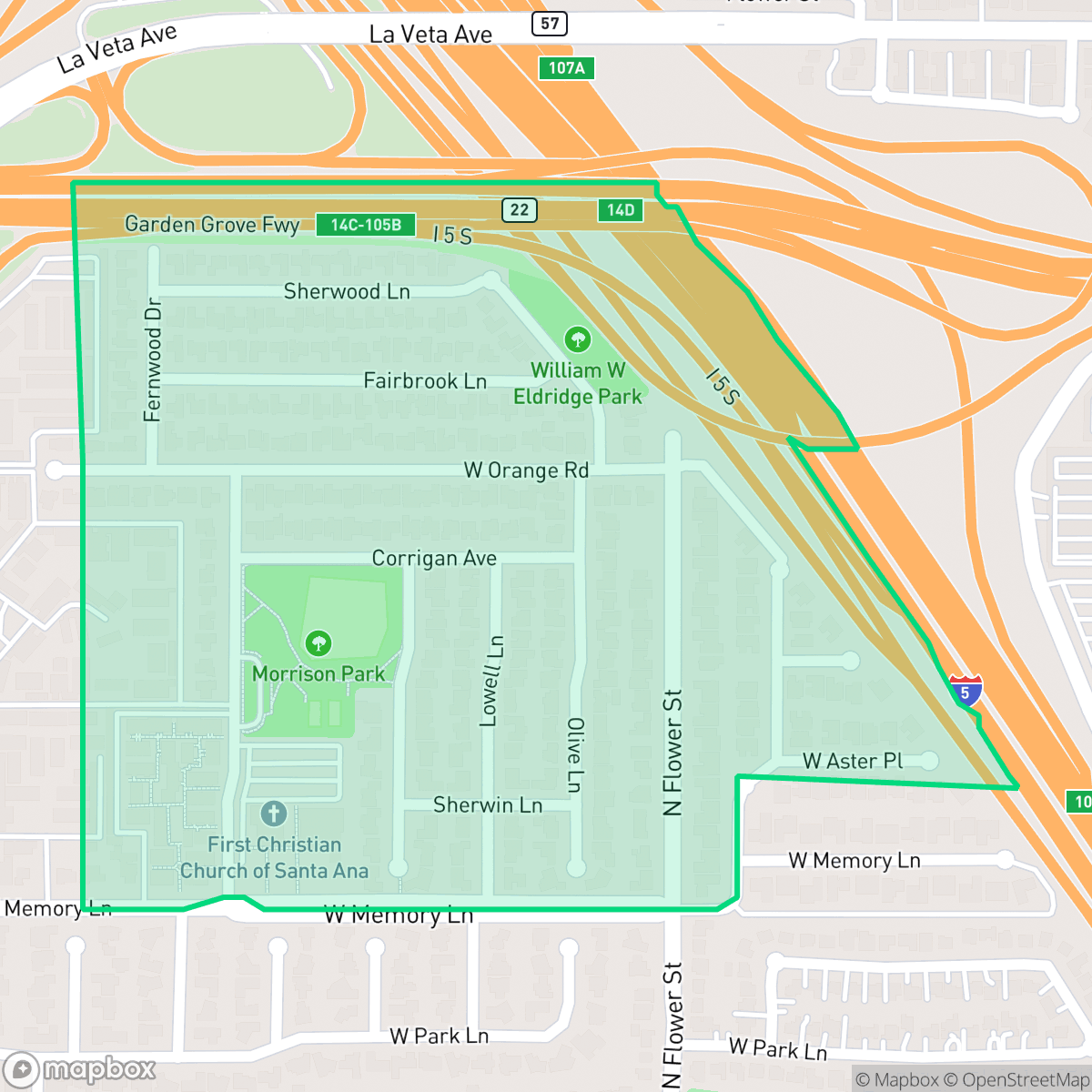
The Morrison-Eldridge Park neighborhood in northern Santa Ana, California, was primarily composed of orange groves until its first residential tract was constructed around 1955. Developed largely between 1940 and 1969, the area is characterized by its mid-century ranch homes and tree-lined streets. In the late 1960s, local residents successfully mobilized against a proposal by landowner Corrigan to replace his orange grove with apartments. Appealing to Mayor Loren Griset, neighbors secured zoning rights to establish a church and a public park instead. The resulting Morrison Park was named in honor of Judge Kenneth Morrison, a dedicated juvenile court judge and advocate for Orange County's youth. Today, the neighborhood retains its quiet suburban character, anchored by both Morrison Park and the nearby 1.2-acre Eldridge Park.
The neighborhood maintains a distinct suburban character through its collection of mid-century ranch homes, which are complemented by social hubs such as the St. John Maron Church. It is situated within an urban corridor that benefits from high air quality and an absence of industrial hazards, making it a stable choice for those who value established residential zones. The area is characterized by a lively atmosphere in its mid-rise blocks, though the layout is heavily influenced by the surrounding transportation infrastructure, which serves as a central feature of the local landscape.
Prospective residents should consider the trade-offs associated with the area's car-dependent design. The proximity to major freeway interchanges results in elevated ambient noise levels, and the physical barriers created by these roads limit walkability and access to pet-friendly spaces. Families may find varying educational opportunities depending on their specific district boundaries, as the area is served by both the Orange Unified and Santa Ana Unified school districts. This neighborhood is best suited for those who prioritize a central location and a quiet, historical suburban aesthetic over high walkability or complete acoustic isolation.
Neighborhood Scores Across 15 Qualities
Residential spacing varies between detached houses with small side yards and denser multi-unit structures. This level of separation is higher than the Santa Ana average, according to iHuus data.
Residential streets feature sidewalks and safe crossings, though connectivity is limited by nearby multi-lane freeways. This level of walkability is lower than the average for Santa Ana.
Large homes with well-maintained private landscaping and high pool density provide a visually pleasing environment that is notably more attractive than the Santa Ana average. According to iHuus data, the area features prominent upscale amenities and spacious residential lots.
Large parks and green belts along the southern canal offer good walking opportunities, though massive freeway interchanges create significant barriers for movement. According to iHuus data, the area is more pet-friendly than the Santa Ana average despite some fragmented green spaces.
Residential streets and green spaces exist in relatively equal measure, though the area feels slightly less densely developed than the Santa Ana average. According to iHuus data, the landscape transitions between organized single-family grids and pockets of dense multi-family housing near highway infrastructure.
A blend of active social hubs and quiet residential streets provides a level of activity that is higher than the Santa Ana average. According to iHuus data, residents can find a diverse selection of dining and services, though the area's layout remains somewhat car dependent.
Continuous noise from nearby airport flight paths and heavy rail transit defines the area. Acoustic comfort is significantly lower than the Santa Ana average according to iHuus data.
Air quality remains mostly clean with rare instances of elevated readings, performing better than the Santa Ana average according to iHuus data.
Residential life remains largely uninterrupted by heavy industry, as the area features only occasional light commercial use and small utility footprints. This lack of significant industrial activity is slightly better than the Santa Ana average, according to iHuus data.
Health insurance accessibility is notably higher here than the Santa Ana average, according to iHuus data. Most residents in this area maintain active health coverage.
Political leanings in this area are predominantly liberal, which is very similar to the broader Santa Ana community according to iHuus data.
Residents live alongside a balanced distribution of young adults, families, and seniors. This age profile is slightly more varied than the average found across Santa Ana, according to iHuus data.
Flood risk levels in this area are slightly higher than the Santa Ana average, though official FEMA studies for the neighborhood remain incomplete. Residents should remain aware of potential vulnerabilities as the area lacks a detailed federal flood assessment.
Address-Level Insights for Morrison-Eldridge Park


iHuus Neighborhood Intelligence Insights
Get address-level neighborhood insights for Morrison-Eldridge Park
- Street-level scores — see how individual blocks compare, not just neighborhood averages
- Micro-zone boundaries — identify quiet pockets, flood boundaries, and walkable clusters before you visit
- 15 dimensions in full — walkability, noise, air quality, school quality, insurance coverage, population age profile, urban/rural index, and more
- Boundary risk alerts — know if your address sits near a block boundary where scores drop, the kind of detail no listing will ever mention
- School insights — individual school ratings and insights, not just district-level data
- Compare before you commit — side-by-side data across neighborhoods, down to block precision
No credit card required
Compare with Any Neighborhood
| Dimension | Morrison-Eldridge Park | Artesia Pilar |
|---|---|---|
| 🚶 Walkabilityavg 9.05 | ||
| 🔊 Acoustic Comfortavg 2.11 | ||
| 🤫 Privacy Indexavg 4.2 | ||
| 🎨 Visual Appealavg 6.18 | ||
| 🐕 Dog Friendlinessavg 5.61 | ||
| 🗺️ Urban-Rural Indexavg 6.4 | ||
| ✨ Neighborhood Vibeavg 4.4 | ||
| 🏥 Health Insurance Coverageavg 5.33 | ||
| 🌿 Air Qualityavg 7.05 | ||
| 🏭 Industrial Proximityavg 8.16 | ||
| 🌊 Flood Safetyavg 3.08 | ||
| 🗳️ Ideological Leanavg 8.63 | ||
| 👥 Population Age Profileavg 4.55 | ||
| 🔥 Fire Safety | ||
| 🏫 School Quality |
Morrison-Eldridge Park Rankings
School Districts Serving Morrison-Eldridge Park
School Insights for Morrison-Eldridge Park
Below average outcomes; significant attendance and academic challenges.
School Insights
See what's really behind every school rating near Morrison-Eldridge Park
- Individual school ratings — each school's own score with outcome context, not just a district average
- Enrollment & class size data — student-to-teacher ratio and how it compares to the state average
- Full demographics breakdown — ethnicity and gender composition for every school in the enrollment zone
- Every school in the district — all schools within the enrollment boundary ranked by rating, not just the closest one
- Grade levels & benchmarks — elementary through high school, with below/above state-average flags
No credit card required