Memorial Park, Santa Ana
Updated · 11,236 residents
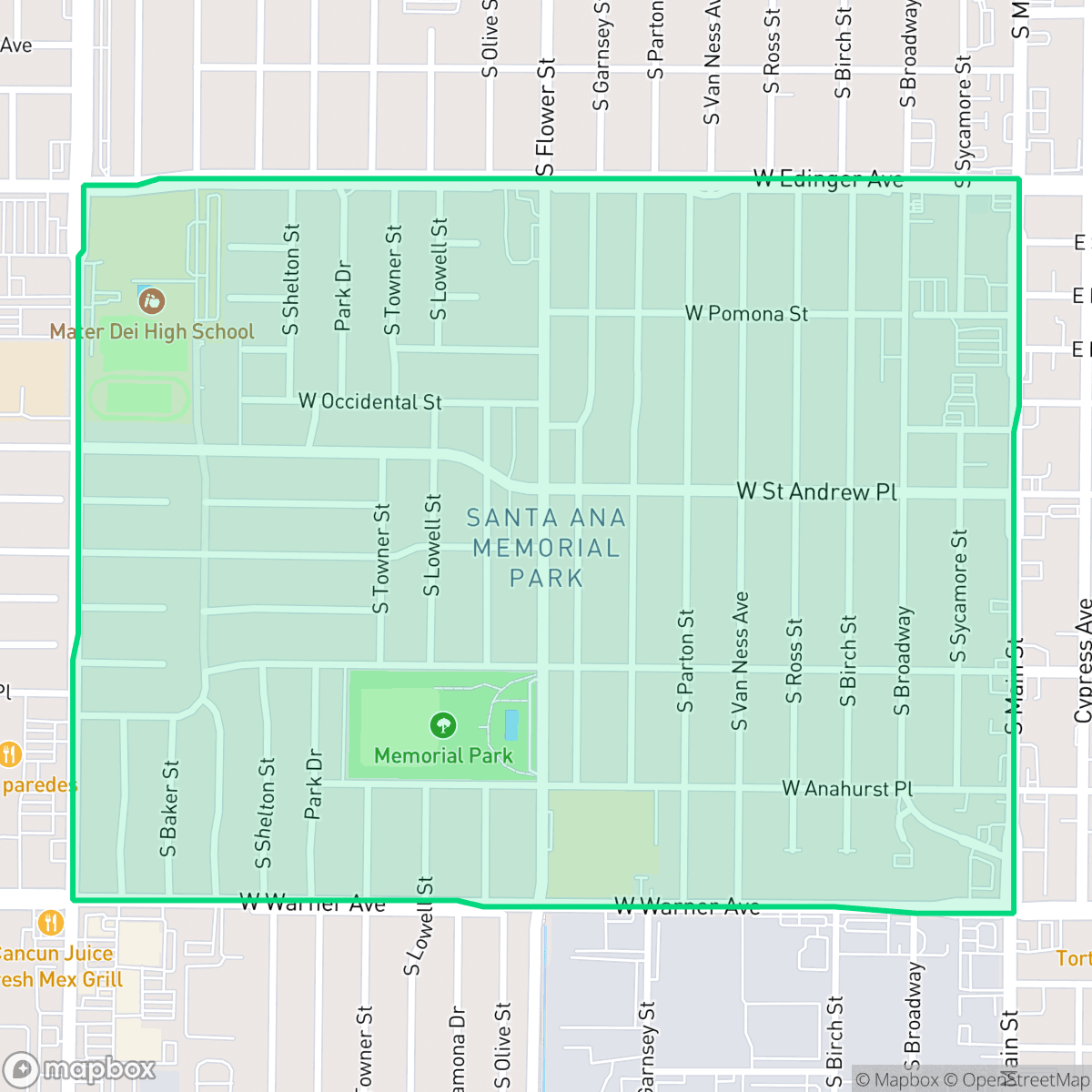
Memorial Park is a highly walkable neighborhood in central-south Santa Ana defined by its dense, grid-based layout and historic namesake green space. While the area offers excellent pedestrian access to local amenities and schools, residents experience significant noise from road traffic and close living quarters.
Key Highlights
About Memorial Park
The central-south Santa Ana neighborhood of Memorial Park centers around its namesake 16.3-acre public park, which was dedicated in May 1950 by former California Governor Earl Warren as a "living memorial" to honor local residents who died serving in World War II. The low-rise residential neighborhood is characterized by single-family homes with distinct gabled rooflines. A defining cultural landmark of the neighborhood is "Chicano Gothic," a prominent mural painted in 1987 by renowned Chicano artist Emigdio Vasquez on the neighborhood's original 1956 pool facility. This vital piece of local heritage is being carefully preserved and integrated as a central entry marker for the neighborhood's modern, all-electric aquatics center and park master plan.
The area functions as a dense residential hub where a consistent grid of streets and sidewalks makes daily errands and school commutes highly accessible on foot. Beyond the central park, the landscape is characterized by uniform, single-family homes on small lots, reflecting a traditional suburban layout that prioritizes connectivity over expansive private space. According to iHuus data, the proximity to both institutional facilities and commercial corridors provides a functional, albeit compact, living environment that balances residential stability with urban convenience.
Prospective residents should be aware that the neighborhood experiences elevated noise levels primarily due to consistent road traffic. While the community benefits from a strong pedestrian infrastructure, the proximity to industrial and commercial zones in the southern reaches contributes to a busier atmosphere than quieter residential enclaves. The area is best suited for those who value walkability and proximity to public resources over acoustic privacy or large, secluded yards, as noted by iHuus findings on the local density.
Neighborhood Scores Across 15 Qualities
Residential structures are often closely spaced with minimal yard setbacks, resulting in a sense of privacy that is slightly lower than the Santa Ana average.
Pedestrian infrastructure is exceptionally well developed, featuring a complete grid of sidewalks and clear crosswalks on nearly all streets. This level of connectivity for walkers and runners is notably higher than the Santa Ana average, according to iHuus data.
Uniform tract housing with small yards and minimal private amenities defines the landscape here; this visual profile is largely consistent with the Santa Ana average.
Large public parks and wide green verges in the northeast quadrant provide good opportunities for walking dogs; however, other residential pockets feature narrow parkways and limited accessible green space. This level of accessibility is slightly lower than the Santa Ana average, according to iHuus data.
Dense suburban development characterizes this area, featuring a mix of single-family homes, apartment complexes, and commercial strips. This landscape is largely consistent with the typical urban density found throughout Santa Ana.
Low levels of activity and a sparse business landscape make this a quiet, suburban area where most dining and retail options require a vehicle to reach. According to iHuus data, the neighborhood's energy is notably lower than the Santa Ana average.
Constant sound from nearby freeway and railroad traffic makes this a noisy area. According to iHuus data, acoustic comfort is lower than the Santa Ana average.
Air quality levels fluctuate between acceptable and unhealthy, appearing slightly lower than the Santa Ana average. Sensitive groups may experience occasional concern during certain periods, according to iHuus data.
Industrial activity is minimal throughout most of the area, consisting primarily of light commercial and warehouse structures near major transit corridors. This level of proximity to industrial zones is slightly lower than the Santa Ana average according to iHuus data.
Health insurance access is slightly above the Santa Ana average. According to iHuus data, a portion of the local population remains uninsured.
Voting patterns and census indicators reflect a predominantly liberal political leaning that is more pronounced than the Santa Ana city average, according to iHuus data.
A balanced range of young adults, families, and older residents characterizes this area. This demographic spread is largely consistent with the overall Santa Ana average, according to iHuus data.
Property located within a designated floodplain may require flood insurance. According to iHuus data, the flood risk in this area is slightly higher than the Santa Ana average.
Address-Level Insights for Memorial Park


iHuus Neighborhood Intelligence Insights
Get address-level neighborhood insights for Memorial Park
- Street-level scores — see how individual blocks compare, not just neighborhood averages
- Micro-zone boundaries — identify quiet pockets, flood boundaries, and walkable clusters before you visit
- 15 dimensions in full — walkability, noise, air quality, school quality, insurance coverage, population age profile, urban/rural index, and more
- Boundary risk alerts — know if your address sits near a block boundary where scores drop, the kind of detail no listing will ever mention
- School insights — individual school ratings and insights, not just district-level data
- Compare before you commit — side-by-side data across neighborhoods, down to block precision
No credit card required
Compare with Any Neighborhood
| Dimension | Memorial Park | Artesia Pilar |
|---|---|---|
| 🚶 Walkabilityavg 9.05 | ||
| 🔊 Acoustic Comfortavg 2.11 | ||
| 🤫 Privacy Indexavg 4.2 | ||
| 🎨 Visual Appealavg 6.18 | ||
| 🐕 Dog Friendlinessavg 5.61 | ||
| 🗺️ Urban-Rural Indexavg 6.4 | ||
| ✨ Neighborhood Vibeavg 4.4 | ||
| 🏥 Health Insurance Coverageavg 5.33 | ||
| 🌿 Air Qualityavg 7.05 | ||
| 🏭 Industrial Proximityavg 8.16 | ||
| 🌊 Flood Safetyavg 3.08 | ||
| 🗳️ Ideological Leanavg 8.63 | ||
| 👥 Population Age Profileavg 4.55 | ||
| 🔥 Fire Safety | ||
| 🏫 School Quality |
Memorial Park Rankings
School Districts Serving Memorial Park
School Insights for Memorial Park
Below average outcomes; significant attendance and academic challenges.
School Insights
See what's really behind every school rating near Memorial Park
- Individual school ratings — each school's own score with outcome context, not just a district average
- Enrollment & class size data — student-to-teacher ratio and how it compares to the state average
- Full demographics breakdown — ethnicity and gender composition for every school in the enrollment zone
- Every school in the district — all schools within the enrollment boundary ranked by rating, not just the closest one
- Grade levels & benchmarks — elementary through high school, with below/above state-average flags
No credit card required