Madison Park, Santa Ana
Updated · 8,242 residents
Madison Park is a highly walkable community in Santa Ana defined by its dense residential grid and long-standing civic engagement. While the area offers a serene suburban atmosphere with accessible local schooling, residents should expect notable noise levels from consistent road traffic.
Key Highlights
About Madison Park
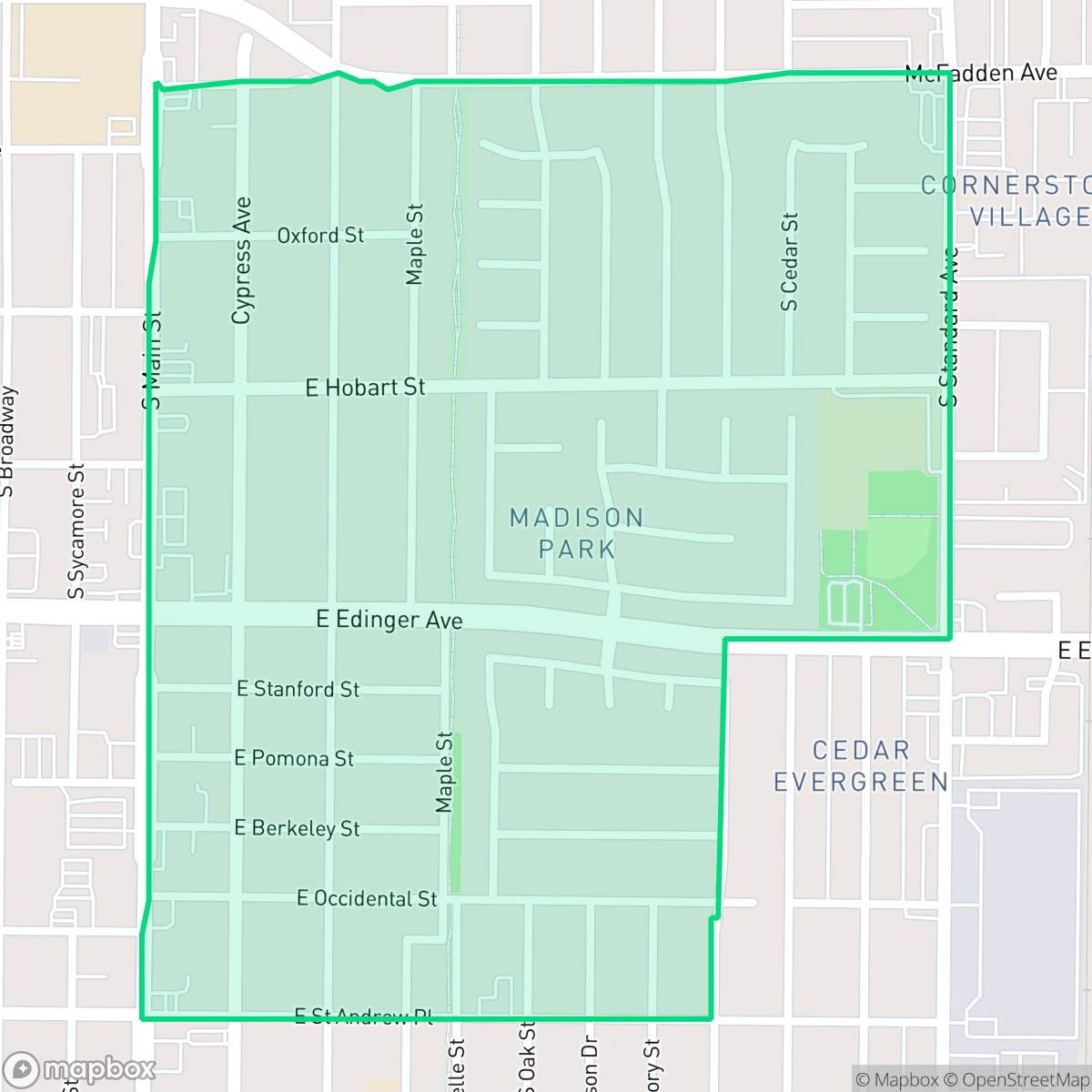
Located in southeast Santa Ana, California, Madison Park is a densely populated neighborhood defined by its rich history of grassroots activism and strong Mexican-American heritage, with over 94% of residents identifying with Mexican ancestry. The neighborhood's housing stock features well-established single-family homes and townhomes dating primarily from 1940 to 1969. At the heart of the community is its namesake 6.06-acre Madison Park, which features "Parkopolis," an interactive learning landscape developed by UC Irvine. Since 1987, the Madison Park Neighborhood Association (MPNA) has driven local advocacy. Partnering with James Madison Elementary School, MPNA and its spin-off GREEN-MPNA have championed environmental justice, establishing Santa Ana’s first Community Air Monitoring Network to combat local industrial pollution.
The physical layout of the neighborhood is characterized by a dense, grid-like arrangement of single-family homes that prioritize neighborhood proximity over expansive private space. Residents benefit from exceptional walkability, as continuous sidewalks and marked crossings make the area easy to navigate on foot. While the general atmosphere is quiet, the average noise level of 64 decibels, primarily driven by road traffic, is a key consideration for those sensitive to sound. The area maintains a consistent suburban aesthetic with uniform housing and small, well-maintained yards that offer a sense of order and stability.
This neighborhood is well-suited for families and individuals who value a stable, community-oriented environment with proximity to the well-regarded Madison Elementary School. The absence of nearby heavy industry and high air quality scores contribute to a healthier living environment for long-term residents. While the housing stock lacks significant architectural variety, the area is ideal for those who prioritize pedestrian accessibility and active community involvement over the privacy of larger, isolated properties.
Neighborhood Scores Across 15 Qualities
Residential structures are closely packed with minimal separation between homes. This level of density is notably higher than the Santa Ana average, as according to iHuus data, houses often feature very small side-yard setbacks.
Continuous sidewalks on both sides of most streets and clearly marked crossings make navigating the area easy on foot. This level of pedestrian infrastructure is slightly above the Santa Ana average, according to iHuus data.
Standard tract housing and uniform rooflines define the local landscape. The area features modest yards and a mix of apartment complexes and industrial warehouses, making the visual character slightly below the Santa Ana average.
Public park access and green verges are sparse, making the area less dog-friendly than the Santa Ana average. Most residents must rely on private backyards or a single central park in the northwest portion of the neighborhood for pet exercise.
Residential blocks consist primarily of single-family homes and low-rise commercial strips. This landscape is largely consistent with the typical urban-suburban mix found across Santa Ana.
Steady residential life and diverse dining options exist alongside light industrial areas, resulting in a level of activity that is consistent with the Santa Ana average. Most residents will find a serene setting, though many local eateries require a car to reach.
Frequent noise from nearby freeway and railroad corridors impacts the area. According to iHuus data, acoustic disturbances in Madison Park are more significant than the average for Santa Ana.
Air quality in this area is generally good, with only rare instances of elevated readings. According to iHuus data, the air quality is slightly better than the average for Santa Ana.
Industrial presence is limited primarily to light commercial zones and small warehouses near main transit corridors. While some warehouse activity exists near arterial roads, the area contains significantly less industrial density than the Santa Ana average.
Health insurance accessibility is slightly higher than the Santa Ana average, though a significant portion of the population remains uninsured according to iHuus data.
Voting patterns and census indicators show a predominantly liberal political leaning that is more pronounced than the Santa Ana average, according to iHuus data.
Residents live alongside a balanced mix of young adults, families, and older individuals. This demographic spread is roughly in line with the average seen across Santa Ana.
Property within this area sits inside a designated floodplain, which presents a significantly higher risk of flooding than the Santa Ana average. According to iHuus data, residents should expect that flood insurance will likely be a requirement for most properties.
Address-Level Insights for Madison Park


iHuus Neighborhood Intelligence Insights
Get address-level neighborhood insights for Madison Park
- Street-level scores — see how individual blocks compare, not just neighborhood averages
- Micro-zone boundaries — identify quiet pockets, flood boundaries, and walkable clusters before you visit
- 15 dimensions in full — walkability, noise, air quality, school quality, insurance coverage, population age profile, urban/rural index, and more
- Boundary risk alerts — know if your address sits near a block boundary where scores drop, the kind of detail no listing will ever mention
- School insights — individual school ratings and insights, not just district-level data
- Compare before you commit — side-by-side data across neighborhoods, down to block precision
No credit card required
Compare with Any Neighborhood
| Dimension | Madison Park | Artesia Pilar |
|---|---|---|
| 🚶 Walkabilityavg 9.05 | ||
| 🔊 Acoustic Comfortavg 2.11 | ||
| 🤫 Privacy Indexavg 4.2 | ||
| 🎨 Visual Appealavg 6.18 | ||
| 🐕 Dog Friendlinessavg 5.61 | ||
| 🗺️ Urban-Rural Indexavg 6.4 | ||
| ✨ Neighborhood Vibeavg 4.4 | ||
| 🏥 Health Insurance Coverageavg 5.33 | ||
| 🌿 Air Qualityavg 7.05 | ||
| 🏭 Industrial Proximityavg 8.16 | ||
| 🌊 Flood Safetyavg 3.08 | ||
| 🗳️ Ideological Leanavg 8.63 | ||
| 👥 Population Age Profileavg 4.55 | ||
| 🔥 Fire Safety | ||
| 🏫 School Quality |
Madison Park Rankings
School Districts Serving Madison Park
School Insights for Madison Park
Below average outcomes; significant attendance and academic challenges.
School Insights
See what's really behind every school rating near Madison Park
- Individual school ratings — each school's own score with outcome context, not just a district average
- Enrollment & class size data — student-to-teacher ratio and how it compares to the state average
- Full demographics breakdown — ethnicity and gender composition for every school in the enrollment zone
- Every school in the district — all schools within the enrollment boundary ranked by rating, not just the closest one
- Grade levels & benchmarks — elementary through high school, with below/above state-average flags
No credit card required