Lyon Street, Santa Ana
Updated · 6,783 residents
Lyon Street is a dense, industrial-adjacent neighborhood in Santa Ana characterized by a mix of multi-family housing and mobile home parks. While it offers a consistent sidewalk network for pedestrians, the area is notably loud due to heavy road traffic and proximity to local rail lines.
Key Highlights
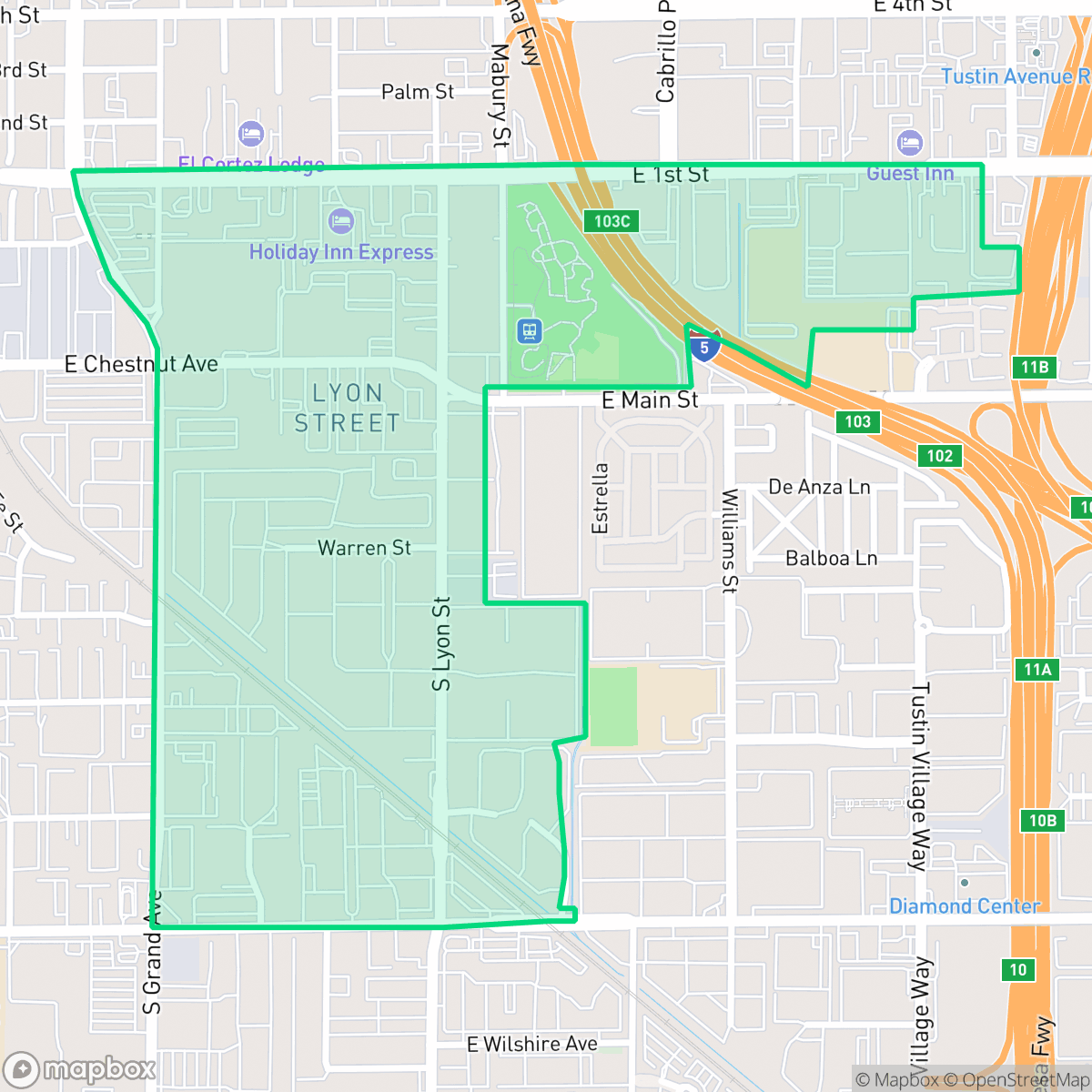
About Lyon Street
Located southeast of Downtown Santa Ana and bordering Tustin, the Lyon Street neighborhood is named after pioneer George B. Lyon, who settled the area in the early 1870s. Although Lyon subdivided his land during the 1880s railroad boom, the bust reverted the tract to farm acreage for several decades. The modern neighborhood developed primarily in the mid-20th century, with a residential housing stock consisting of apartments, duplexes, and mobile homes built between 1940 and 1969. Today, Lyon Street is home to the landmark Santa Ana Zoo. The neighborhood has a vibrant cultural identity, with a population that is predominantly of Mexican ancestry and primarily Spanish-speaking.
The area functions as a quiet, working-class residential enclave defined by its proximity to significant industrial warehouse districts. Residents benefit from a reliable grid of sidewalks that facilitate local movement, though the overall environment is marked by high-density living and limited private outdoor space. The neighborhood maintains a distinct urban feel, balancing its residential roots with the operational presence of nearby freight and logistics hubs.
Prospective residents should note the acoustic environment, as the intersection of road traffic and rail activity creates a consistent noise profile. While the area offers good air quality and high flood safety, the lack of dedicated dog-friendly green spaces and the presence of heavy industrial traffic are key trade-offs. It is best suited for those prioritizing proximity to major transit corridors and industrial employment centers over a quiet or highly manicured suburban aesthetic.
Neighborhood Scores Across 15 Qualities
Residential spacing is comparable to the Santa Ana average, featuring a mix of multi-family apartments and closely packed mobile homes. Shared walls and narrow distances between structures are common throughout this area according to iHuus data.
Sidewalks are available on most streets, but high-traffic arterials and large industrial blocks can make pedestrian travel less comfortable than in most of Santa Ana. Navigating the area on foot is possible, yet frequent intersections and wide roads reduce overall ease of movement.
Residential views consist mainly of dense tract housing, mobile home parks, and industrial warehouses. This landscape offers less visual variety than the Santa Ana average due to the prevalence of boxy rooftops and uniform apartment blocks.
Public greenery and grass verges are relatively scarce in this area, falling below the Santa Ana average. Most accessible vegetation is restricted to fenced sports fields or private residential complexes according to iHuus data.
Residential areas consist of a dense mix of apartment complexes, mobile home parks, and industrial warehouses. This landscape is slightly more developed than the typical Santa Ana environment, according to iHuus data.
Primarily composed of industrial and suburban blocks, this area offers limited pedestrian activity and relies heavily on vehicles for transit. According to iHuus data, the local vibe is more functional and subdued than the typical Santa Ana neighborhood.
Frequent noise from nearby transit corridors and rail lines makes this a loud area. According to iHuus data, acoustic comfort is lower than the Santa Ana average.
Air quality in this area remains consistently high with infrequent periods of poor air. According to iHuus data, the air is cleaner than the typical levels found across Santa Ana.
Large warehouses and commercial loading docks are present alongside residential areas, resulting in a higher concentration of industrial activity than the Santa Ana average. According to iHuus data, some sections of the neighborhood experience intermittent operational noise and increased heavy vehicle traffic near the northern sector.
Health insurance access is notably lower than the Santa Ana average, which may present challenges for residents seeking consistent medical coverage. According to iHuus data, a small portion of the local population maintains active health benefits.
Voting patterns and census indicators show a significantly more liberal leaning than the Santa Ana average, according to iHuus data.
Residents live alongside a balanced mix of young adults, families, and seniors. This demographic distribution is slightly lower than the Santa Ana average, according to iHuus data.
Flood risk levels in this area are higher than the Santa Ana average, though FEMA has not yet completed a detailed study to provide a definitive assessment. According to iHuus data, the neighborhood falls into a category of undetermined risk.
Address-Level Insights for Lyon Street


iHuus Neighborhood Intelligence Insights
Get address-level neighborhood insights for Lyon Street
- Street-level scores — see how individual blocks compare, not just neighborhood averages
- Micro-zone boundaries — identify quiet pockets, flood boundaries, and walkable clusters before you visit
- 15 dimensions in full — walkability, noise, air quality, school quality, insurance coverage, population age profile, urban/rural index, and more
- Boundary risk alerts — know if your address sits near a block boundary where scores drop, the kind of detail no listing will ever mention
- School insights — individual school ratings and insights, not just district-level data
- Compare before you commit — side-by-side data across neighborhoods, down to block precision
No credit card required
Compare with Any Neighborhood
| Dimension | Lyon Street | Artesia Pilar |
|---|---|---|
| 🚶 Walkabilityavg 9.05 | ||
| 🔊 Acoustic Comfortavg 2.11 | ||
| 🤫 Privacy Indexavg 4.2 | ||
| 🎨 Visual Appealavg 6.18 | ||
| 🐕 Dog Friendlinessavg 5.61 | ||
| 🗺️ Urban-Rural Indexavg 6.4 | ||
| ✨ Neighborhood Vibeavg 4.4 | ||
| 🏥 Health Insurance Coverageavg 5.33 | ||
| 🌿 Air Qualityavg 7.05 | ||
| 🏭 Industrial Proximityavg 8.16 | ||
| 🌊 Flood Safetyavg 3.08 | ||
| 🗳️ Ideological Leanavg 8.63 | ||
| 👥 Population Age Profileavg 4.55 | ||
| 🔥 Fire Safety | ||
| 🏫 School Quality |
Lyon Street Rankings
School Districts Serving Lyon Street
School Insights for Lyon Street
Below average outcomes; significant attendance and academic challenges.
School Insights
See what's really behind every school rating near Lyon Street
- Individual school ratings — each school's own score with outcome context, not just a district average
- Enrollment & class size data — student-to-teacher ratio and how it compares to the state average
- Full demographics breakdown — ethnicity and gender composition for every school in the enrollment zone
- Every school in the district — all schools within the enrollment boundary ranked by rating, not just the closest one
- Grade levels & benchmarks — elementary through high school, with below/above state-average flags
No credit card required