Logan, Santa Ana
Updated · 1,458 residents
Logan is a historic, tight-knit enclave in Santa Ana defined by its resilient cultural identity and proximity to major transit corridors. While the neighborhood offers a walkable layout with convenient access to local dining, residents experience significant noise from nearby freeway traffic and high-density living conditions.
Key Highlights
About Logan
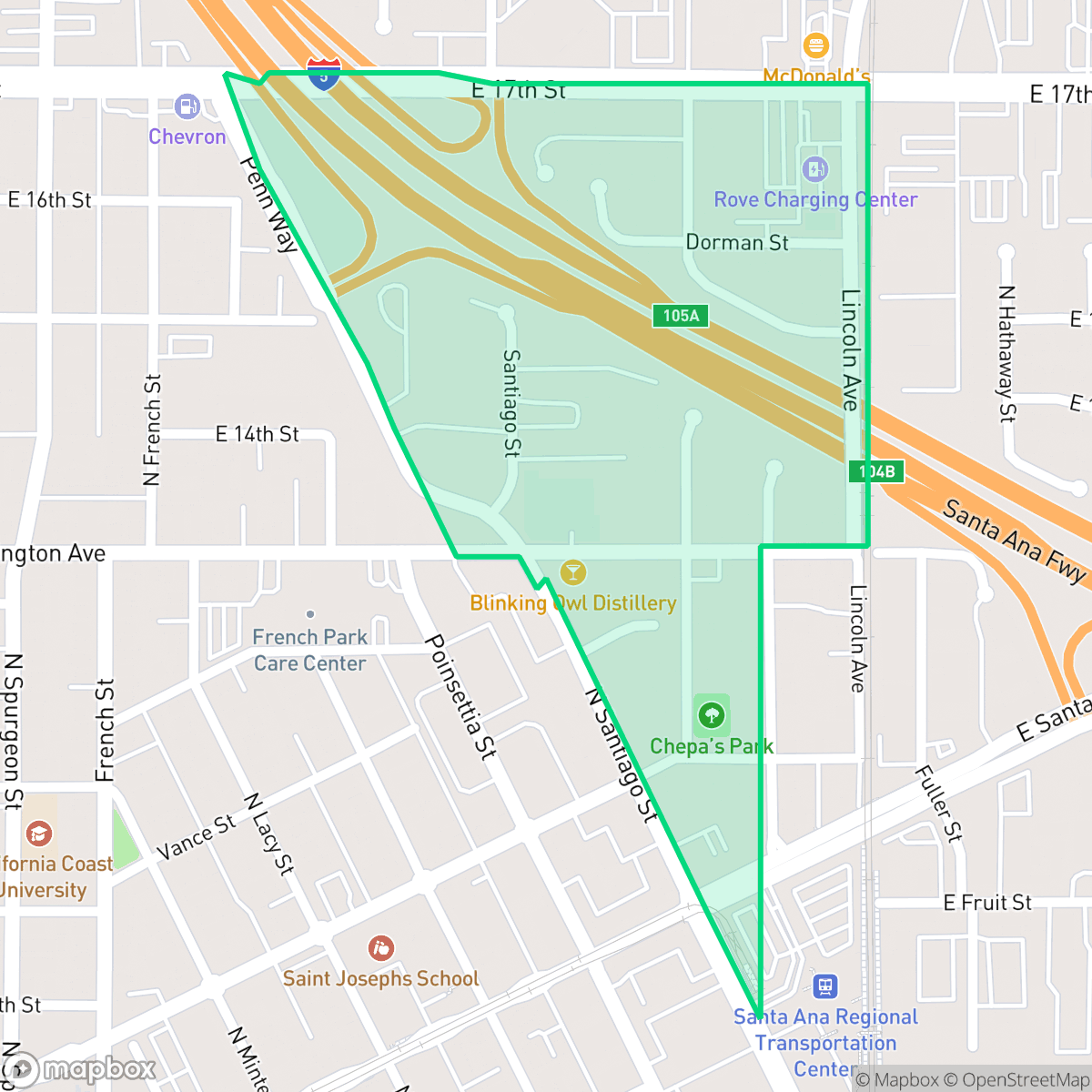
Established in 1886 near the Santa Ana East train depot, Logan Barrio is one of the oldest Mexican-American neighborhoods in Orange County. Named after Civil War General John A. Logan, the barrio grew as a working-class enclave but faced systemic neglect, racially restrictive covenants elsewhere, and mid-20th-century encroachment from Interstate 5 and industrial rezoning. Residents fiercely defended their community, led by activist Josephine "Chepa" Andrade ("La Reina de la Logan"), who successfully fought to block further freeway expansion and secure a local park. Today, the neighborhood's resilient cultural identity is anchored by Chepa's Park, the historic La Chiquita Restaurant—which originated as a grocery in the early 1900s—and the annual Logan Barrio Reunion, celebrating generations of local families.
The area functions as a dense, suburban landscape characterized by a blend of single-family tracts and industrial footprints. Its location near major infrastructure allows for a walkable environment where residents can reach local amenities like El Centenario Grill and Seafood on foot. According to iHuus data, the community benefits from relatively high air quality despite the immediate presence of heavy transit corridors, maintaining a distinct urban character that balances its industrial proximity with established residential roots.
Prospective residents should note that the neighborhood faces significant noise challenges, with average decibel levels reaching 73 dB primarily due to freeway traffic. The high-density residential design means homes are situated closely together, offering limited privacy compared to more suburban settings. While the Santa Ana Unified School District provides access to education, the district remains in a period of transition with varying performance across its institutions. This area is best suited for individuals who prioritize cultural heritage and proximity to urban transit over absolute acoustic seclusion.
Neighborhood Scores Across 15 Qualities
Residential units are tightly packed with minimal separation between structures. This density is notably higher than the Santa Ana average, where houses and shared commercial boundaries often sit in close proximity.
Pedestrians benefit from a consistent sidewalk network and clear crosswalks, though movement is occasionally interrupted by major arterials and a high-traffic freeway. While the area remains highly walkable, it sits slightly below the Santa Ana city average due to these heavy traffic corridors.
Uniform rooflines and modest yards characterize this area. The visual landscape is largely consistent with the rest of Santa Ana, featuring a mix of high-density apartment complexes and traditional tract housing.
Public park access and green sidewalk verges are minimal in this area. According to iHuus data, most available greenery is contained within private fenced backyards, making the neighborhood less dog friendly than the Santa Ana average.
Residential streets and green spaces are balanced with large-scale commercial retail and infrastructure. This landscape is less urbanized than the Santa Ana city average according to iHuus data.
Active commercial blocks near the railway offer a diverse selection of cafes and shops, though some areas near the highway remain quiet and suburban. This balance of high-energy streets and more tranquil, industrial-adjacent pockets makes the area more lively than the Santa Ana average, according to iHuus data.
Frequent disturbances from nearby railroad tracks and heavy freeway traffic characterize the area. According to iHuus data, acoustic comfort in Logan is slightly lower than the Santa Ana average.
Air quality remains mostly clean with infrequent periods of elevated readings, performing better than the Santa Ana average according to iHuus data.
Large warehouses and industrial buildings are concentrated near the freeway corridor, making the area more industrial than the typical Santa Ana neighborhood. Residents may experience increased noise and air quality considerations due to this proximity to heavy commercial zones and the multi-lane highway.
Health insurance coverage among residents is moderate and sits slightly above the Santa Ana average, according to iHuus data.
Voting patterns and census indicators show a predominantly liberal leaning, which is more pronounced than the average found across Santa Ana. According to iHuus data, the area exhibits a high concentration of progressive political alignment.
Residents live alongside a balanced mix of young adults, families, and seniors. This demographic spread in Logan is consistent with the broader Santa Ana population.
Address-Level Insights for Logan


iHuus Neighborhood Intelligence Insights
Get address-level neighborhood insights for Logan
- Street-level scores — see how individual blocks compare, not just neighborhood averages
- Micro-zone boundaries — identify quiet pockets, flood boundaries, and walkable clusters before you visit
- 15 dimensions in full — walkability, noise, air quality, school quality, insurance coverage, population age profile, urban/rural index, and more
- Boundary risk alerts — know if your address sits near a block boundary where scores drop, the kind of detail no listing will ever mention
- School insights — individual school ratings and insights, not just district-level data
- Compare before you commit — side-by-side data across neighborhoods, down to block precision
No credit card required
Compare with Any Neighborhood
| Dimension | Logan | Artesia Pilar |
|---|---|---|
| 🚶 Walkabilityavg 9.05 | ||
| 🔊 Acoustic Comfortavg 2.11 | ||
| 🤫 Privacy Indexavg 4.2 | ||
| 🎨 Visual Appealavg 6.18 | ||
| 🐕 Dog Friendlinessavg 5.61 | ||
| 🗺️ Urban-Rural Indexavg 6.4 | ||
| ✨ Neighborhood Vibeavg 4.4 | ||
| 🏥 Health Insurance Coverageavg 5.33 | ||
| 🌿 Air Qualityavg 7.05 | ||
| 🏭 Industrial Proximityavg 8.16 | ||
| 🌊 Flood Safetyavg 3.08 | ||
| 🗳️ Ideological Leanavg 8.63 | ||
| 👥 Population Age Profileavg 4.55 | ||
| 🔥 Fire Safety | ||
| 🏫 School Quality |
Logan Rankings
School Districts Serving Logan
School Insights for Logan
Below average outcomes; significant attendance and academic challenges.
School Insights
See what's really behind every school rating near Logan
- Individual school ratings — each school's own score with outcome context, not just a district average
- Enrollment & class size data — student-to-teacher ratio and how it compares to the state average
- Full demographics breakdown — ethnicity and gender composition for every school in the enrollment zone
- Every school in the district — all schools within the enrollment boundary ranked by rating, not just the closest one
- Grade levels & benchmarks — elementary through high school, with below/above state-average flags
No credit card required