French Park, Santa Ana
Updated · 1,925 residents
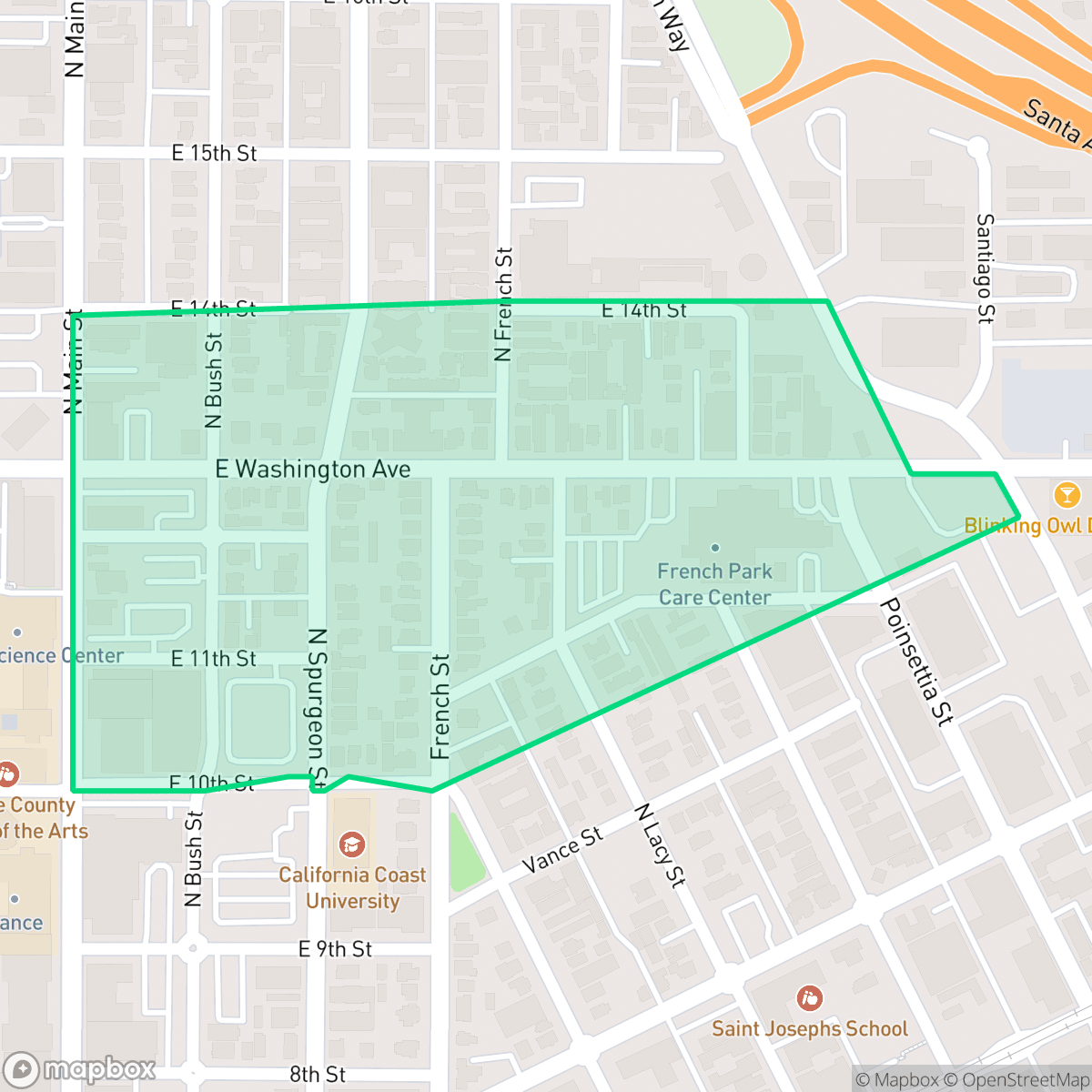
French Park is a high-energy urban neighborhood in Santa Ana defined by its exceptional walkability and dense, historic character. While residents enjoy easy access to local cafes and shops, the area experiences notable road traffic noise and limited private outdoor space.
Key Highlights
About French Park
Platted in 1878 as "Santa Ana East" by founders William Spurgeon, J.H. Fruit, and James McFadden, the Historic French Park neighborhood in Santa Ana, California, grew into a fashionable enclave known as the "Nob Hill of Orange County". Its tree-lined streets are celebrated for an eclectic array of late 19th- and early 20th-century architecture, including Queen Anne "Painted Ladies," Craftsman bungalows, and grand Colonial Revival homes, such as the 1900 Miles Crookshank house. The neighborhood's namesake park—originally a triangular plot called Flatiron Park—was created after resident George Wright's home was relocated. Following mid-century decline and the conversion of homes into wartime apartments, grassroots preservationists formed the Historic French Park Association in 1980. They successfully secured a National Register of Historic Places listing in 1999 and saved endangered vintage homes by relocating them into the district.
The area functions as a vibrant, transit-oriented hub characterized by its proximity to railway lines and a mix of light commercial and residential units. Local favorites such as Maz Café Con Leche, La Central Dulceria, and Benchmark anchor the neighborhood, fostering a lively atmosphere that benefits from high walkability. According to iHuus data, the infrastructure supports a pedestrian-friendly lifestyle with consistent sidewalk coverage throughout the district. Prospective residents should note the trade-offs inherent in this dense urban environment. The neighborhood features tightly packed residential units with minimal privacy and elevated noise levels from nearby road traffic. While the air quality remains relatively high, the lack of expansive green spaces and the presence of industrial-adjacent architecture may not suit those seeking a quiet, suburban experience. It is best suited for individuals who prioritize proximity to urban amenities and a walkable commute over silence and private outdoor living.
Neighborhood Scores Across 15 Qualities
Residential structures are tightly packed with minimal separation between homes, resulting in less privacy than the Santa Ana average. According to iHuus data, many units feature shared walls or very small gaps between buildings.
Pedestrian infrastructure is exceptional in this area, featuring continuous sidewalks on both sides of the streets and clear crosswalks. This level of connectivity for walkers is significantly higher than the Santa Ana average, according to iHuus data.
Residential views consist primarily of uniform tract housing and high-density apartment complexes. This level of visual variety is roughly consistent with the city average for Santa Ana.
Limited access to large parks and narrow sidewalk verges make pet walking more challenging than in other parts of Santa Ana. According to iHuus data, the area consists mostly of paved lots and dense urban pockets with minimal public grass available for dogs.
Streets and green spaces are distributed in roughly equal measure, providing a suburban feel that is less dense than the Santa Ana city average. According to iHuus data, the area contains a mix of mid-rise residential complexes and commercial blocks.
A notable concentration of local cafes, dining, and galleries creates a much more active atmosphere than the typical Santa Ana neighborhood. According to iHuus data, the area features high-energy blocks and diverse social spots ranging from urban commercial units to lively suburban streets.
Frequent noise from nearby-freeway proximity and railroad tracks creates a loud environment. This level of acoustic disturbance is notably higher than the Santa Ana average, according to iHuus data.
Air quality remains consistently high with rare instances of elevated readings. According to iHuus data, the air quality in French Park is better than the average for Santa Ana.
Residential and commercial uses dominate the area with very little heavy industry or warehouse activity. According to iHuus data, this neighborhood maintains a cleaner profile regarding industrial proximity compared to the Santa Ana average.
Health insurance coverage among residents is notably lower than the Santa Ana average, according to iHuus data. This indicates a higher proportion of uninsured individuals living in the area compared to the rest of the city.
Voting patterns and census indicators show a predominantly liberal leaning that is more pronounced than the Santa Ana average, according to iHuus data.
Residents live alongside a balanced mix of young adults, families, and seniors. This demographic spread is slightly lower than the Santa Ana average, according to iHuus data.
Address-Level Insights for French Park


iHuus Neighborhood Intelligence Insights
Get address-level neighborhood insights for French Park
- Street-level scores — see how individual blocks compare, not just neighborhood averages
- Micro-zone boundaries — identify quiet pockets, flood boundaries, and walkable clusters before you visit
- 15 dimensions in full — walkability, noise, air quality, school quality, insurance coverage, population age profile, urban/rural index, and more
- Boundary risk alerts — know if your address sits near a block boundary where scores drop, the kind of detail no listing will ever mention
- School insights — individual school ratings and insights, not just district-level data
- Compare before you commit — side-by-side data across neighborhoods, down to block precision
No credit card required
Compare with Any Neighborhood
| Dimension | French Park | Artesia Pilar |
|---|---|---|
| 🚶 Walkabilityavg 9.05 | ||
| 🔊 Acoustic Comfortavg 2.11 | ||
| 🤫 Privacy Indexavg 4.2 | ||
| 🎨 Visual Appealavg 6.18 | ||
| 🐕 Dog Friendlinessavg 5.61 | ||
| 🗺️ Urban-Rural Indexavg 6.4 | ||
| ✨ Neighborhood Vibeavg 4.4 | ||
| 🏥 Health Insurance Coverageavg 5.33 | ||
| 🌿 Air Qualityavg 7.05 | ||
| 🏭 Industrial Proximityavg 8.16 | ||
| 🌊 Flood Safetyavg 3.08 | ||
| 🗳️ Ideological Leanavg 8.63 | ||
| 👥 Population Age Profileavg 4.55 | ||
| 🔥 Fire Safety | ||
| 🏫 School Quality |
French Park Rankings
School Districts Serving French Park
School Insights for French Park
Below average outcomes; significant attendance and academic challenges.
School Insights
See what's really behind every school rating near French Park
- Individual school ratings — each school's own score with outcome context, not just a district average
- Enrollment & class size data — student-to-teacher ratio and how it compares to the state average
- Full demographics breakdown — ethnicity and gender composition for every school in the enrollment zone
- Every school in the district — all schools within the enrollment boundary ranked by rating, not just the closest one
- Grade levels & benchmarks — elementary through high school, with below/above state-average flags
No credit card required