Floral Park, Santa Ana
Updated · 2,923 residents
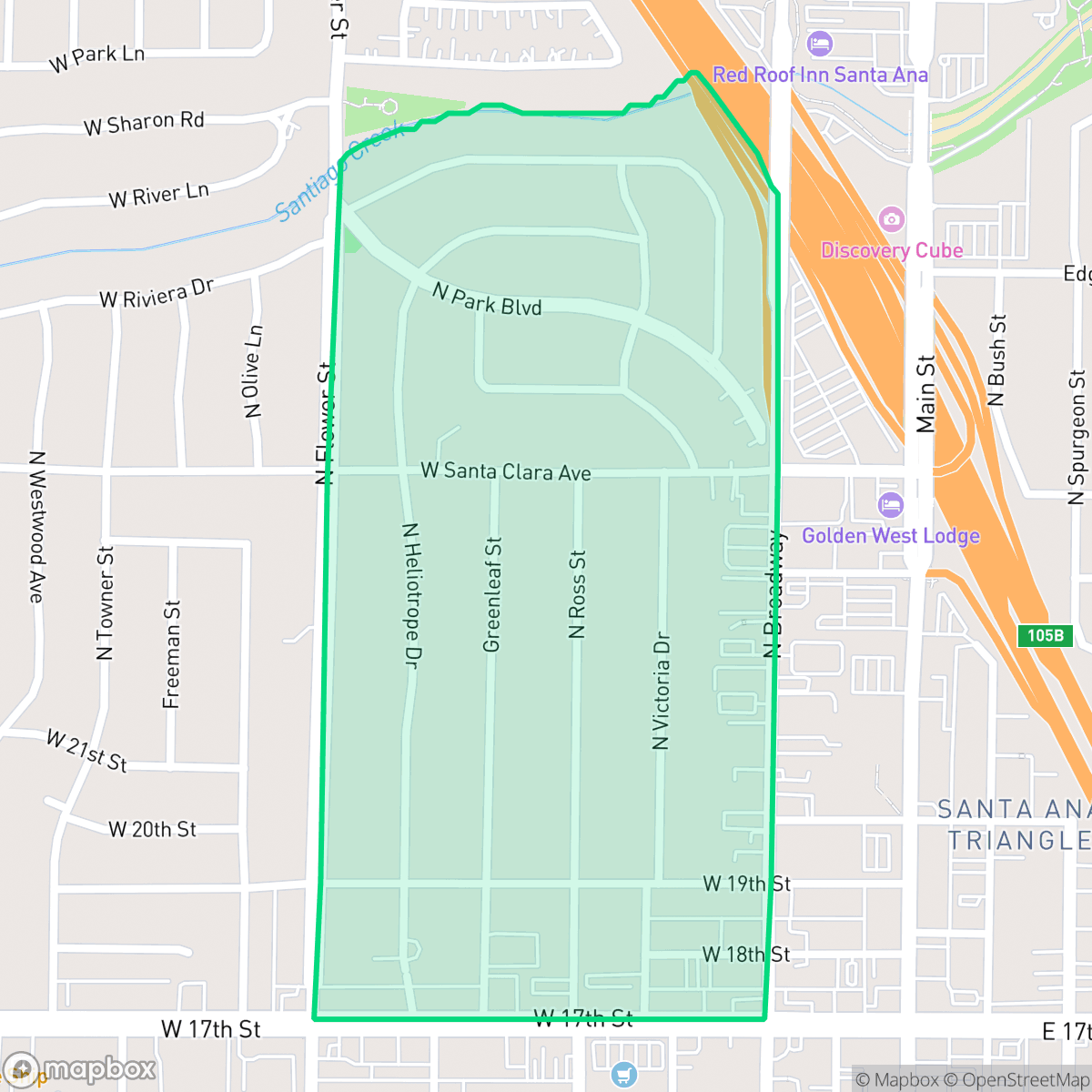
Floral Park is a visually distinct neighborhood in Santa Ana known for its diverse, historic architecture and exceptional walkability. According to iHuus data, the area offers a quiet, residential environment with high acoustic comfort and a strong sense of community.
Key Highlights
About Floral Park
Once a landscape of orange, avocado, and walnut groves, the Floral Park neighborhood in Santa Ana, California, began its transition into an upscale residential enclave in 1923 when developer Allison Honer broke ground. Developed primarily between the 1920s and 1950s, the neighborhood features more than 600 homes showcasing diverse architectural styles, including Spanish Colonial Revival, Tudor, Craftsman, and Cape Cod. Historically, it served as a premier address for prominent Orange County figures, such as the Segerstrom family, and even hosted international royalty like the Maharajah of Indore, who built an estate here in 1938. Characterized by its lush, tree-lined streets, Floral Park was added to the National Register of Historic Places in 2023. Today, the community’s heritage is celebrated through the highly anticipated annual Floral Park Home & Garden Tour.
The area functions as a highly walkable residential enclave that balances suburban space with accessibility. Residents benefit from high visual appeal, supported by well-maintained historic homes and mature landscaping. The neighborhood maintains a calm atmosphere, with acoustic comfort levels significantly higher than the Santa Ana city average. Its proximity to local amenities makes it a practical choice for those who value pedestrian access to daily needs without sacrificing a peaceful living environment.
Prospective residents should consider the broader context of the Santa Ana Unified School District, which presents varying academic outcomes across its institutions. While the area boasts high health insurance coverage rates, it faces challenges common to the region, including specific risks related to flood and fire safety. The community is well-suited for families and professionals who prioritize neighborhood character and walkability over newer, high-density residential developments.
Neighborhood Scores Across 15 Qualities
Homes in this area are positioned in close quarters with minimal separation between structures. According to iHuus data, this density is notably higher than the Santa Ana average, often featuring houses with very narrow gaps or shared walls.
Continuous sidewalks and clear pedestrian crossings are available on both residential and arterial streets. According to iHuus data, this level of pedestrian infrastructure is even more comprehensive than the average found throughout Santa Ana.
Manicured landscaping and large homes with private pools contribute to an aesthetic that is slightly above the Santa Ana average. While some areas feature denser apartment complexes, much of the neighborhood is characterized by spacious properties and upscale amenities according to iHuus data.
Limited public green space and narrow sidewalk verges make finding areas for exercise difficult. According to iHuus data, this neighborhood offers less access to parks and open grass compared to the Santa Ana average.
Residential pockets feature a blend of single-family homes and apartment complexes, maintaining a level of density that is very similar to the Santa Ana average. According to iHuus data, the area presents a suburban landscape with occasional open spaces interspersed among denser housing and commercial blocks.
Local dining and social hubs provide a noticeable energy that is significantly higher than the Santa Ana average. Residents have access to a diverse mix of restaurants and leisure spots within a suburban setting that features frequent pedestrian activity.
Frequent noise from nearby railroad tracks and heavy freeway traffic is a constant presence. According to iHuus data, acoustic conditions in this area are slightly more disruptive than the Santa Ana average.
Air quality in this area is consistently good with rare instances of elevated readings. This level of cleanliness is higher than the Santa Ana average, according to iHuus data.
Industrial hazards and heavy warehouses are absent from this area. According to iHuus data, this neighborhood maintains a significantly cleaner profile than the Santa Ana average, consisting only of residential and light commercial uses.
Health insurance access among residents is moderate, though notably lower than the average found across Santa Ana. Data from iHuus indicates that a significant portion of the population lacks coverage.
Voting patterns and census indicators reflect a predominantly liberal leaning that is more pronounced than the Santa Ana average, according to iHuus data.
Residents live alongside a balanced distribution of young adults, families, and seniors. This demographic spread is consistent with the broader Santa Ana area, according to iHuus data.
Significant flood hazards and wave action are present in this area, which is much higher than the Santa Ana average. According to iHuus data, residents should anticipate elevated or potentially prohibitive flood insurance costs.
Address-Level Insights for Floral Park


iHuus Neighborhood Intelligence Insights
Get address-level neighborhood insights for Floral Park
- Street-level scores — see how individual blocks compare, not just neighborhood averages
- Micro-zone boundaries — identify quiet pockets, flood boundaries, and walkable clusters before you visit
- 15 dimensions in full — walkability, noise, air quality, school quality, insurance coverage, population age profile, urban/rural index, and more
- Boundary risk alerts — know if your address sits near a block boundary where scores drop, the kind of detail no listing will ever mention
- School insights — individual school ratings and insights, not just district-level data
- Compare before you commit — side-by-side data across neighborhoods, down to block precision
No credit card required
Compare with Any Neighborhood
| Dimension | Floral Park | Artesia Pilar |
|---|---|---|
| 🚶 Walkabilityavg 9.05 | ||
| 🔊 Acoustic Comfortavg 2.11 | ||
| 🤫 Privacy Indexavg 4.2 | ||
| 🎨 Visual Appealavg 6.18 | ||
| 🐕 Dog Friendlinessavg 5.61 | ||
| 🗺️ Urban-Rural Indexavg 6.4 | ||
| ✨ Neighborhood Vibeavg 4.4 | ||
| 🏥 Health Insurance Coverageavg 5.33 | ||
| 🌿 Air Qualityavg 7.05 | ||
| 🏭 Industrial Proximityavg 8.16 | ||
| 🌊 Flood Safetyavg 3.08 | ||
| 🗳️ Ideological Leanavg 8.63 | ||
| 👥 Population Age Profileavg 4.55 | ||
| 🔥 Fire Safety | ||
| 🏫 School Quality |
Floral Park Rankings
School Districts Serving Floral Park
School Insights for Floral Park
Below average outcomes; significant attendance and academic challenges.
School Insights
See what's really behind every school rating near Floral Park
- Individual school ratings — each school's own score with outcome context, not just a district average
- Enrollment & class size data — student-to-teacher ratio and how it compares to the state average
- Full demographics breakdown — ethnicity and gender composition for every school in the enrollment zone
- Every school in the district — all schools within the enrollment boundary ranked by rating, not just the closest one
- Grade levels & benchmarks — elementary through high school, with below/above state-average flags
No credit card required