Eastside, Santa Ana
Updated · 12,224 residents
Eastside is a historic, highly walkable community defined by its dense residential layout and vibrant cultural identity. While the area offers excellent pedestrian access and clean air, residents should be prepared for frequent noise from nearby transit corridors and limited private outdoor space.
Key Highlights
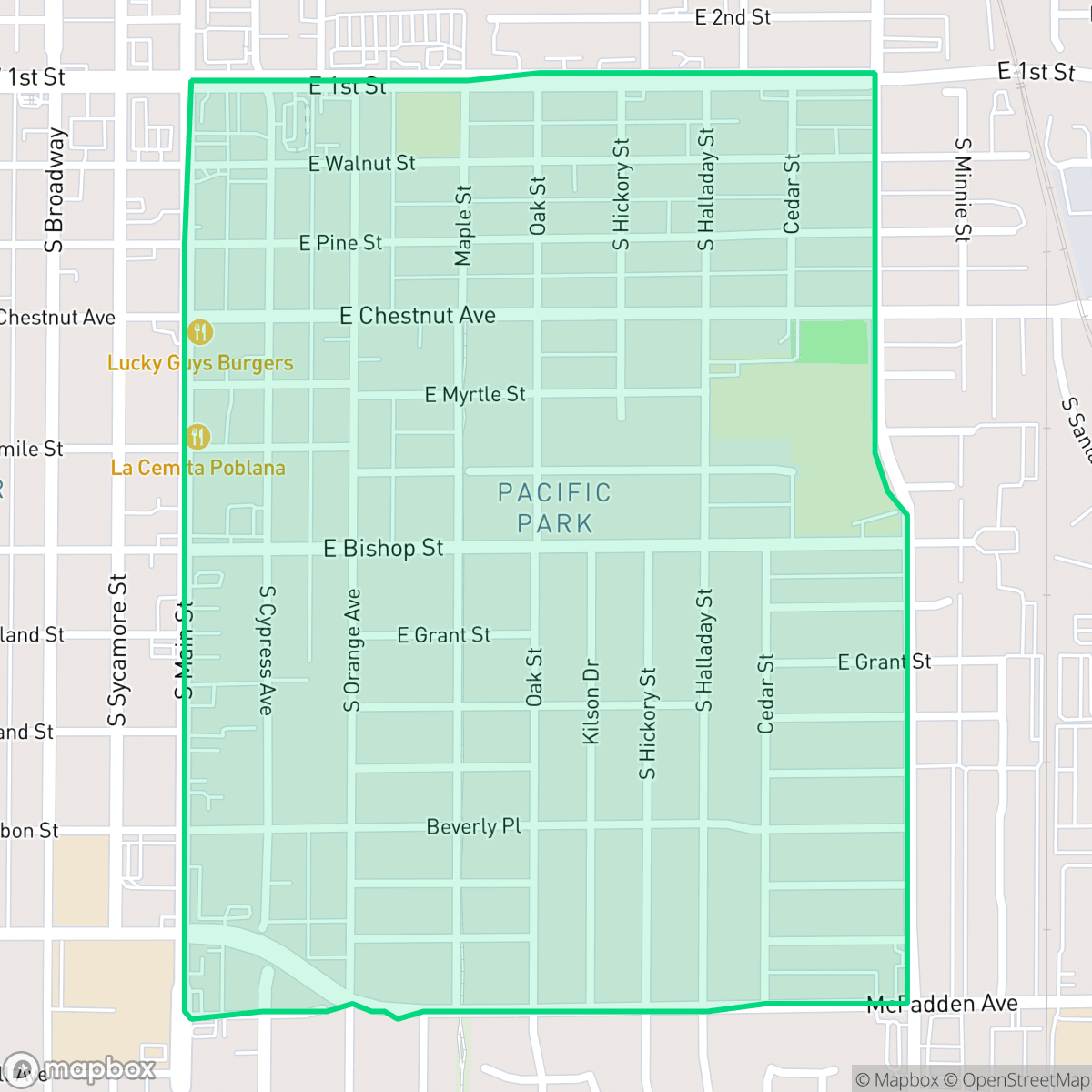
About Eastside
The Eastside neighborhood in Santa Ana, California, is a historically significant community that was fully developed by the 1930s. Situated adjacent to the city's historic downtown core, the neighborhood is characterized by its dense residential layout and a housing stock featuring period-specific bungalows and homes dating back to before 1939. Eastside has long served as a cultural heart for the city's Mexican-American population, maintaining a distinct identity defined by its high concentration of residents with Mexican ancestry and a strong sense of community. Its proximity to the central business district and its high walkability have made it a vital part of Santa Ana’s urban fabric for nearly a century.
The area functions as a lively social hub, characterized by a mix of residential streets and light commercial zones that foster a strong sense of community. The architecture consists primarily of uniform, closely spaced homes that reflect the neighborhood's long-standing development patterns. Residents benefit from high levels of walkability, allowing for easy access to local amenities and social centers that contribute to the neighborhood's active atmosphere.
Prospective residents should consider certain environmental factors, as the neighborhood is situated within a designated floodplain and experiences significant auditory disturbances from nearby freeway and railroad infrastructure. While the local air quality is generally high, the dense housing stock offers limited privacy and minimal private green space for pets. The area is served by the Santa Ana Unified School District, which presents a varied academic landscape for families navigating the local education system.
Neighborhood Scores Across 15 Qualities
Structures and homes are positioned in close quarters with minimal separation between buildings. This level of density is slightly higher than the Santa Ana average, according to iHuus data.
Pedestrian infrastructure is excellent, featuring a complete grid of sidewalks on both sides of streets and clearly marked crossings. This level of accessibility matches the city average for Santa Ana.
Standard tract housing and multi-family units dominate the area, featuring uniform rooflines and small yards. This visual landscape is slightly below the Santa Ana average due to the dense, boxy architecture and limited private greenery.
Public green space for dogs is relatively scarce in this area compared to the Santa Ana average. While some sections offer sidewalk verges and access to a baseball park, much of the neighborhood consists of dense residential or industrial zones with few accessible parks.
Residential streets and green spaces exist in roughly equal measure with industrial and commercial zones. This area is slightly less suburban than the Santa Ana average, characterized by a dense mix of single-family homes and low-rise industrial warehouses according to iHuus data.
Concentrated pockets of dining and social spots create a vibrant atmosphere that is notably more active than the rest of Santa Ana. While some areas feature energetic urban centers, other sections remain quiet and suburban with limited pedestrian accessibility.
Frequent noise from nearby freeway and railroad corridors makes for a louder environment than much of Santa Ana. According to iHuus data, residents may experience more consistent auditory disturbances compared to the city average.
Air quality remains mostly clean with rare instances of elevated readings. This level of freshness is notably higher than the Santa Ana average, according to iHuus data.
Residential and light commercial zones dominate most of the area, with significantly fewer large warehouses or heavy industrial hazards than the Santa Ana average. Some eastern sections of the neighborhood contain larger commercial vehicle parking and light industrial units, according to iHuus data.
Health insurance access is slightly higher than the Santa Ana average, according to iHuus data. While many residents are covered, a notable portion of the population remains uninsured.
Voting patterns and census indicators show a notably more liberal leaning than the Santa Ana average, according to iHuus data.
Residents live alongside a balanced distribution of young adults, families, and seniors. This demographic spread is largely consistent with the broader Santa Ana area, according to iHuus data.
Significant flood risk exists here due to the area's location within a designated floodplain. According to iHuus data, this risk is notably higher than the average for Santa Ana and may necessitate flood insurance.
Address-Level Insights for Eastside


iHuus Neighborhood Intelligence Insights
Get address-level neighborhood insights for Eastside
- Street-level scores — see how individual blocks compare, not just neighborhood averages
- Micro-zone boundaries — identify quiet pockets, flood boundaries, and walkable clusters before you visit
- 15 dimensions in full — walkability, noise, air quality, school quality, insurance coverage, population age profile, urban/rural index, and more
- Boundary risk alerts — know if your address sits near a block boundary where scores drop, the kind of detail no listing will ever mention
- School insights — individual school ratings and insights, not just district-level data
- Compare before you commit — side-by-side data across neighborhoods, down to block precision
No credit card required
Compare with Any Neighborhood
| Dimension | Eastside | Artesia Pilar |
|---|---|---|
| 🚶 Walkabilityavg 9.05 | ||
| 🔊 Acoustic Comfortavg 2.11 | ||
| 🤫 Privacy Indexavg 4.2 | ||
| 🎨 Visual Appealavg 6.18 | ||
| 🐕 Dog Friendlinessavg 5.61 | ||
| 🗺️ Urban-Rural Indexavg 6.4 | ||
| ✨ Neighborhood Vibeavg 4.4 | ||
| 🏥 Health Insurance Coverageavg 5.33 | ||
| 🌿 Air Qualityavg 7.05 | ||
| 🏭 Industrial Proximityavg 8.16 | ||
| 🌊 Flood Safetyavg 3.08 | ||
| 🗳️ Ideological Leanavg 8.63 | ||
| 👥 Population Age Profileavg 4.55 | ||
| 🔥 Fire Safety | ||
| 🏫 School Quality |
Eastside Rankings
School Districts Serving Eastside
School Insights for Eastside
Below average outcomes; significant attendance and academic challenges.
School Insights
See what's really behind every school rating near Eastside
- Individual school ratings — each school's own score with outcome context, not just a district average
- Enrollment & class size data — student-to-teacher ratio and how it compares to the state average
- Full demographics breakdown — ethnicity and gender composition for every school in the enrollment zone
- Every school in the district — all schools within the enrollment boundary ranked by rating, not just the closest one
- Grade levels & benchmarks — elementary through high school, with below/above state-average flags
No credit card required