Downtown, Santa Ana
Updated · 2,776 residents
Downtown Santa Ana is a highly walkable, vibrant urban hub defined by its dense concentration of historic architecture and energetic cultural atmosphere. While the area offers excellent pedestrian access and clean air, residents should expect a busy urban environment with higher noise levels from nearby transit corridors.
Key Highlights
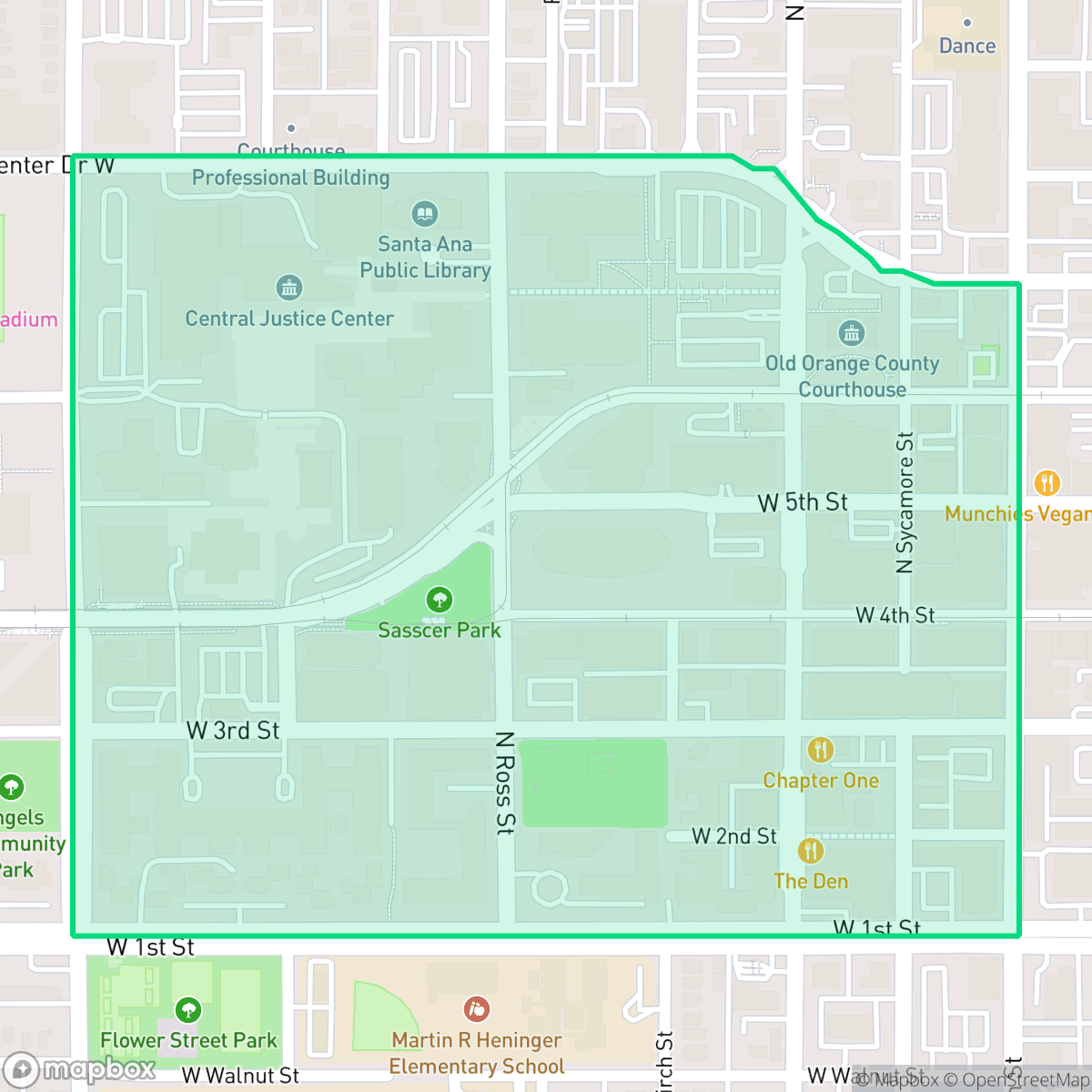
About Downtown
Downtown Santa Ana, established in 1869 by William Spurgeon, serves as the historic core and former commercial hub of Orange County. The district is characterized by a dense concentration of 20th-century architecture, including notable Spanish Colonial Revival, Art Deco, and Romanesque Revival structures. Key landmarks include the 1901 Old Orange County Courthouse, the 1913 Spurgeon Building—the city's first skyscraper—and the 1928 Santora Building, which historically hosted prominent cultural figures. Following a period of commercial decline in the mid-20th century, the neighborhood underwent significant revitalization, evolving into a vibrant cultural center known for its Artists Village, independent cinemas, and preserved historic building stock that remains listed on the National Register of Historic Places.
The neighborhood functions as a dynamic urban center where pedestrian-priority infrastructure makes daily errands and social outings exceptionally accessible. The landscape is characterized by a dense, uniform arrangement of mid-rise office buildings and multi-unit residential complexes that foster a strong sense of community engagement. As a hub for local dining and cultural expression, the area maintains a consistently energetic atmosphere that appeals to those who value proximity to city life and a strongly liberal social environment.
Living in this district requires balancing the benefits of high walkability and clean air against the realities of a busy urban setting. The area experiences elevated noise levels due to its proximity to major freeways and railroad tracks, and residents often find limited private outdoor space for pets. While the local school district provides essential services, it faces ongoing challenges regarding academic performance and resource allocation. This neighborhood is best suited for individuals or households who prioritize an active, transit-oriented lifestyle over suburban quiet or expansive private yards.
Neighborhood Scores Across 15 Qualities
Building proximity varies by block, with many multi-unit structures sharing walls or situated very close to neighbors. According to iHuus data, this level of density is roughly in line with the rest of Santa Ana.
Pedestrian-priority infrastructure and a complete sidewalk grid make navigating the area on foot exceptionally easy. According to iHuus data, the quality of crossings and sidewalk continuity in this neighborhood is notably higher than the Santa Ana average.
The area consists of standard apartment complexes, office buildings, and multi-family units with minimal private yard space. According to iHuus data, the visual landscape is slightly less varied than the Santa Ana average.
Access to green space for pets is somewhat constrained by narrow sidewalks and paved lots, placing the area slightly below the Santa Ana average. While some small public plazas and large school athletic fields are available, much of the urban fabric lacks wide verges for easy walking.
A dense mix of mid-rise civic buildings, parking lots, and residential complexes creates a landscape where grey infrastructure is more prominent than green space. According to iHuus data, this area is less suburban than the Santa Ana average.
High levels of social activity and a dense concentration of dining and cultural destinations make this area significantly more energetic than the Santa Ana average. Residents have access to a diverse array of mid-rise urban spaces and social spots, according to iHuus data.
Frequent noise from nearby railroad tracks and major freeway traffic is a constant presence. According to iHuus data, acoustic disturbance in this area is slightly higher than the Santa Ana average.
Air quality is mostly clean with rare instances of elevated readings. According to iHuus data, these conditions are better than the Santa Ana city average.
Industrial facilities, warehouses, and hazardous sites are entirely absent from this area. According to iHuus data, this neighborhood offers a cleaner environment than the Santa Ana average due to its focus on residential, civic, and light commercial uses.
Health insurance access is notably lower in this area than the Santa Ana average. According to iHuus data, fewer residents in this neighborhood have verified medical coverage compared to the rest of the city.
Voting patterns and census indicators show a predominantly liberal political leaning, which is more pronounced than the average for Santa Ana. According to iHuus data, this area exhibits much stronger liberal-leaning demographics than the rest of the city.
Residents experience a balanced distribution of young adults, families, and older individuals. This demographic spread is slightly lower than the Santa Ana city average, according to iHuus data.
Address-Level Insights for Downtown


iHuus Neighborhood Intelligence Insights
Get address-level neighborhood insights for Downtown
- Street-level scores — see how individual blocks compare, not just neighborhood averages
- Micro-zone boundaries — identify quiet pockets, flood boundaries, and walkable clusters before you visit
- 15 dimensions in full — walkability, noise, air quality, school quality, insurance coverage, population age profile, urban/rural index, and more
- Boundary risk alerts — know if your address sits near a block boundary where scores drop, the kind of detail no listing will ever mention
- School insights — individual school ratings and insights, not just district-level data
- Compare before you commit — side-by-side data across neighborhoods, down to block precision
No credit card required
Compare with Any Neighborhood
| Dimension | Downtown | Artesia Pilar |
|---|---|---|
| 🚶 Walkabilityavg 9.05 | ||
| 🔊 Acoustic Comfortavg 2.11 | ||
| 🤫 Privacy Indexavg 4.2 | ||
| 🎨 Visual Appealavg 6.18 | ||
| 🐕 Dog Friendlinessavg 5.61 | ||
| 🗺️ Urban-Rural Indexavg 6.4 | ||
| ✨ Neighborhood Vibeavg 4.4 | ||
| 🏥 Health Insurance Coverageavg 5.33 | ||
| 🌿 Air Qualityavg 7.05 | ||
| 🏭 Industrial Proximityavg 8.16 | ||
| 🌊 Flood Safetyavg 3.08 | ||
| 🗳️ Ideological Leanavg 8.63 | ||
| 👥 Population Age Profileavg 4.55 | ||
| 🔥 Fire Safety | ||
| 🏫 School Quality |
Downtown Rankings
School Districts Serving Downtown
School Insights for Downtown
Below average outcomes; significant attendance and academic challenges.
School Insights
See what's really behind every school rating near Downtown
- Individual school ratings — each school's own score with outcome context, not just a district average
- Enrollment & class size data — student-to-teacher ratio and how it compares to the state average
- Full demographics breakdown — ethnicity and gender composition for every school in the enrollment zone
- Every school in the district — all schools within the enrollment boundary ranked by rating, not just the closest one
- Grade levels & benchmarks — elementary through high school, with below/above state-average flags
No credit card required