Delhi, Santa Ana
Updated · 5,841 residents
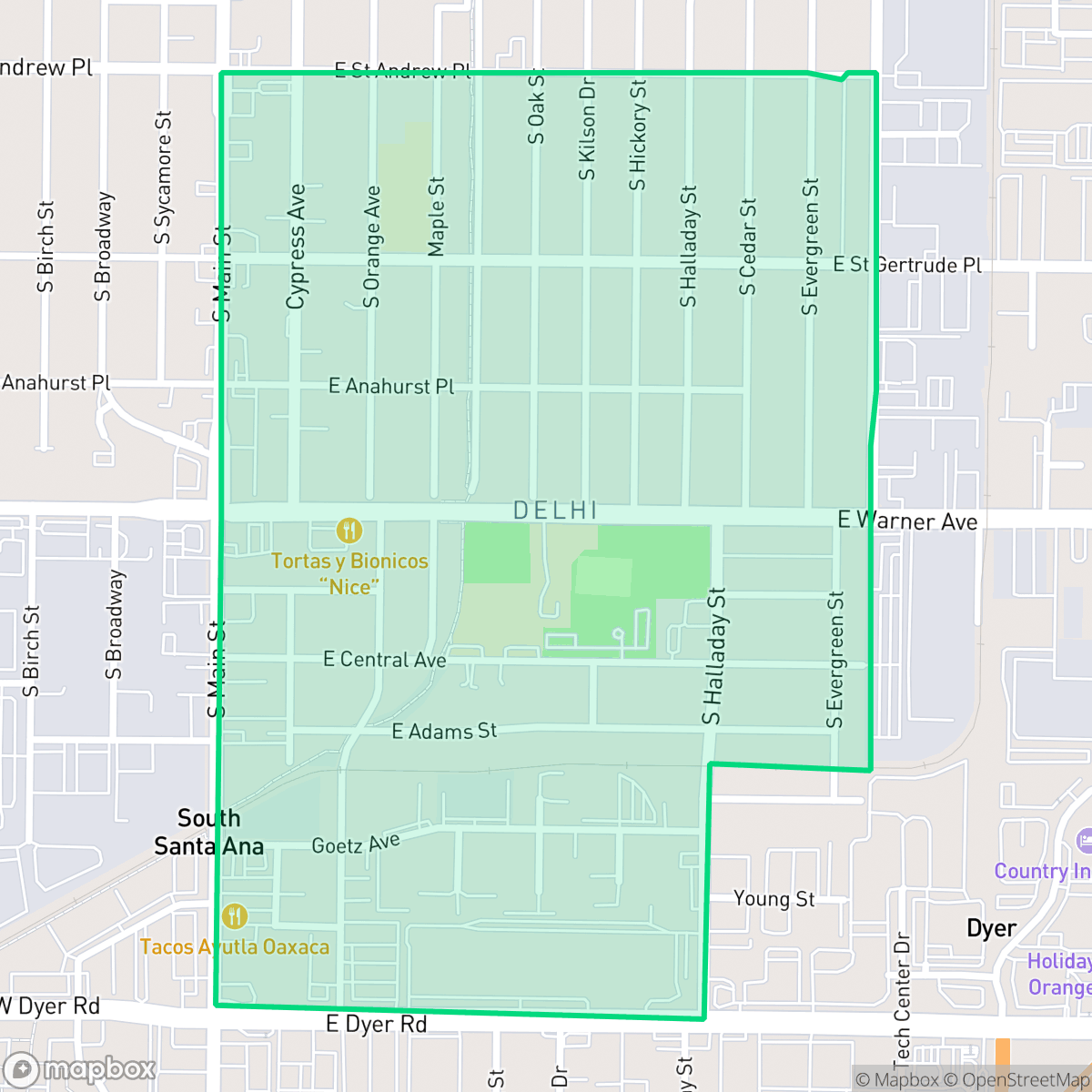
Delhi is a dense, highly walkable residential community in Santa Ana characterized by a grid of single-family homes interspersed with light industrial facilities. While residents benefit from excellent access to local services, the area experiences high noise levels from road traffic and offers limited privacy due to its compact suburban layout.
Key Highlights
About Delhi
Established in the 1870s by pioneer James McFadden and named after his hometown of Delhi, New York, the Delhi neighborhood (pronounced “del-high”) in Santa Ana began as a farming community anchored by early 20th-century sugar beet factories. In the 1910s and 1920s, it developed into one of the few Orange County enclaves where Mexican-American families, many fleeing the Mexican Revolution, were legally permitted to purchase land. Annexed by Santa Ana in 1929, the neighborhood grew around key community anchors, including Edison Elementary School (1929) and Our Lady of Guadalupe Catholic Church (1940s). The historic Delhi Road was later renamed Warner Avenue. In 1969, residents established the Delhi Center—initially housed in donated World War II-era Quonset huts—which remains a vital community hub alongside the expanded Delhi Park.
The neighborhood functions as a dense suburban environment where residential streets sit in close proximity to commercial warehouses and industrial zones. According to iHuus data, the area maintains a high walkability score, facilitating easy access to community hubs like Delhi Park and local dining establishments. The landscape is defined by a consistent grid of homes, though the close proximity of structures and the prevalence of industrial activity contribute to a lower privacy index and elevated ambient noise levels.
Prospective residents should consider that this area is well-suited for those prioritizing transit connectivity and proximity to essential services over seclusion. While the community benefits from established local institutions, the trade-offs include a lack of expansive green space for pets and significant noise exposure from nearby transit corridors. The area remains a practical choice for individuals seeking a central location within Santa Ana, provided they are comfortable with a high-density, urban-adjacent atmosphere.
Neighborhood Scores Across 15 Qualities
Residential structures are tightly packed with minimal separation between homes, resulting in less privacy than the Santa Ana average. According to iHuus data, many houses are situated very close together with little buffer between adjacent properties.
Continuous sidewalks and marked crosswalks are available on most residential streets and major thoroughfares. While the sidewalk network is slightly below the Santa Ana average, many daily errands can be completed on foot via the established grid.
Standard tract housing with small yards and boxy roofs characterizes this area; the visual landscape is slightly below the Santa Ana average due to the presence of large industrial warehouses and commercial facilities.
Limited green verges and narrow sidewalks characterize most residential streets, making it less ideal for pet owners compared to the Santa Ana average. While a public park with green fields and baseball diamonds provides some access in the northwest, much of the neighborhood lacks nearby open space for dogs.
Residential areas exist alongside large-scale industrial and commercial warehousing, creating a landscape that is slightly more developed than the Santa Ana average. While some sectors feature single-family homes, other pockets consist of dense industrial zones with minimal open space.
Industrial landscapes and warehouse corridors create a low-energy environment with limited nightlife. According to iHuus data, the area is significantly less lively than the Santa Ana average and relies heavily on car travel for access to dining and services.
Frequent noise from nearby freeways and railroad tracks is a constant presence here. This level of acoustic disturbance is slightly higher than the average found across Santa Ana.
Air quality levels in this area experience occasional periods of concern for sensitive groups, falling slightly below the Santa Ana average according to iHuus data.
Light industrial and commercial activities, including warehouses and logistics hubs, are more prevalent here than in much of Santa Ana. While some areas feature local services like restaurants and printing shops, others contain large-scale distribution centers and utility yards.
Health insurance access is slightly above the Santa Ana average. According to iHuus data, a notable portion of the population remains uninsured.
Voting patterns and census indicators show a predominantly liberal political leaning, which is notably more pronounced than the average for Santa Ana according to iHuus data.
Residents live among a balanced mix of young adults, families, and older individuals. This age distribution is slightly lower than the Santa Ana average, according to iHuus data.
Flood risk is significantly higher than the Santa Ana average because this area sits within a designated floodplain. According to iHuus data, residents should anticipate a higher likelihood of flooding and the potential requirement for flood insurance.
Address-Level Insights for Delhi


iHuus Neighborhood Intelligence Insights
Get address-level neighborhood insights for Delhi
- Street-level scores — see how individual blocks compare, not just neighborhood averages
- Micro-zone boundaries — identify quiet pockets, flood boundaries, and walkable clusters before you visit
- 15 dimensions in full — walkability, noise, air quality, school quality, insurance coverage, population age profile, urban/rural index, and more
- Boundary risk alerts — know if your address sits near a block boundary where scores drop, the kind of detail no listing will ever mention
- School insights — individual school ratings and insights, not just district-level data
- Compare before you commit — side-by-side data across neighborhoods, down to block precision
No credit card required
Compare with Any Neighborhood
| Dimension | Delhi | Artesia Pilar |
|---|---|---|
| 🚶 Walkabilityavg 9.05 | ||
| 🔊 Acoustic Comfortavg 2.11 | ||
| 🤫 Privacy Indexavg 4.2 | ||
| 🎨 Visual Appealavg 6.18 | ||
| 🐕 Dog Friendlinessavg 5.61 | ||
| 🗺️ Urban-Rural Indexavg 6.4 | ||
| ✨ Neighborhood Vibeavg 4.4 | ||
| 🏥 Health Insurance Coverageavg 5.33 | ||
| 🌿 Air Qualityavg 7.05 | ||
| 🏭 Industrial Proximityavg 8.16 | ||
| 🌊 Flood Safetyavg 3.08 | ||
| 🗳️ Ideological Leanavg 8.63 | ||
| 👥 Population Age Profileavg 4.55 | ||
| 🔥 Fire Safety | ||
| 🏫 School Quality |
Delhi Rankings
School Districts Serving Delhi
School Insights for Delhi
Below average outcomes; significant attendance and academic challenges.
School Insights
See what's really behind every school rating near Delhi
- Individual school ratings — each school's own score with outcome context, not just a district average
- Enrollment & class size data — student-to-teacher ratio and how it compares to the state average
- Full demographics breakdown — ethnicity and gender composition for every school in the enrollment zone
- Every school in the district — all schools within the enrollment boundary ranked by rating, not just the closest one
- Grade levels & benchmarks — elementary through high school, with below/above state-average flags
No credit card required