Cornerstone Village, Santa Ana
Updated · 1,411 residents
Cornerstone Village is a densely populated residential area in Santa Ana characterized by its mix of modern affordable housing and proximity to industrial zones. While the neighborhood provides good air quality, residents experience significant noise from road traffic and limited privacy due to the close proximity of buildings.
Key Highlights
About Cornerstone Village
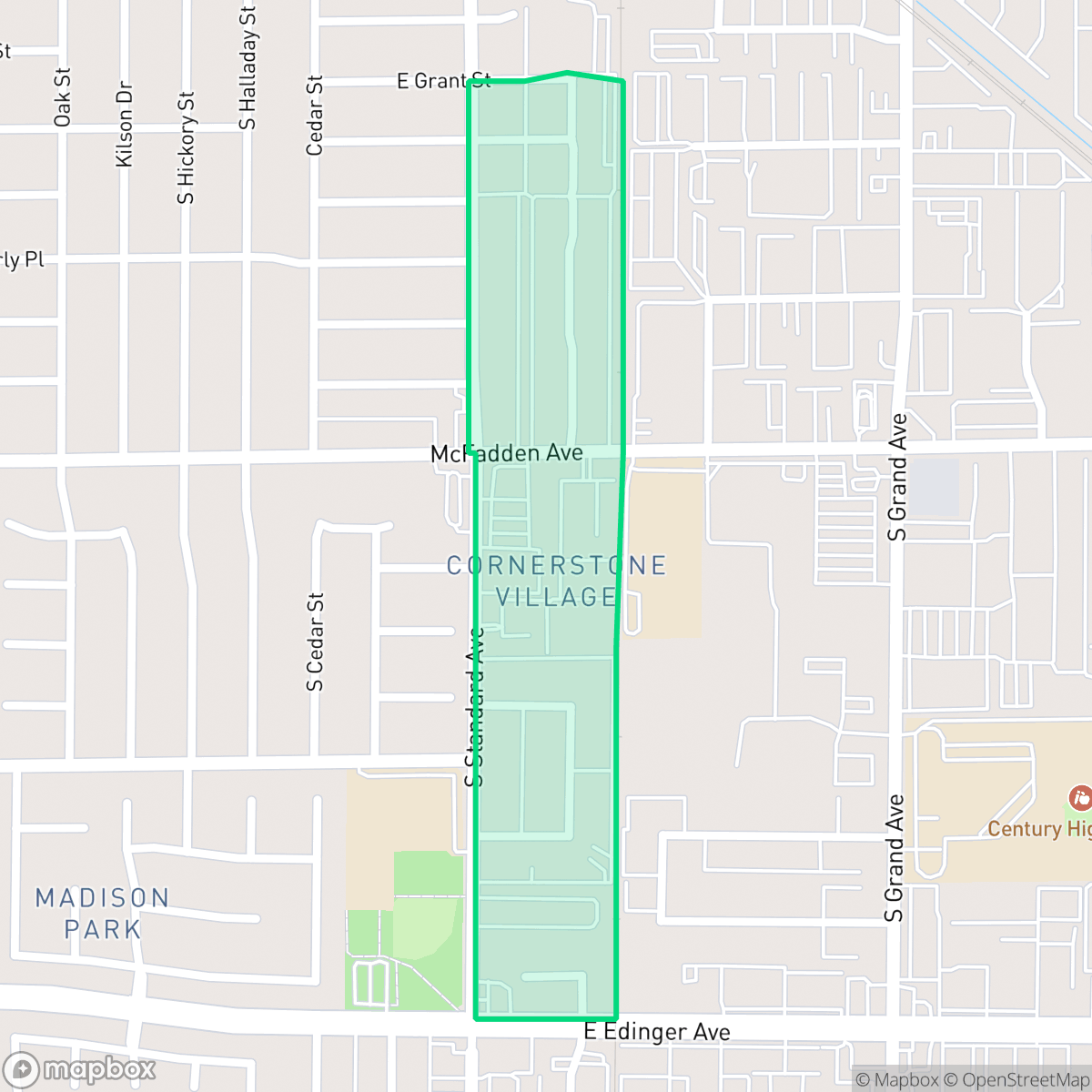
Cornerstone Village in Santa Ana, California, originated in the late 1950s as off-base housing for the Marine Corps. Built primarily in 1961, the densely populated apartment complexes along Minnie Street eventually suffered from severe blight, gang activity, and high crime rates. To revitalize the area, the City of Santa Ana, Jamboree Housing, and local residents launched the Cornerstone Village redevelopment project in 2001. Residents chose the name "Cornerstone" to represent a foundation for future neighborhood transformations. The initiative rehabilitated 48 apartment buildings, established a dedicated police substation, and introduced the Lighthouse Learning Center. Today, the neighborhood stands as a model of affordable housing rehabilitation, highlighted by a major $6.3 million modernization completed by Jamboree in 2020.
The neighborhood is defined by a landscape of tightly packed residential clusters situated amidst a broader industrial backdrop of warehouses and commercial facilities. The area functions as a quiet, urban-adjacent environment where daily life revolves around local amenities such as small grills and eateries. While the street layout includes sidewalks on major thoroughfares, the presence of large industrial blocks and truck traffic can make pedestrian navigation challenging. Residents should be aware that the area is situated in a high-risk zone for both flood and fire, which is a critical factor for long-term planning.
This community is best suited for individuals who prioritize proximity to industrial employment hubs and affordable housing options. The local environment is notably quiet despite the nearby road noise, creating a subdued atmosphere that contrasts with more active, walkable parts of the city. Prospective residents should consider the limited access to private green space and the necessity of navigating a district with mixed academic outcomes within the local school system.
Neighborhood Scores Across 15 Qualities
Residential structures are closely packed with minimal separation between homes, creating a more compressed living environment than is typical for Santa Ana. This density is characteristic of urban California suburbs where houses often sit just a few meters apart according to iHuus data.
Pedestrian movement is supported by sidewalks and marked crossings on most residential streets, though ease of walking is slightly lower than the Santa Ana average. High traffic volumes near certain industrial zones may impact the overall experience for those traveling on foot.
Standard tract housing and large apartment complexes define the landscape, featuring uniform rooflines and modest yards. The visual character is slightly below the Santa Ana average due to the presence of dense housing and nearby industrial warehouses.
Public park access is primarily concentrated in the northwest portion of the neighborhood near the baseball fields. Available walking space along sidewalks is somewhat limited compared to the Santa Ana average, as much of the greenery is restricted to private yards and narrow parkway strips.
Residential grids here blend single-family homes with large-scale industrial and commercial blocks. This layout is consistent with the broader Santa Ana area, offering a mix of suburban living and significant warehouse presence according to iHuus data.
Suburban streets and light industrial zones create a calm atmosphere, though the area lacks high-density activity and stays roughly in line with the city average. Residents will find limited walking options for dining and services, making a vehicle necessary for most errands according to iHuus data.
Frequent noise from nearby freeways and railroad tracks is a notable characteristic of this area. According to iHuus data, acoustic levels in this neighborhood are higher than the Santa Ana average.
Air quality in this area is mostly clean with infrequent periods of elevated readings. According to iHuus data, the atmosphere here is notably clearer than the average for Santa Ana.
Residential tranquility is maintained by a lack of heavy industry, though some light commercial activity exists near the edges. This area features significantly less industrial density than the Santa Ana average according to iHuus data.
Health insurance coverage among residents is slightly lower than the Santa Ana average, according to iHuus data.
Voting patterns and census indicators show a predominantly liberal leaning that is more pronounced than the Santa Ana city average, according to iHuus data.
Residents live alongside a balanced mix of young adults, families, and older individuals. This demographic distribution is consistent with the broader Santa Ana area according to iHuus data.
Properties in this area are located within a designated floodplain, which may necessitate flood insurance. According to iHuus data, the risk level in Cornerstone Village is slightly higher than the Santa Ana average.
Address-Level Insights for Cornerstone Village


iHuus Neighborhood Intelligence Insights
Get address-level neighborhood insights for Cornerstone Village
- Street-level scores — see how individual blocks compare, not just neighborhood averages
- Micro-zone boundaries — identify quiet pockets, flood boundaries, and walkable clusters before you visit
- 15 dimensions in full — walkability, noise, air quality, school quality, insurance coverage, population age profile, urban/rural index, and more
- Boundary risk alerts — know if your address sits near a block boundary where scores drop, the kind of detail no listing will ever mention
- School insights — individual school ratings and insights, not just district-level data
- Compare before you commit — side-by-side data across neighborhoods, down to block precision
No credit card required
Compare with Any Neighborhood
| Dimension | Cornerstone Village | Artesia Pilar |
|---|---|---|
| 🚶 Walkabilityavg 9.05 | ||
| 🔊 Acoustic Comfortavg 2.11 | ||
| 🤫 Privacy Indexavg 4.2 | ||
| 🎨 Visual Appealavg 6.18 | ||
| 🐕 Dog Friendlinessavg 5.61 | ||
| 🗺️ Urban-Rural Indexavg 6.4 | ||
| ✨ Neighborhood Vibeavg 4.4 | ||
| 🏥 Health Insurance Coverageavg 5.33 | ||
| 🌿 Air Qualityavg 7.05 | ||
| 🏭 Industrial Proximityavg 8.16 | ||
| 🌊 Flood Safetyavg 3.08 | ||
| 🗳️ Ideological Leanavg 8.63 | ||
| 👥 Population Age Profileavg 4.55 | ||
| 🔥 Fire Safety | ||
| 🏫 School Quality |
Cornerstone Village Rankings
School Districts Serving Cornerstone Village
School Insights for Cornerstone Village
Below average outcomes; significant attendance and academic challenges.
School Insights
See what's really behind every school rating near Cornerstone Village
- Individual school ratings — each school's own score with outcome context, not just a district average
- Enrollment & class size data — student-to-teacher ratio and how it compares to the state average
- Full demographics breakdown — ethnicity and gender composition for every school in the enrollment zone
- Every school in the district — all schools within the enrollment boundary ranked by rating, not just the closest one
- Grade levels & benchmarks — elementary through high school, with below/above state-average flags
No credit card required