Mill Street District, San Luis Obispo
Updated · 247 residents
The Mill Street District is a highly walkable, grid-aligned neighborhood known for its dense collection of historic architecture and mature camphor trees. While residents enjoy excellent air quality and convenient access to local dining, the area experiences significant noise from nearby road traffic and faces challenges regarding fire and flood safety.
Key Highlights
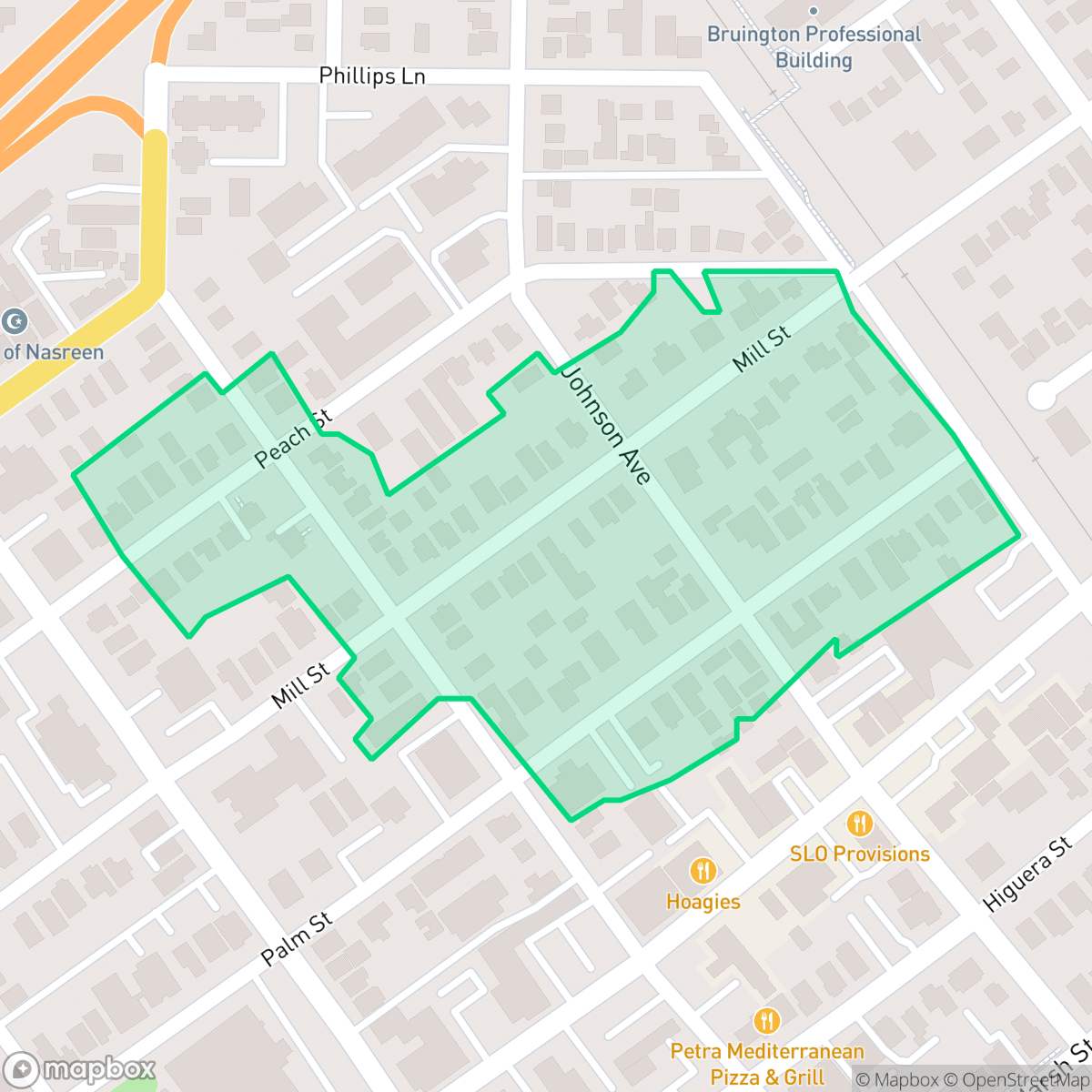
About Mill Street District
Established in 1987, the Mill Street Historic District in San Luis Obispo is a 20-acre residential neighborhood boasting the city's highest concentration of historic structures. Recorded in 1878 as part of "The Town of San Luis Obispo" subdivision and historically known as Fremont Heights, the neighborhood was developed on high ground with wide lots to safeguard against seasonal flooding and fires. Its primary period of significance spans the 1900s to the 1920s, reflecting a local population boom. Due to its proximity to the county courthouse, it historically housed many public officials, including clerks and attorneys. The district's architectural fabric features Tudor Revival, Craftsman, Mission Revival, and Victorian homes built by local craftsmen like E.D. Bray. Signature characteristics include 20-foot setbacks, recessed coach barns, and streets lined with distinctive camphor trees.
The neighborhood offers a distinct urban-suburban blend, characterized by its grid-based layout and immediate access to commercial amenities near Santa Rosa Park. Residents benefit from exceptional walkability, making it easy to reach local dining options and green spaces without a vehicle. The area maintains a strong sense of community, supported by high rates of health insurance coverage and a consistent ideological alignment among its inhabitants. According to iHuus data, the neighborhood provides a stable residential environment that integrates well with the surrounding city infrastructure.
Prospective residents should carefully weigh the architectural charm against specific livability trade-offs. The area is notably loud due to high levels of road traffic, which significantly impacts acoustic comfort. Furthermore, the district faces environmental risks related to fire and flood safety, which are important considerations for long-term property maintenance and insurance planning. The neighborhood is best suited for those who prioritize pedestrian access and historic character over complete acoustic tranquility.
Neighborhood Scores Across 15 Qualities
Residential spacing offers a moderate degree of separation between neighbors, providing slightly more privacy than the San Luis Obispo average. Backyard fencing and typical building setbacks create a standard buffer between adjacent properties according to iHuus data.
Pedestrian-friendly infrastructure, including wide sidewalks and frequent crosswalks, makes navigating the area on foot very easy. This level of accessibility is notably higher than the average for San Luis Obispo.
Standard middle-class housing characterizes this area, featuring boxy rooflines and small yards. This landscape is slightly less visually varied than the San Luis Obispo average, according to iHuus data.
Large central park areas and grassy street verges provide ample space for pets. This neighborhood offers a level of dog friendliness that is nearly on par with the rest of San Luis Obispo.
A mix of single-family homes and low-rise apartments provides a transition between urban and natural spaces. According to iHuus data, this area is slightly less developed than the typical San Luis Obispo landscape, featuring more frequent open land and scattered woodland.
Diverse local dining options and nearby green spaces create a high-energy atmosphere that is notably more active than the San Luis Obispo average. Residents have easy access to a variety of establishments, ranging from casual eateries to specialty coffee shops, according to iHuus data.
Frequent disturbances from nearby railroad tracks and heavy freeway traffic characterize this area. According to iHuus data, acoustic comfort is notably lower than the San Luis Obispo average.
Air quality in this area remains consistently high with minimal health concerns. According to iHuus data, these levels are on par with the rest of San Luis Obispo.
Residential and light commercial uses dominate the area with an absence of heavy warehouses or industrial hazards. This makes the district cleaner and quieter than the San Luis Obispo average, according to iHuus data.
Health insurance accessibility in this area is slightly lower than the San Luis Obispo city average, according to iHuus data.
Voting patterns and census indicators in this area reflect a deeply liberal political leaning that is slightly more pronounced than the San Luis Obispo average.
Residents live alongside a balanced blend of young adults, families, and seniors. This demographic spread is consistent with the broader San Luis Obispo area.
Significant flood risk exists here due to its location within a coastal high-hazard zone subject to wave action. According to iHuus data, this risk is substantially higher than the San Luis Obispo city average and may result in elevated insurance costs.
Address-Level Insights for Mill Street District


iHuus Neighborhood Intelligence Insights
Get address-level neighborhood insights for Mill Street District
- Street-level scores — see how individual blocks compare, not just neighborhood averages
- Micro-zone boundaries — identify quiet pockets, flood boundaries, and walkable clusters before you visit
- 15 dimensions in full — walkability, noise, air quality, school quality, insurance coverage, population age profile, urban/rural index, and more
- Boundary risk alerts — know if your address sits near a block boundary where scores drop, the kind of detail no listing will ever mention
- School insights — individual school ratings and insights, not just district-level data
- Compare before you commit — side-by-side data across neighborhoods, down to block precision
No credit card required
Compare with Any Neighborhood
| Dimension | Mill Street District | Downtown |
|---|---|---|
| 🚶 Walkabilityavg 8.55 | ||
| 🔊 Acoustic Comfortavg 3.09 | ||
| 🤫 Privacy Indexavg 5.37 | ||
| 🎨 Visual Appealavg 6.61 | ||
| 🐕 Dog Friendlinessavg 8.17 | ||
| 🗺️ Urban-Rural Indexavg 7.06 | ||
| ✨ Neighborhood Vibeavg 6.03 | ||
| 🏥 Health Insurance Coverageavg 8.08 | ||
| 🌿 Air Qualityavg 9.99 | ||
| 🏭 Industrial Proximityavg 8.94 | ||
| 🌊 Flood Safetyavg 3.32 | ||
| 🗳️ Ideological Leanavg 9.27 | ||
| 👥 Population Age Profileavg 4.55 | ||
| 🔥 Fire Safetyavg 1.35 | ||
| 🏫 School Quality |
Mill Street District Rankings
School Districts Serving Mill Street District
School Insights for Mill Street District
Below average outcomes; significant attendance and academic challenges.
School Insights
See what's really behind every school rating near Mill Street District
- Individual school ratings — each school's own score with outcome context, not just a district average
- Enrollment & class size data — student-to-teacher ratio and how it compares to the state average
- Full demographics breakdown — ethnicity and gender composition for every school in the enrollment zone
- Every school in the district — all schools within the enrollment boundary ranked by rating, not just the closest one
- Grade levels & benchmarks — elementary through high school, with below/above state-average flags
No credit card required