Japantown, San Luis Obispo
Updated · 359 residents
Japantown is a distinct San Luis Obispo enclave characterized by a blend of residential living and active commercial corridors. While the area offers high walkability and excellent air quality, residents should be prepared for significant road noise and limited privacy.
Key Highlights
About Japantown
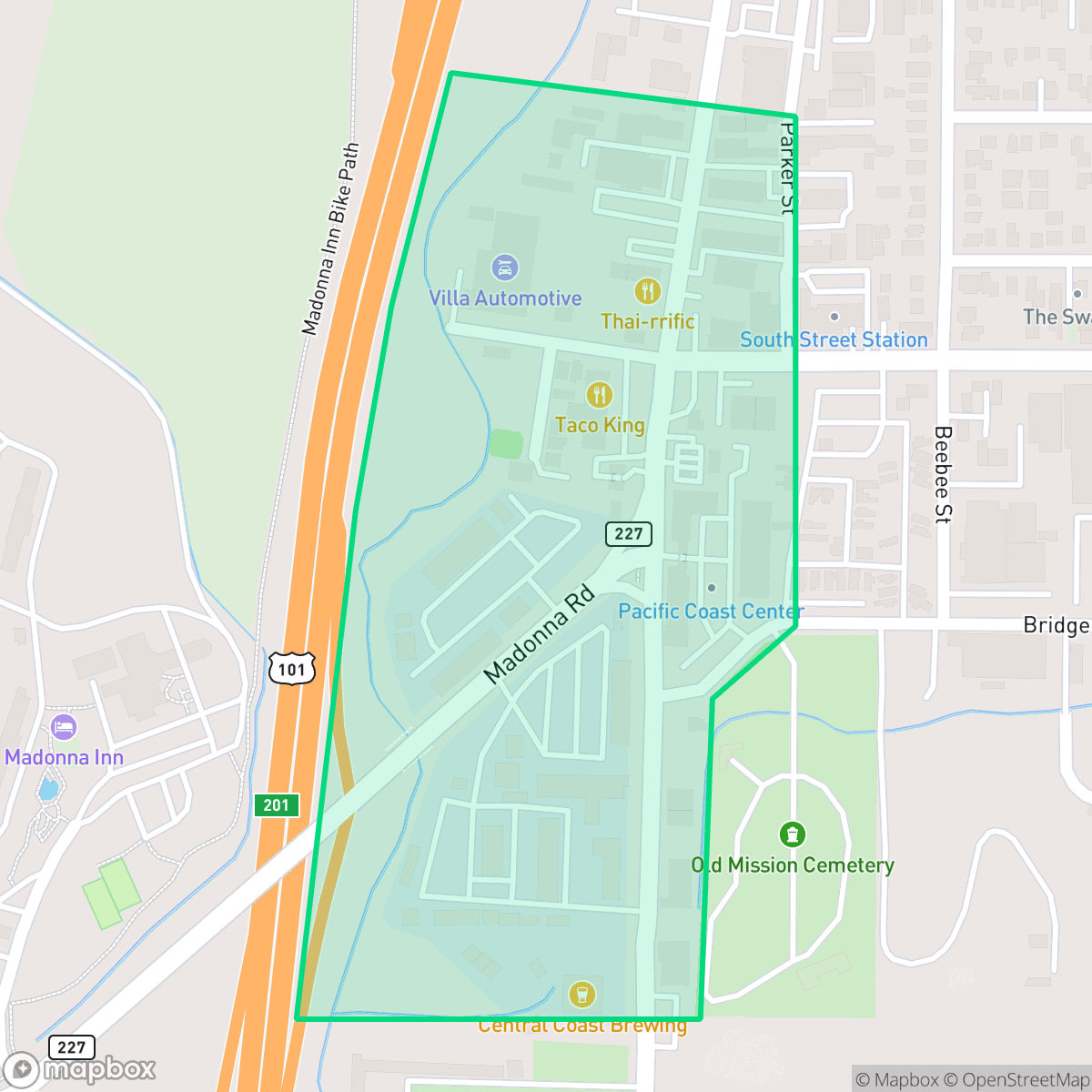
San Luis Obispo’s Japantown, historically known as Nihonmachi or the "Nippon Tract," emerged in 1923 when Japanese immigrant Yoroku Watanabe leased a parcel on Higuera Street across from the Pacific Coast Railway. Centered between South Street and French Road, the enclave grew into a bustling commercial hub supporting local agricultural workers. It featured businesses like the Pacific Hotel, Hokubei Ryokan, and Watanabe's grocery. Prominent residents included the Eto family, for whom Eto Street was named in 1935 (renamed Brook Street during World War II). The thriving community abruptly ended in 1942 when Executive Order 9066 forced the relocation of over 900 Japanese Americans. Today, the neighborhood's legacy is preserved at Eto Park, a public memorial garden featuring traditional stone lanterns and historical plaques.
The neighborhood functions as a mixed-use environment where suburban residential blocks meet light industrial activity. It benefits from proximity to local landmarks like the High Street Church and convenient access to diverse dining options. According to iHuus data, the area maintains a high walkability score, making it easy for residents to access nearby amenities on foot while navigating a landscape that balances daily commerce with quiet residential streets.
Prospective residents should consider specific livability trade-offs, particularly regarding acoustic comfort. Due to its proximity to major transit corridors, road traffic noise is a notable factor for those living in the area. Additionally, the neighborhood faces challenges with flood and fire safety, which are important factors for long-term planning. This location is best suited for individuals who prioritize central access and a vibrant, mixed-use atmosphere over absolute seclusion.
Neighborhood Scores Across 15 Qualities
Residential spacing provides a moderate level of separation between neighbors, appearing slightly more private than the San Luis Obispo average.
Safe crossings and sidewalks on one side of the street support pedestrian activity, though the area is slightly less walkable than the San Luis Obispo average.
Standard tract housing defines the area, featuring modest yards and uniform rooflines. This visual landscape is slightly less varied than the San Luis Obispo city average.
Connected green spaces and wide paths provide safe areas for walking pets, though overall accessibility for dogs is slightly below the San Luis Obispo city average according to iHuus data.
Frequent open land and scattered homes among woodland characterize this area. According to iHuus data, this landscape is slightly less dense than the San Luis Obispo average.
A combination of lively social hubs and quiet industrial pockets creates a social atmosphere that is slightly below the city average. According to iHuus data, the area features diverse dining options and green spaces, though many amenities are located near major highways rather than within walking distance.
Frequent noise from nearby railroad tracks and the adjacent freeway creates a significantly louder environment than the rest of San Luis Obispo. According to iHuus data, residents can expect persistent acoustic disturbances due to these transportation corridors.
Air quality remains consistently high with minimal pollutants, matching the excellent levels found throughout the rest of San Luis Obispo.
Active commercial units and light industrial spaces are integrated with residential areas, resulting in higher daytime traffic than is typical for San Luis Obispo. This mix of uses creates a landscape of light commercial activity alongside housing, according to iHuus data.
Health insurance coverage among residents is notably lower than the San Luis Obispo city average, according to iHuus data.
Voting patterns and census indicators show a predominantly liberal leaning that is slightly more pronounced than the San Luis Obispo city average, according to iHuus data.
A balanced mix of young adults, families, and older residents defines the local community. This demographic spread is consistent with the average seen across San Luis Obispo.
Significant flood and wave action risks exist in this area, which is substantially higher than the San Luis Obispo average. Residents should expect elevated or potentially prohibitive insurance costs due to its location within a coastal high-hazard zone, according to iHuus data.
Fire hazards in this area are more significant than the San Luis Obispo average. Residents should be aware of heightened mitigation requirements according to iHuus data.
Address-Level Insights for Japantown


iHuus Neighborhood Intelligence Insights
Get address-level neighborhood insights for Japantown
- Street-level scores — see how individual blocks compare, not just neighborhood averages
- Micro-zone boundaries — identify quiet pockets, flood boundaries, and walkable clusters before you visit
- 15 dimensions in full — walkability, noise, air quality, school quality, insurance coverage, population age profile, urban/rural index, and more
- Boundary risk alerts — know if your address sits near a block boundary where scores drop, the kind of detail no listing will ever mention
- School insights — individual school ratings and insights, not just district-level data
- Compare before you commit — side-by-side data across neighborhoods, down to block precision
No credit card required
Compare with Any Neighborhood
| Dimension | Japantown | Downtown |
|---|---|---|
| 🚶 Walkabilityavg 8.55 | ||
| 🔊 Acoustic Comfortavg 3.09 | ||
| 🤫 Privacy Indexavg 5.37 | ||
| 🎨 Visual Appealavg 6.61 | ||
| 🐕 Dog Friendlinessavg 8.17 | ||
| 🗺️ Urban-Rural Indexavg 7.06 | ||
| ✨ Neighborhood Vibeavg 6.03 | ||
| 🏥 Health Insurance Coverageavg 8.08 | ||
| 🌿 Air Qualityavg 9.99 | ||
| 🏭 Industrial Proximityavg 8.94 | ||
| 🌊 Flood Safetyavg 3.32 | ||
| 🗳️ Ideological Leanavg 9.27 | ||
| 👥 Population Age Profileavg 4.55 | ||
| 🔥 Fire Safetyavg 1.35 | ||
| 🏫 School Quality |
Japantown Rankings
School Districts Serving Japantown
School Insights for Japantown
Below average outcomes; significant attendance and academic challenges.
School Insights
See what's really behind every school rating near Japantown
- Individual school ratings — each school's own score with outcome context, not just a district average
- Enrollment & class size data — student-to-teacher ratio and how it compares to the state average
- Full demographics breakdown — ethnicity and gender composition for every school in the enrollment zone
- Every school in the district — all schools within the enrollment boundary ranked by rating, not just the closest one
- Grade levels & benchmarks — elementary through high school, with below/above state-average flags
No credit card required