Yerba Buena, San Francisco
Updated · 5,740 residents
Yerba Buena is a vibrant cultural and civic hub in San Francisco, defined by its high-density urban architecture and exceptional walkability. The area serves as a central destination for arts and conventions, offering residents immediate access to diverse dining and major institutions while maintaining a fast-paced, metropolitan atmosphere.
Key Highlights
About Yerba Buena
Initially a working-class South of Market enclave populated by retired laborers and Filipino immigrants, San Francisco’s Yerba Buena neighborhood underwent a dramatic transformation during the mid-20th century. In 1966, the city launched the Yerba Buena Center Redevelopment Project, aiming to demolish local single-room occupancy (SRO) hotels for commercial high-rises. This sparked fierce resistance from displaced residents, who formed Tenants and Owners in Opposition to Redevelopment (TOOR). Their legal battles forced the city to integrate affordable housing and public community spaces into its plans. This activism reshaped the district into a major cultural and civic hub, anchored by the Yerba Buena Gardens, the Moscone Center, and the Yerba Buena Center for the Arts. Today, the neighborhood also celebrates its deep heritage as part of the SOMA Pilipinas Filipino Cultural Heritage District.
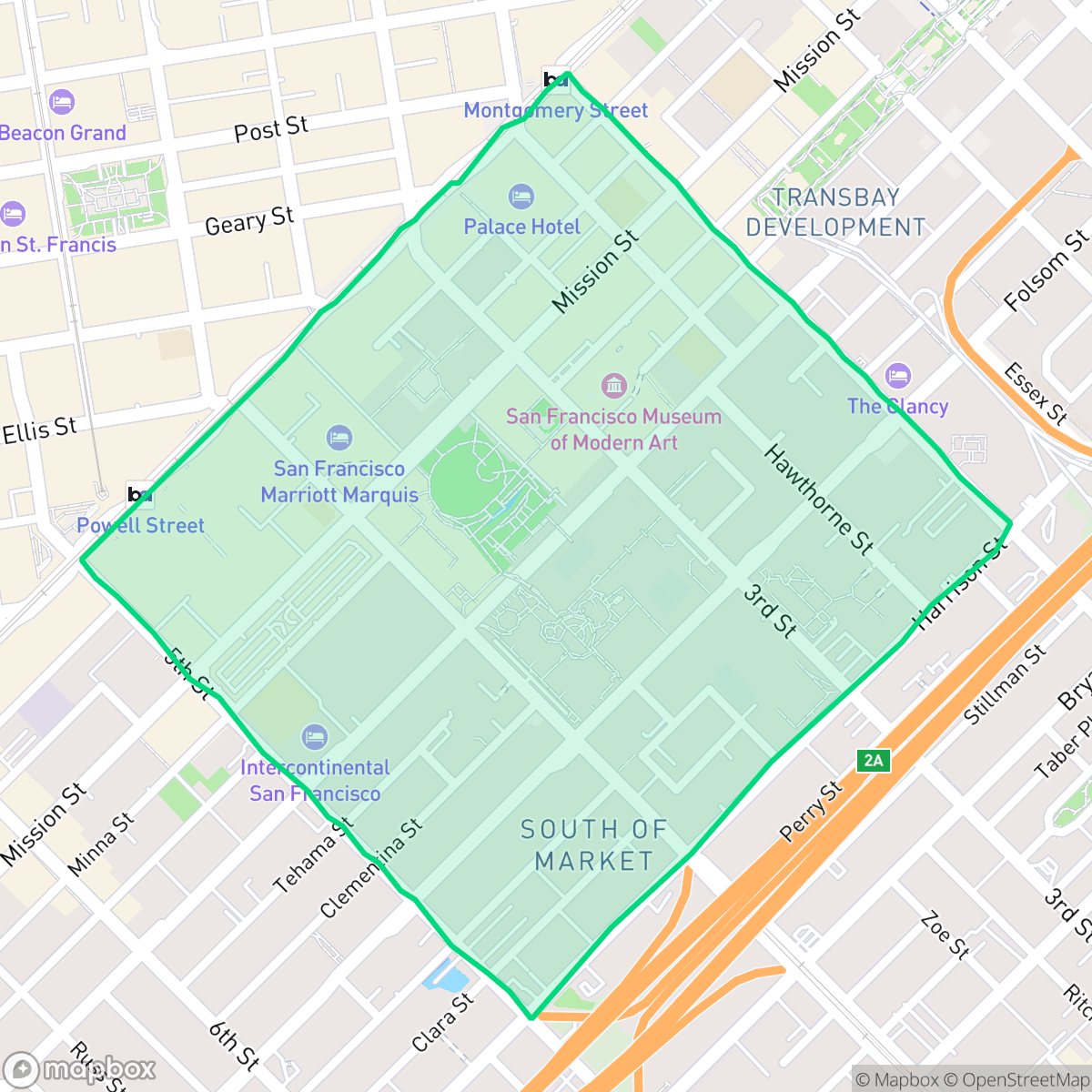
This district functions as a primary commercial and cultural anchor for the city, characterized by a grid of high-rise buildings and significant public spaces like the Yerba Buena Gardens. The area provides a highly accessible environment for pedestrians, with wide sidewalks and a dense concentration of amenities including the Moscone Center and various museums. According to iHuus data, the neighborhood offers a lively urban experience, featuring a mix of modern dining options and cultural institutions that cater to both professionals and visitors.
Living here involves trade-offs typical of a dense city core. Residents experience significant ambient noise from road traffic and limited privacy due to the proximity of neighboring buildings. While the neighborhood excels in walkability, those seeking suburban amenities like large green spaces or quiet residential streets may find the environment challenging. Families should consider that the local school district currently faces significant financial and operational hurdles, which may impact educational stability in the region.
Neighborhood Scores Across 15 Qualities
Building density is extremely high, with structures often touching or separated only by narrow alleys. This level of proximity to neighbors is consistent with the rest of the city.
Extensive sidewalk networks and high-visibility crosswalks facilitate easy movement throughout the urban grid. This infrastructure is slightly more comprehensive than the San Francisco average, making the area exceptionally easy to navigate on foot.
The landscape is defined by high-density commercial structures and large cultural institutions. While the area features expensive real estate, it lacks private luxury amenities like estates or personal pools, placing its visual variety slightly below the city average.
High concrete density and minimal street-level greenery make it difficult to find open spaces for pets. According to iHuus data, the availability of accessible grass verges and parks is significantly lower than the city average.
High-rise buildings and extensive pavement dominate the landscape with very little natural greenery or vegetation. This level of urban density is significantly higher than the San Francisco average, according to iHuus data.
A notable concentration of diverse dining and cultural venues provides a more active social atmosphere than the San Francisco average. According to iHuus data, the area features many social hubs and galleries, although several pockets are characterized by high-rise density and proximity to major highways.
Constant sound from nearby transit corridors and major thoroughfares makes this a significantly louder area than the San Francisco average. According to iHuus data, residents can expect frequent disturbances from heavy traffic and nearby infrastructure.
Air quality in this area is consistently good with rare instances of elevated readings. According to iHuus data, the air quality is slightly better than the San Francisco city average.
Industrial hazards and heavy warehouses are absent from this district, as the area consists primarily of high-rise commercial, retail, and residential structures. While this lack of industry is slightly lower than the city average, residents can expect an environment free from heavy industrial pollution.
Voting patterns and census indicators reflect a deeply liberal political landscape, consistent with the broader San Francisco average according to iHuus data.
Residents live alongside a balanced spread of young adults, families, and older individuals. This demographic distribution is roughly consistent with the broader San Francisco population, according to iHuus data.
Located within a coastal high-hazard zone, this area faces significant risks from wave action and flooding. According to iHuus data, the vulnerability here is considerably higher than the San Francisco average, which may result in elevated insurance costs.
Address-Level Insights for Yerba Buena


iHuus Neighborhood Intelligence Insights
Get address-level neighborhood insights for Yerba Buena
- Street-level scores — see how individual blocks compare, not just neighborhood averages
- Micro-zone boundaries — identify quiet pockets, flood boundaries, and walkable clusters before you visit
- 15 dimensions in full — walkability, noise, air quality, school quality, insurance coverage, population age profile, urban/rural index, and more
- Boundary risk alerts — know if your address sits near a block boundary where scores drop, the kind of detail no listing will ever mention
- School insights — individual school ratings and insights, not just district-level data
- Compare before you commit — side-by-side data across neighborhoods, down to block precision
No credit card required
Compare with Any Neighborhood
| Dimension | Yerba Buena | Alamo Square |
|---|---|---|
| 🚶 Walkabilityavg 9.91 | ||
| 🔊 Acoustic Comfortavg 3.4 | ||
| 🤫 Privacy Indexavg 2.14 | ||
| 🎨 Visual Appealavg 6.26 | ||
| 🐕 Dog Friendlinessavg 6.55 | ||
| 🗺️ Urban-Rural Indexavg 4.07 | ||
| ✨ Neighborhood Vibeavg 6.4 | ||
| 🏥 Health Insurance Coverageavg 7.87 | ||
| 🌿 Air Qualityavg 7.78 | ||
| 🏭 Industrial Proximityavg 9.37 | ||
| 🌊 Flood Safetyavg 1.89 | ||
| 🗳️ Ideological Leanavg 9.92 | ||
| 👥 Population Age Profileavg 5.18 | ||
| 🔥 Fire Safetyavg 0.01 | ||
| 🏫 School Quality |
Yerba Buena Rankings
School Districts Serving Yerba Buena
School Insights for Yerba Buena
Below average outcomes; significant attendance and academic challenges.
School Insights
See what's really behind every school rating near Yerba Buena
- Individual school ratings — each school's own score with outcome context, not just a district average
- Enrollment & class size data — student-to-teacher ratio and how it compares to the state average
- Full demographics breakdown — ethnicity and gender composition for every school in the enrollment zone
- Every school in the district — all schools within the enrollment boundary ranked by rating, not just the closest one
- Grade levels & benchmarks — elementary through high school, with below/above state-average flags
No credit card required