Yerba Buena Island, San Francisco
Updated · 144 residents
Yerba Buena Island offers a unique, secluded living experience in the middle of the San Francisco Bay, defined by its dramatic topography and proximity to the Bay Bridge. Residents enjoy exceptional visual appeal and a rural atmosphere, though the area is notably loud due to constant highway traffic and remains heavily car-dependent.
Key Highlights
About Yerba Buena Island
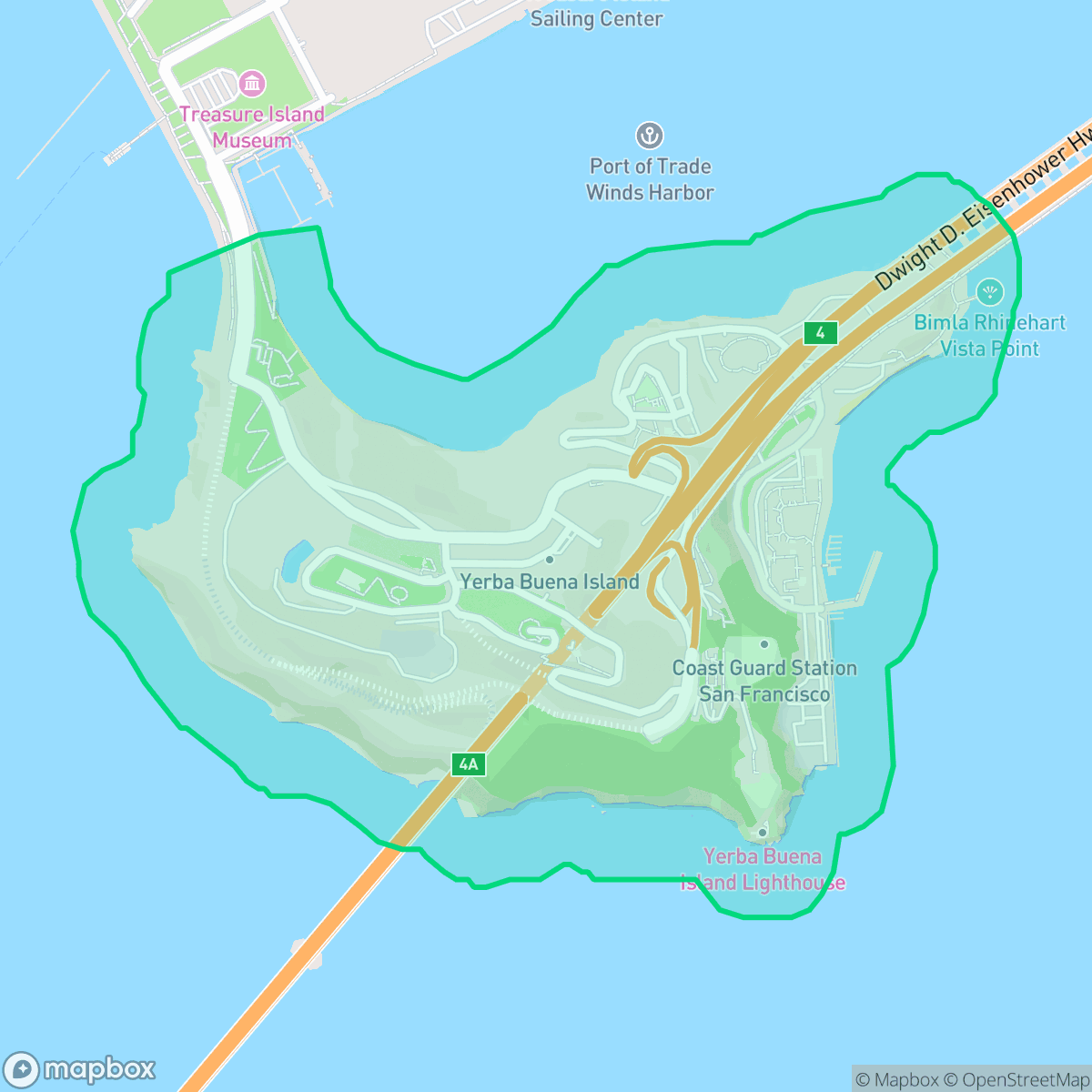
Yerba Buena Island has a rich history starting with the Huchiun Ohlone people, who used the natural landmass as a fishing station as early as 1450 BC. Spanish explorer Juan Manuel de Ayala mapped the island in 1775. In the 19th century, it became widely known as "Goat Island" before its original Spanish name—meaning "good herb"—was officially restored in 1931. The island’s military legacy began in the 1870s, leading to the establishment of the Pacific Coast's first U.S. Naval Training Station in 1898. Notable landmarks include an 1875 octagonal lighthouse and the "Great Whites," a cluster of historic officers' quarters. Among these is Quarters One (Nimitz House), a Classical Revival mansion that housed Admiral Chester Nimitz during World War II. Today, the island is famously bisected by the San Francisco–Oakland Bay Bridge tunnel.
The neighborhood serves as a quiet, elevated enclave that provides panoramic views of the San Francisco skyline and the East Bay. Unlike the dense urban fabric of the city center, the area features expansive open spaces and a rugged landscape that feels disconnected from the typical metropolitan pace. The architecture blends historic military structures with modern residential development, creating a distinct aesthetic that honors its past while transitioning into a contemporary residential destination.
Living here requires a significant trade-off between natural beauty and acoustic comfort. The proximity to the San Francisco-Oakland Bay Bridge results in elevated noise levels, making it less suitable for those seeking a tranquil retreat. Furthermore, the lack of local commercial services necessitates frequent travel to neighboring districts for shopping and dining. This area is best suited for individuals who prioritize privacy, outdoor access, and a rural-like environment over immediate walkability or proximity to urban amenities.
Neighborhood Scores Across 15 Qualities
Residential spacing provides a fair amount of buffer between neighbors, offering significantly more seclusion than the typical San Francisco density.
Sidewalks are available on only one side of the roads and include safe crossings, though walking for daily errands is significantly less convenient than in most other parts of San Francisco. According to iHuus data, the area lacks the high level of pedestrian connectivity found across the rest of the city.
Large residential structures and premium amenities contribute to a landscape that is more visually pleasing than the San Francisco average. According to iHuus data, the area features spacious driveways and well-maintained properties.
Connected green spaces and wide, traffic-free paths make this area significantly more dog friendly than the San Francisco average, according to iHuus data.
Extensive open landscapes and low building density create a semi-rural atmosphere that is significantly more open than the San Francisco average. According to iHuus data, the area is characterized by vast natural terrain and minimal urban crowding.
Sparse development and limited local businesses create a tranquil but car-dependent environment. This area is significantly less active than the San Francisco average, offering a remote landscape dominated by open space and coastal scenery.
Constant noise from nearby airport runways and heavy transit infrastructure makes this area significantly louder than the San Francisco average. According to iHuus data, residents can expect minimal acoustic comfort due to the immediate proximity to flight paths.
Air quality is consistently high with rare instances of elevated readings, performing slightly better than the San Francisco average according to iHuus data.
Residential areas and green spaces dominate the landscape, providing a much quieter environment than the more industrial portions of San Francisco. While some utility infrastructure and maritime logistics are visible nearby, the area lacks the heavy industrial density found elsewhere in the city.
Health insurance enrollment among residents is lower than the San Francisco average, according to iHuus data.
Political leanings on the island are largely liberal, though this concentration is slightly lower than the citywide average according to iHuus data.
Residents encounter a diverse mix of young adults, families, and seniors, though the population skew is slightly more concentrated in specific age brackets than the San Francisco average. According to iHuus data, this creates a demographic profile that is less evenly distributed across all life stages compared to the rest of the city.
Address-Level Insights for Yerba Buena Island


iHuus Neighborhood Intelligence Insights
Get address-level neighborhood insights for Yerba Buena Island
- Street-level scores — see how individual blocks compare, not just neighborhood averages
- Micro-zone boundaries — identify quiet pockets, flood boundaries, and walkable clusters before you visit
- 15 dimensions in full — walkability, noise, air quality, school quality, insurance coverage, population age profile, urban/rural index, and more
- Boundary risk alerts — know if your address sits near a block boundary where scores drop, the kind of detail no listing will ever mention
- School insights — individual school ratings and insights, not just district-level data
- Compare before you commit — side-by-side data across neighborhoods, down to block precision
No credit card required
Compare with Any Neighborhood
| Dimension | Yerba Buena Island | Alamo Square |
|---|---|---|
| 🚶 Walkabilityavg 9.91 | ||
| 🔊 Acoustic Comfortavg 3.4 | ||
| 🤫 Privacy Indexavg 2.14 | ||
| 🎨 Visual Appealavg 6.26 | ||
| 🐕 Dog Friendlinessavg 6.55 | ||
| 🗺️ Urban-Rural Indexavg 4.07 | ||
| ✨ Neighborhood Vibeavg 6.4 | ||
| 🏥 Health Insurance Coverageavg 7.87 | ||
| 🌿 Air Qualityavg 7.78 | ||
| 🏭 Industrial Proximityavg 9.37 | ||
| 🌊 Flood Safetyavg 1.89 | ||
| 🗳️ Ideological Leanavg 9.92 | ||
| 👥 Population Age Profileavg 5.18 | ||
| 🔥 Fire Safetyavg 0.01 | ||
| 🏫 School Quality |
Yerba Buena Island Rankings
School Districts Serving Yerba Buena Island
School Insights for Yerba Buena Island
Below average outcomes; significant attendance and academic challenges.
School Insights
See what's really behind every school rating near Yerba Buena Island
- Individual school ratings — each school's own score with outcome context, not just a district average
- Enrollment & class size data — student-to-teacher ratio and how it compares to the state average
- Full demographics breakdown — ethnicity and gender composition for every school in the enrollment zone
- Every school in the district — all schools within the enrollment boundary ranked by rating, not just the closest one
- Grade levels & benchmarks — elementary through high school, with below/above state-average flags
No credit card required