Westwood Highlands, San Francisco
Updated · 1,952 residents
Westwood Highlands is a serene, master-planned enclave on the slopes of Mount Davidson, defined by its winding streets and dense urban forest canopy. Residents enjoy an exceptionally walkable environment and high air quality, though the compact housing footprint results in limited privacy between neighbors.
Key Highlights
About Westwood Highlands
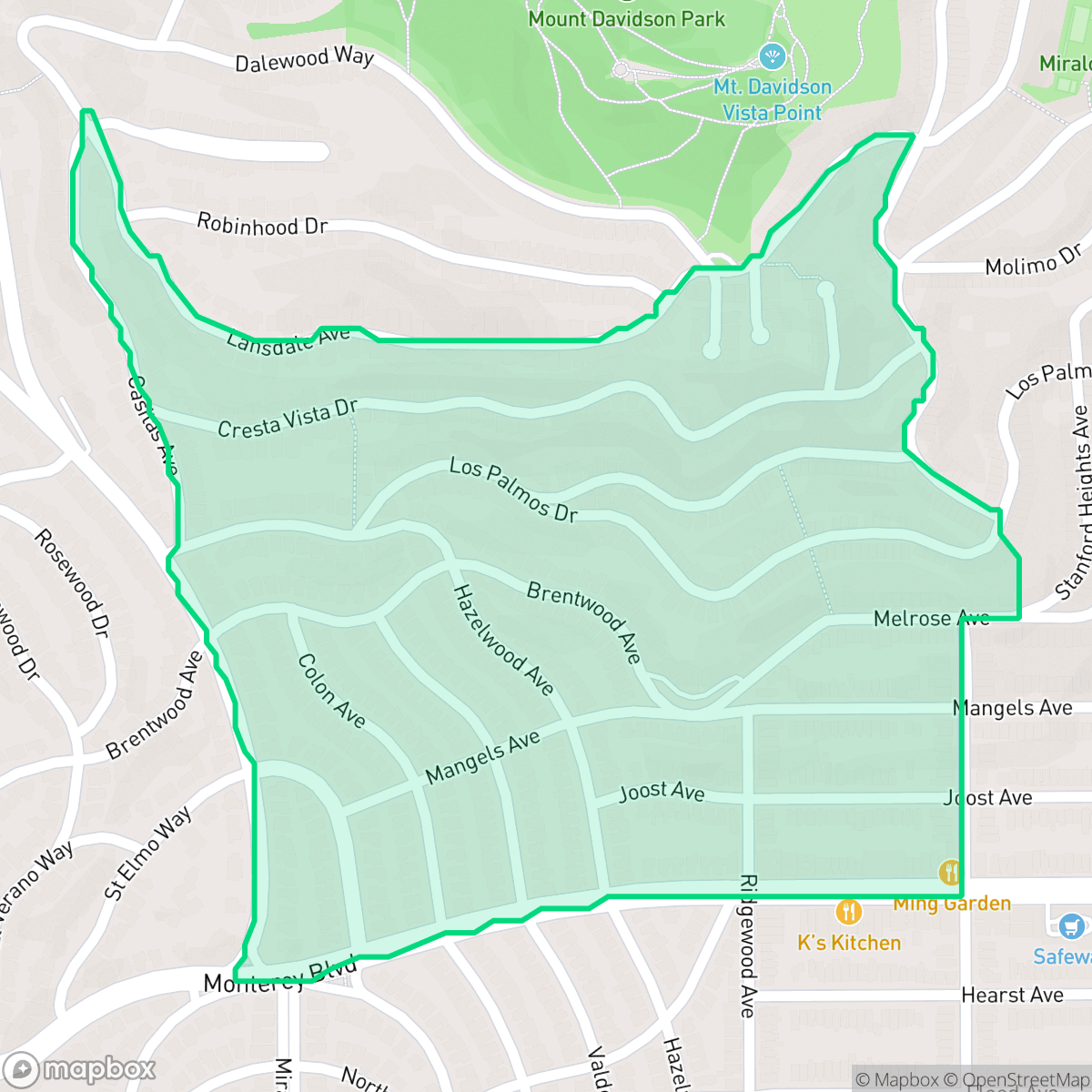
Developed between 1924 and 1929 on the southern slope of Mount Davidson, Westwood Highlands is a highly planned San Francisco residential park of 283 homes. Created by the real estate firm Baldwin & Howell on former forested land from the Adolph Sutro estate, it was among the first master-planned communities in the United States governed by strict private covenants. To match its steep topography, planners rejected the city's traditional grid in favor of winding, curvilinear streets. Designed to evoke the charm of an English village, the neighborhood features custom-built homes in diverse architectural styles, including Tudor and Mediterranean Revival, with utilities hidden underground. Today, the enclave is marked by original globe streetlights and eight distinctive wrought-iron boundary signs.
The area functions as a quiet residential retreat within San Francisco, characterized by its low-rise housing and significant tree cover. With a high walkability score, the neighborhood offers residents easy access to local amenities and nearby green spaces, including the expansive trails of Mount Davidson. According to iHuus data, the community benefits from excellent air quality and a lack of industrial proximity, contributing to a peaceful living environment with low noise levels.
While the neighborhood provides a strong sense of community, prospective residents should note the trade-offs associated with its dense layout, which limits individual property privacy. The local school district currently faces significant financial and operational challenges, which may be a consideration for families. The area is best suited for those who prioritize a quiet, pedestrian-friendly lifestyle and proximity to nature over the bustle of more central city districts.
Neighborhood Scores Across 15 Qualities
Residential properties feature minimal separation between buildings, resulting in a higher degree of proximity to neighbors than the San Francisco average. According to iHuus data, many detached homes are situated with very narrow side yards and close property boundaries.
Continuous sidewalk networks and clear pedestrian crossings are available on most residential streets. According to iHuus data, the ease of navigating this area on foot is slightly above the San Francisco average.
Large, well-maintained homes with complex rooflines and private decks contribute to a visual environment that is slightly above the San Francisco average. According to iHuus data, the area features prominent upscale amenities and expansive views in certain sections.
Immediate access to large wooded parks and athletic fields provides excellent space for pets. According to iHuus data, the availability of greenery and continuous paths makes this area slightly more dog friendly than the San Francisco average.
Residential streets and green spaces are present in nearly equal measure, creating a suburban character that is more balanced than the typical San Francisco urban landscape. According to iHuus data, the area features a notable amount of tree canopy and greenery integrated within the housing fabric.
A combination of serene residential streets and localized social hubs provides a tranquil atmosphere that is less active than the San Francisco average. Residents can access a modest selection of neighborhood cafes and dining options, though the area lacks the high intensity of the city's central urban corridors.
Steady traffic sounds from nearby busy streets are present. This level of acoustic activity is notably higher than the city average for San Francisco.
Air quality remains consistently high with very few instances of elevated pollutants. This level of cleanliness is slightly above the San Francisco average, according to iHuus data.
Industrial activity and heavy warehouses are entirely absent from this area. According to iHuus data, this neighborhood is more free of industrial hazards and manufacturing facilities than most of San Francisco.
Health insurance access is exceptionally high among residents, significantly surpassing the average seen across San Francisco. According to iHuus data, nearly all inhabitants of the area are covered by a health plan.
Voting patterns and census indicators show a highly liberal political leaning that aligns with the city average. This political landscape is consistent with broader trends observed across San Francisco according to iHuus data.
Residents experience a diverse age distribution that is slightly more varied than the San Francisco average. According to iHuus data, the area maintains a balanced presence of young professionals, families, and older adults.
Address-Level Insights for Westwood Highlands


iHuus Neighborhood Intelligence Insights
Get address-level neighborhood insights for Westwood Highlands
- Street-level scores — see how individual blocks compare, not just neighborhood averages
- Micro-zone boundaries — identify quiet pockets, flood boundaries, and walkable clusters before you visit
- 15 dimensions in full — walkability, noise, air quality, school quality, insurance coverage, population age profile, urban/rural index, and more
- Boundary risk alerts — know if your address sits near a block boundary where scores drop, the kind of detail no listing will ever mention
- School insights — individual school ratings and insights, not just district-level data
- Compare before you commit — side-by-side data across neighborhoods, down to block precision
No credit card required
Compare with Any Neighborhood
| Dimension | Westwood Highlands | Alamo Square |
|---|---|---|
| 🚶 Walkabilityavg 9.91 | ||
| 🔊 Acoustic Comfortavg 3.4 | ||
| 🤫 Privacy Indexavg 2.14 | ||
| 🎨 Visual Appealavg 6.26 | ||
| 🐕 Dog Friendlinessavg 6.55 | ||
| 🗺️ Urban-Rural Indexavg 4.07 | ||
| ✨ Neighborhood Vibeavg 6.4 | ||
| 🏥 Health Insurance Coverageavg 7.87 | ||
| 🌿 Air Qualityavg 7.78 | ||
| 🏭 Industrial Proximityavg 9.37 | ||
| 🌊 Flood Safetyavg 1.89 | ||
| 🗳️ Ideological Leanavg 9.92 | ||
| 👥 Population Age Profileavg 5.18 | ||
| 🔥 Fire Safetyavg 0.01 | ||
| 🏫 School Quality |
Westwood Highlands Rankings
School Districts Serving Westwood Highlands
School Insights for Westwood Highlands
Below average outcomes; significant attendance and academic challenges.
School Insights
See what's really behind every school rating near Westwood Highlands
- Individual school ratings — each school's own score with outcome context, not just a district average
- Enrollment & class size data — student-to-teacher ratio and how it compares to the state average
- Full demographics breakdown — ethnicity and gender composition for every school in the enrollment zone
- Every school in the district — all schools within the enrollment boundary ranked by rating, not just the closest one
- Grade levels & benchmarks — elementary through high school, with below/above state-average flags
No credit card required