Western Addition, San Francisco
Updated · 10,942 residents
The Western Addition is a highly walkable urban district characterized by its dense residential grid and vibrant mix of local cafes and diverse dining options. While residents benefit from excellent pedestrian connectivity and proximity to cultural hubs, the area features tightly packed housing with limited privacy and elevated noise levels from road traffic.
Key Highlights
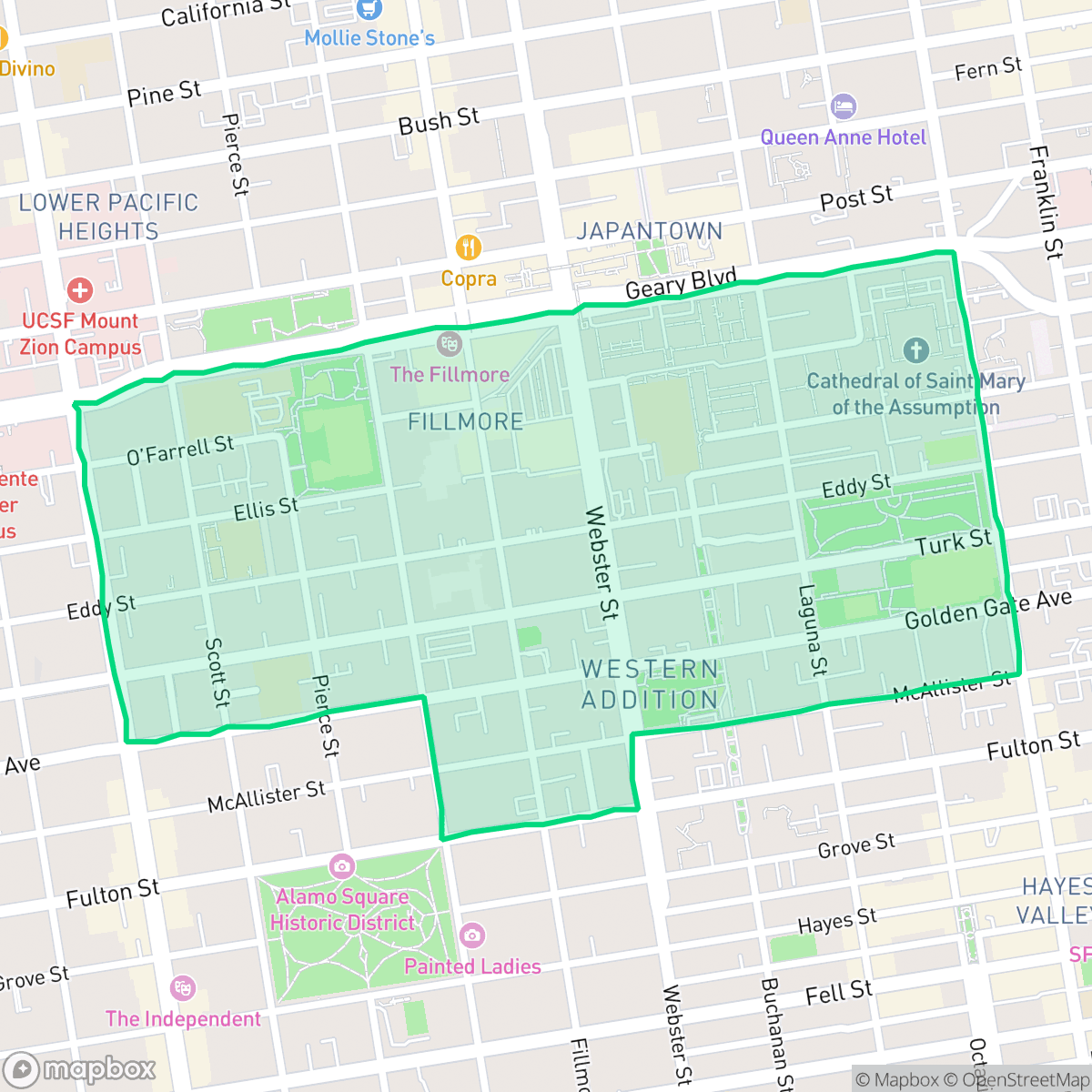
About Western Addition
Platted in the 1850s under the Van Ness Ordinance, San Francisco’s Western Addition developed as a Victorian streetcar suburb west of Larkin Street. Because it survived the 1906 earthquake largely intact, it retained a rich stock of Italianate and Queen Anne Victorian homes. During World War II, the neighborhood—particularly the Fillmore District—became a major cultural and residential hub for African Americans and Japanese Americans, earning renown as the "Harlem of the West" for its legendary jazz scene. However, starting in the late 1940s, the San Francisco Redevelopment Agency targeted the area for massive urban renewal. This controversial campaign widened Geary Boulevard into an expressway, demolished approximately 2,500 historic Victorians, closed over 800 businesses, and displaced nearly 20,000 residents, permanently altering the neighborhood’s cultural and architectural landscape.
Today, the area functions as a dense, transit-oriented hub that balances its deep-rooted cultural legacy with a modern, fast-paced urban environment. The streetscape is defined by a continuous grid layout that supports high walkability, allowing residents easy access to local social spots and a wide variety of international eateries. The neighborhood maintains a strong sense of community through its diverse commercial corridors, which serve as the primary social anchors for the surrounding residential blocks.
Prospective residents should note that the high density results in minimal distance between structures, leading to a trade-off in private outdoor space and acoustic comfort. While the area offers superior air quality and a lack of industrial activity, the noise from road traffic is a notable factor for those living near major thoroughfares. It is well-suited for individuals who prioritize a central location and pedestrian-friendly lifestyle over quiet seclusion, particularly those looking to leverage the neighborhood's proximity to high-performing charter schools like KIPP San Francisco Bay Academy and Creative Arts Charter.
Neighborhood Scores Across 15 Qualities
Buildings are positioned in very close proximity with shared walls or minimal separation between structures. This level of density is consistent with the broader San Francisco average, according to iHuus data.
Continuous sidewalks and frequent, marked crosswalks across the dense urban grid provide exceptional safety for those traveling on foot. This level of connectivity and infrastructure slightly surpasses the city average, making the area ideal for walking. According to iHuus data, the neighborhood features wide, dedicated pedestrian-priority zones on nearly every block.
Standard multi-unit housing and flat roofs characterize this area, which offers a slightly lower level of visual variety compared to the San Francisco average. According to iHuus data, the landscape consists primarily of dense apartment blocks and civic buildings without large private estates or luxury amenities.
Access to green space for pets is slightly below the city average. While many blocks consist of concrete, proximity to several mid-sized public parks and athletic fields provides reliable areas for dog walking.
Multi-story buildings and continuous blocks dominate the landscape, creating a highly built-up environment with significantly less open ground than the San Francisco average. According to iHuus data, this area features a dense urban grid with minimal unbuilt space and very few patches of green.
Diverse dining options and active social hubs create a lively atmosphere that is notably more energetic than the San Francisco average. According to iHuus data, the area features a dense concentration of cultural landmarks and varied eateries, though accessibility to these destinations varies depending on the specific block.
Persistent noise from nearby major freeways and transit corridors makes this area louder than most of San Francisco. According to iHuus data, residents can expect frequent auditory disturbances from heavy traffic and rail proximity.
Air quality remains consistently high with infrequent periods of poor ventilation, sitting slightly above the San Francisco average according to iHuus data.
Industrial presence is minimal in this area, as the landscape is almost entirely composed of residential, commercial, and civic structures. While a transit depot exists, the neighborhood lacks the heavy warehouses and industrial hazards found more frequently elsewhere in the city.
Health insurance access is widespread among residents, sitting well above the San Francisco average according to iHuus data.
Voting patterns and census indicators reflect a deeply liberal political landscape, consistent with the broader trends seen across San Francisco.
Residents live alongside a balanced demographic of young professionals, families, and seniors. This age distribution is consistent with the broader San Francisco population, according to iHuus data.
Flood risk in this area is notably higher than the San Francisco average due to its location within a coastal high-hazard zone. Residents should anticipate significantly elevated or potentially prohibitive flood insurance costs according to iHuus data.
Address-Level Insights for Western Addition


iHuus Neighborhood Intelligence Insights
Get address-level neighborhood insights for Western Addition
- Street-level scores — see how individual blocks compare, not just neighborhood averages
- Micro-zone boundaries — identify quiet pockets, flood boundaries, and walkable clusters before you visit
- 15 dimensions in full — walkability, noise, air quality, school quality, insurance coverage, population age profile, urban/rural index, and more
- Boundary risk alerts — know if your address sits near a block boundary where scores drop, the kind of detail no listing will ever mention
- School insights — individual school ratings and insights, not just district-level data
- Compare before you commit — side-by-side data across neighborhoods, down to block precision
No credit card required
Compare with Any Neighborhood
| Dimension | Western Addition | Alamo Square |
|---|---|---|
| 🚶 Walkabilityavg 9.91 | ||
| 🔊 Acoustic Comfortavg 3.4 | ||
| 🤫 Privacy Indexavg 2.14 | ||
| 🎨 Visual Appealavg 6.26 | ||
| 🐕 Dog Friendlinessavg 6.55 | ||
| 🗺️ Urban-Rural Indexavg 4.07 | ||
| ✨ Neighborhood Vibeavg 6.4 | ||
| 🏥 Health Insurance Coverageavg 7.87 | ||
| 🌿 Air Qualityavg 7.78 | ||
| 🏭 Industrial Proximityavg 9.37 | ||
| 🌊 Flood Safetyavg 1.89 | ||
| 🗳️ Ideological Leanavg 9.92 | ||
| 👥 Population Age Profileavg 5.18 | ||
| 🔥 Fire Safetyavg 0.01 | ||
| 🏫 School Quality |
Western Addition Rankings
School Districts Serving Western Addition
School Insights for Western Addition
Below average outcomes; significant attendance and academic challenges.
School Insights
See what's really behind every school rating near Western Addition
- Individual school ratings — each school's own score with outcome context, not just a district average
- Enrollment & class size data — student-to-teacher ratio and how it compares to the state average
- Full demographics breakdown — ethnicity and gender composition for every school in the enrollment zone
- Every school in the district — all schools within the enrollment boundary ranked by rating, not just the closest one
- Grade levels & benchmarks — elementary through high school, with below/above state-average flags
No credit card required