Visitacion Valley, San Francisco
Updated · 17,526 residents
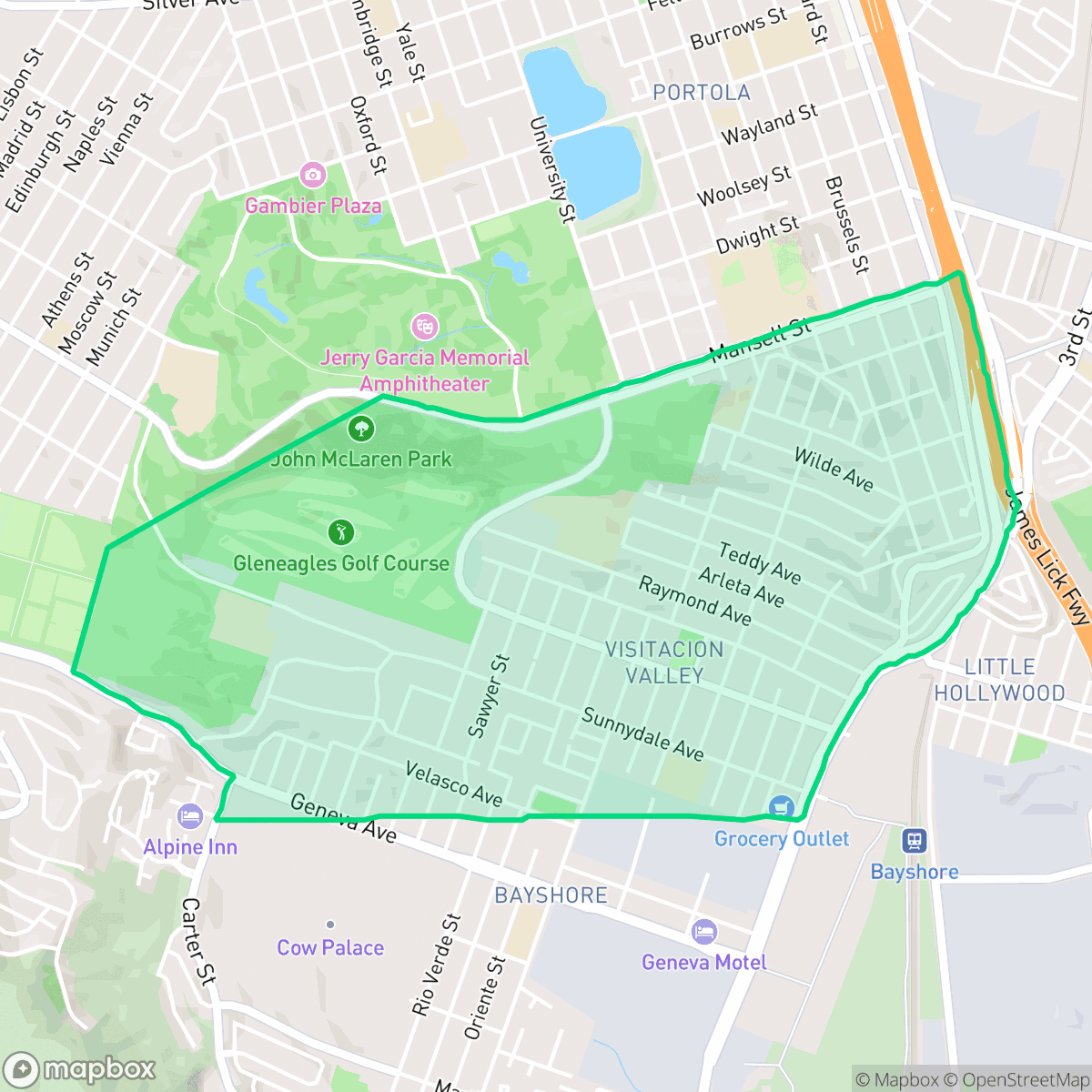
Visitacion Valley is a highly walkable neighborhood in southeastern San Francisco defined by its dense residential grid and proximity to extensive public parkland. Residents enjoy a calm, suburban atmosphere with diverse local dining options and exceptional access to dog-friendly green spaces.
Key Highlights
About Visitacion Valley
Located in southeastern San Francisco, Visitacion Valley was originally home to the Yelamu Ohlone people before being named by Spanish friars on July 2, 1777. In the 19th century, German, Italian, and Maltese immigrants established nurseries and truck farms, earning the area the nickname "Valley of the Windmills". The neighborhood transitioned into an industrial hub in the 20th century, anchored by the Southern Pacific Railroad and the Schlage Lock Company factory. Leland Avenue serves as the commercial spine, featuring notable architectural works like Julia Morgan’s 1923 St. James Presbyterian Church, John Reid Jr.’s 1913 Fire Station #44, and midcentury modern brick townhouses designed by Joseph Eichler.
The neighborhood functions as a quiet, community-oriented enclave characterized by a dense layout of traditional row houses. According to iHuus data, the area offers a high level of walkability, allowing residents to navigate the local grid and reach neighborhood amenities or expansive parks with ease. The presence of significant green space provides a distinct contrast to the surrounding urban density, making it a popular choice for those who prioritize outdoor access and a steady, rhythmic pace of life over the fast-moving environment of downtown San Francisco.
Prospective residents should note that the high density of housing results in limited privacy, as many structures share walls or are separated by minimal space. While the area benefits from good air quality and a lack of industrial activity, the proximity to major roads contributes to a moderate level of traffic noise. Families may find the local school options challenging, as district-wide performance metrics remain low. Overall, the area is well-suited for individuals or households seeking a stable, pedestrian-friendly environment with strong connections to natural recreation areas.
Neighborhood Scores Across 15 Qualities
Structures are characterized by a high-density row-house pattern with shared walls or very narrow gaps between buildings. This level of structural proximity is consistent with the broader San Francisco average.
Continuous sidewalk networks and clear pedestrian crossings facilitate easy movement through residential and park areas. This level of pedestrian connectivity is on par with the rest of San Francisco.
Uniform row houses and dense apartment complexes characterize the area, offering a landscape of small yards and consistent rooflines that is slightly below the city average for visual variety. According to iHuus data, the neighborhood features standard middle-class tract housing and industrial blocks without large private estates or luxury amenities.
Extensive access to large public parks and green corridors makes this area significantly more dog friendly than the San Francisco average. Residents can easily find spacious fields and walking trails suitable for pet exercise.
A blend of low-rise residential blocks and significant public parkland provides a more suburban feel than the typical San Francisco urban core. According to iHuus data, the area features an even distribution of built structures and green space.
Low-density streets and green spaces create a serene environment, though the area lacks the dense commercial energy found in many other San Francisco neighborhoods. Local dining and essential services are available, but the neighborhood is notably more car-oriented and subdued than the city average.
Proximity to major freeways and active railroad tracks results in audible disturbances that are slightly more prevalent than in most other San Francisco neighborhoods, according to iHuus data.
Air quality remains mostly clean with infrequent instances of elevated readings. This level of air quality is slightly higher than the San Francisco average, according to iHuus data.
Residential areas and parklands dominate the landscape with very little industrial activity detected. While the neighborhood remains largely free of warehouses, it sits slightly below the city average due to the presence of some nearby utility and logistics infrastructure.
Health insurance enrollment among residents is slightly below the San Francisco average, according to iHuus data.
Voting patterns and census indicators align with the broader political landscape of San Francisco. This area reflects the same predominant liberal leaning found across the rest of the city.
Residents experience a varied demographic landscape featuring a balanced distribution of young adults, families, and seniors. This age profile is slightly more varied than the typical San Francisco distribution, according to iHuus data.
Flood vulnerability is significantly higher than the San Francisco average, as much of the area sits within a coastal high-hazard zone. Residents should anticipate potential wave action impacts and elevated insurance premiums according to iHuus data.
Extreme fire hazards are present in this area, representing a level of risk that is higher than the San Francisco average. Residents should prioritize maximum protection measures and remain vigilant regarding local fire safety protocols.
Address-Level Insights for Visitacion Valley


iHuus Neighborhood Intelligence Insights
Get address-level neighborhood insights for Visitacion Valley
- Street-level scores — see how individual blocks compare, not just neighborhood averages
- Micro-zone boundaries — identify quiet pockets, flood boundaries, and walkable clusters before you visit
- 15 dimensions in full — walkability, noise, air quality, school quality, insurance coverage, population age profile, urban/rural index, and more
- Boundary risk alerts — know if your address sits near a block boundary where scores drop, the kind of detail no listing will ever mention
- School insights — individual school ratings and insights, not just district-level data
- Compare before you commit — side-by-side data across neighborhoods, down to block precision
No credit card required
Compare with Any Neighborhood
| Dimension | Visitacion Valley | Alamo Square |
|---|---|---|
| 🚶 Walkabilityavg 9.91 | ||
| 🔊 Acoustic Comfortavg 3.4 | ||
| 🤫 Privacy Indexavg 2.14 | ||
| 🎨 Visual Appealavg 6.26 | ||
| 🐕 Dog Friendlinessavg 6.55 | ||
| 🗺️ Urban-Rural Indexavg 4.07 | ||
| ✨ Neighborhood Vibeavg 6.4 | ||
| 🏥 Health Insurance Coverageavg 7.87 | ||
| 🌿 Air Qualityavg 7.78 | ||
| 🏭 Industrial Proximityavg 9.37 | ||
| 🌊 Flood Safetyavg 1.89 | ||
| 🗳️ Ideological Leanavg 9.92 | ||
| 👥 Population Age Profileavg 5.18 | ||
| 🔥 Fire Safetyavg 0.01 | ||
| 🏫 School Quality |
Visitacion Valley Rankings
School Districts Serving Visitacion Valley
School Insights for Visitacion Valley
Below average outcomes; significant attendance and academic challenges.
School Insights
See what's really behind every school rating near Visitacion Valley
- Individual school ratings — each school's own score with outcome context, not just a district average
- Enrollment & class size data — student-to-teacher ratio and how it compares to the state average
- Full demographics breakdown — ethnicity and gender composition for every school in the enrollment zone
- Every school in the district — all schools within the enrollment boundary ranked by rating, not just the closest one
- Grade levels & benchmarks — elementary through high school, with below/above state-average flags
No credit card required