Van Ness - Civic Center, San Francisco
Updated · 16,991 residents
Van Ness - Civic Center is a high-density urban core characterized by its monumental architecture and exceptional walkability. Residents benefit from immediate access to diverse dining and transit, though the area is notably loud due to heavy road traffic and offers limited residential privacy.
Key Highlights
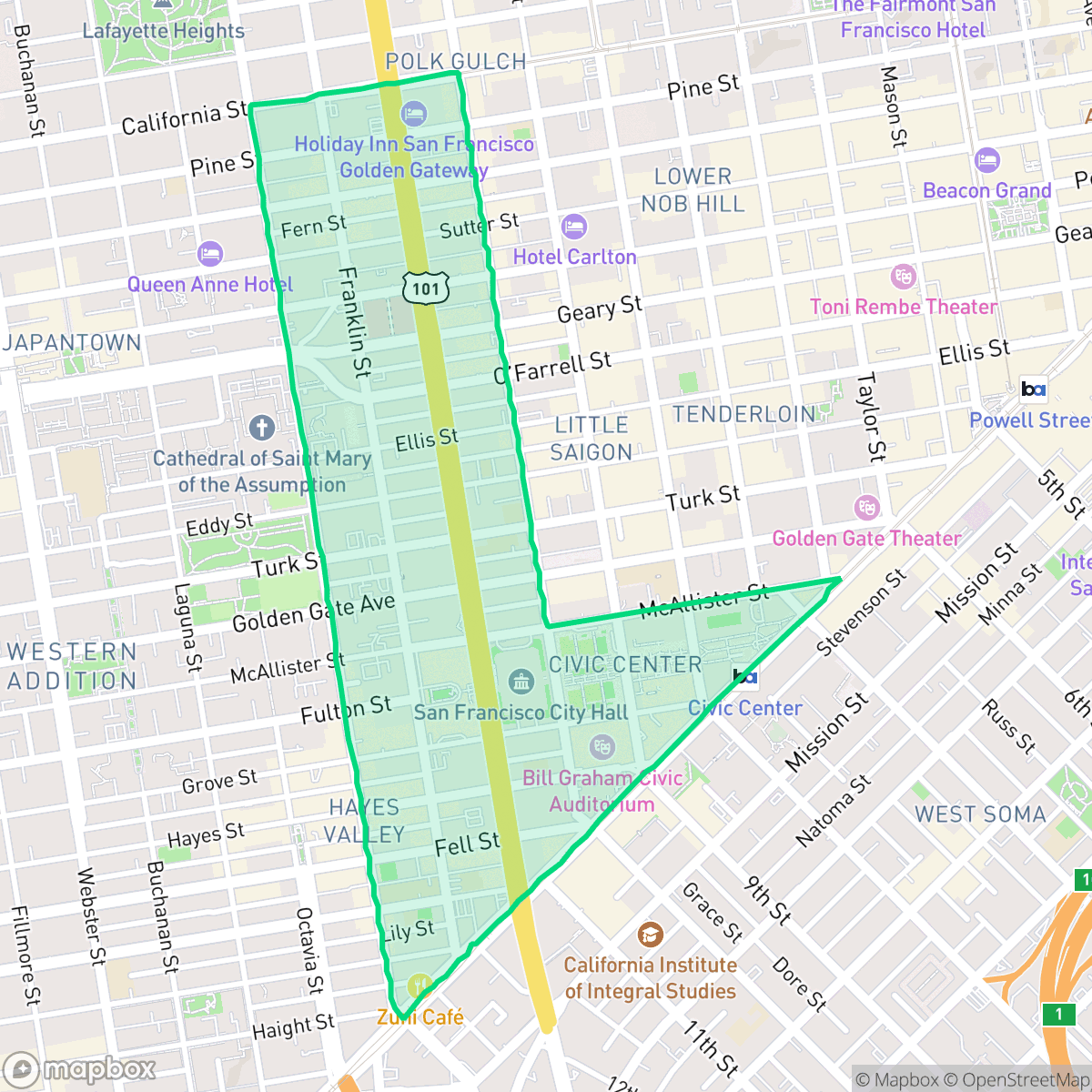
About Van Ness - Civic Center
San Francisco’s Van Ness - Civic Center neighborhood serves as the city’s cultural and governmental heart, defined by its monumental Beaux-Arts architecture. Conceived as a premier manifestation of the "City Beautiful" movement, the district was rebuilt after the 1906 earthquake destroyed the original 1871 City Hall. The grand, domed City Hall reopened in 1915, anchoring an impressive neoclassical ensemble that includes the War Memorial Opera House and the Veterans Building along Van Ness Avenue. This historic neighborhood has hosted pivotal global milestones, including the 1945 signing of the United Nations Charter at the Herbst Theatre and the 1951 Treaty of San Francisco. It also remains a historic epicenter for civic action, hosting landmark protests from anti-war rallies to early gay liberation marches and the 1979 White Night Riots.
The area functions as a dense, high-rise hub defined by its proximity to major transit corridors and a vibrant culinary scene, including local favorites like Aicha Moroccan Cuisine and Akira Japanese Restaurant. Its urban fabric consists of continuous, multi-story buildings that prioritize accessibility, earning a top score for pedestrian convenience. The neighborhood maintains a strong sense of activity, with a lively atmosphere that reflects its role as a central junction for city life and daily commerce. According to iHuus data, the district maintains a stable, high-quality air environment despite its intense urban density.
Living here involves significant trade-offs regarding acoustic comfort and personal space, as the high density results in shared walls and elevated noise levels from constant road traffic. While the area lacks the quiet seclusion of suburban environments, it is well-suited for professionals and urbanites who prioritize proximity to city services, public transit, and cultural landmarks over quietude. Residents also benefit from excellent health insurance coverage, though they should expect a lack of private outdoor amenities like pools or expansive yards in this tightly packed urban core.
Neighborhood Scores Across 15 Qualities
Buildings in this area are often wall-to-wall or separated by very narrow alleys, resulting in a level of density that is roughly in line with the city average. Shared walls and close quarters are common throughout this high-density urban grid, according to iHuus data.
Wide sidewalks and clear, marked pedestrian crossings are present on nearly every block within the dense street grid. This area offers a level of pedestrian accessibility that is slightly higher than the San Francisco average.
Architecture in this area consists primarily of high-density apartment blocks and large institutional buildings. This cityscape offers a typical urban profile that is slightly below the city average for visual variety.
Dense urban infrastructure and minimal street verges make pet outings more challenging here compared to the city average. While some residents benefit from nearby public parks, much of the neighborhood consists of a concrete-heavy environment with limited direct access to greenery.
High-rise buildings and continuous paved surfaces define this area, which is significantly more built-up than the typical San Francisco neighborhood. Minimal unbuilt ground or greenery is available according to iHuus data.
Constant movement and a dense concentration of dining and landmarks create a much more active atmosphere than the typical San Francisco district. This concrete-heavy area features significant commercial pull and a high density of social spots, according to iHuus data.
Frequent noise from nearby transit corridors and heavy traffic is common here. According to iHuus data, acoustic comfort is notably lower than the San Francisco average due to the proximity of major thoroughfares and rail lines.
Air quality remains consistently good with infrequent periods of elevated readings. According to iHuus data, the air quality in this area is slightly better than the San Francisco city average.
Large-scale manufacturing, warehouses, and heavy industrial hazards are entirely absent from this area. According to iHuus data, the neighborhood maintains a cleaner landscape than the San Francisco average by being composed purely of residential, commercial, and civic structures.
Health insurance coverage among residents is notably lower than the San Francisco average. According to iHuus data, a significant portion of the local population lacks comprehensive medical coverage.
Voting patterns and census indicators show a very strong liberal leaning that is consistent with the city average, according to iHuus data.
Residents will find a balanced age distribution ranging from young professionals to older adults. According to iHuus data, the age profile in this area is consistent with the broader San Francisco average.
Elevated flood hazards and wave action make this area significantly more vulnerable to coastal flooding than most of San Francisco. According to iHuus data, residents should anticipate much higher insurance costs due to its location in a high-hazard zone.
Address-Level Insights for Van Ness - Civic Center


iHuus Neighborhood Intelligence Insights
Get address-level neighborhood insights for Van Ness - Civic Center
- Street-level scores — see how individual blocks compare, not just neighborhood averages
- Micro-zone boundaries — identify quiet pockets, flood boundaries, and walkable clusters before you visit
- 15 dimensions in full — walkability, noise, air quality, school quality, insurance coverage, population age profile, urban/rural index, and more
- Boundary risk alerts — know if your address sits near a block boundary where scores drop, the kind of detail no listing will ever mention
- School insights — individual school ratings and insights, not just district-level data
- Compare before you commit — side-by-side data across neighborhoods, down to block precision
No credit card required
Compare with Any Neighborhood
| Dimension | Van Ness - Civic Center | Alamo Square |
|---|---|---|
| 🚶 Walkabilityavg 9.91 | ||
| 🔊 Acoustic Comfortavg 3.4 | ||
| 🤫 Privacy Indexavg 2.14 | ||
| 🎨 Visual Appealavg 6.26 | ||
| 🐕 Dog Friendlinessavg 6.55 | ||
| 🗺️ Urban-Rural Indexavg 4.07 | ||
| ✨ Neighborhood Vibeavg 6.4 | ||
| 🏥 Health Insurance Coverageavg 7.87 | ||
| 🌿 Air Qualityavg 7.78 | ||
| 🏭 Industrial Proximityavg 9.37 | ||
| 🌊 Flood Safetyavg 1.89 | ||
| 🗳️ Ideological Leanavg 9.92 | ||
| 👥 Population Age Profileavg 5.18 | ||
| 🔥 Fire Safetyavg 0.01 | ||
| 🏫 School Quality |
Van Ness - Civic Center Rankings
School Districts Serving Van Ness - Civic Center
School Insights for Van Ness - Civic Center
Below average outcomes; significant attendance and academic challenges.
School Insights
See what's really behind every school rating near Van Ness - Civic Center
- Individual school ratings — each school's own score with outcome context, not just a district average
- Enrollment & class size data — student-to-teacher ratio and how it compares to the state average
- Full demographics breakdown — ethnicity and gender composition for every school in the enrollment zone
- Every school in the district — all schools within the enrollment boundary ranked by rating, not just the closest one
- Grade levels & benchmarks — elementary through high school, with below/above state-average flags
No credit card required