Twin Peaks, San Francisco
Updated · 3,231 residents
Twin Peaks is defined by its dramatic elevation and expansive forest trails that provide a semi-rural escape from the dense urban core. Residents enjoy a quiet, residential atmosphere with highly accessible pedestrian pathways and panoramic views, though the neighborhood experiences some consistent traffic noise and faces specific flood risks.
Key Highlights
About Twin Peaks
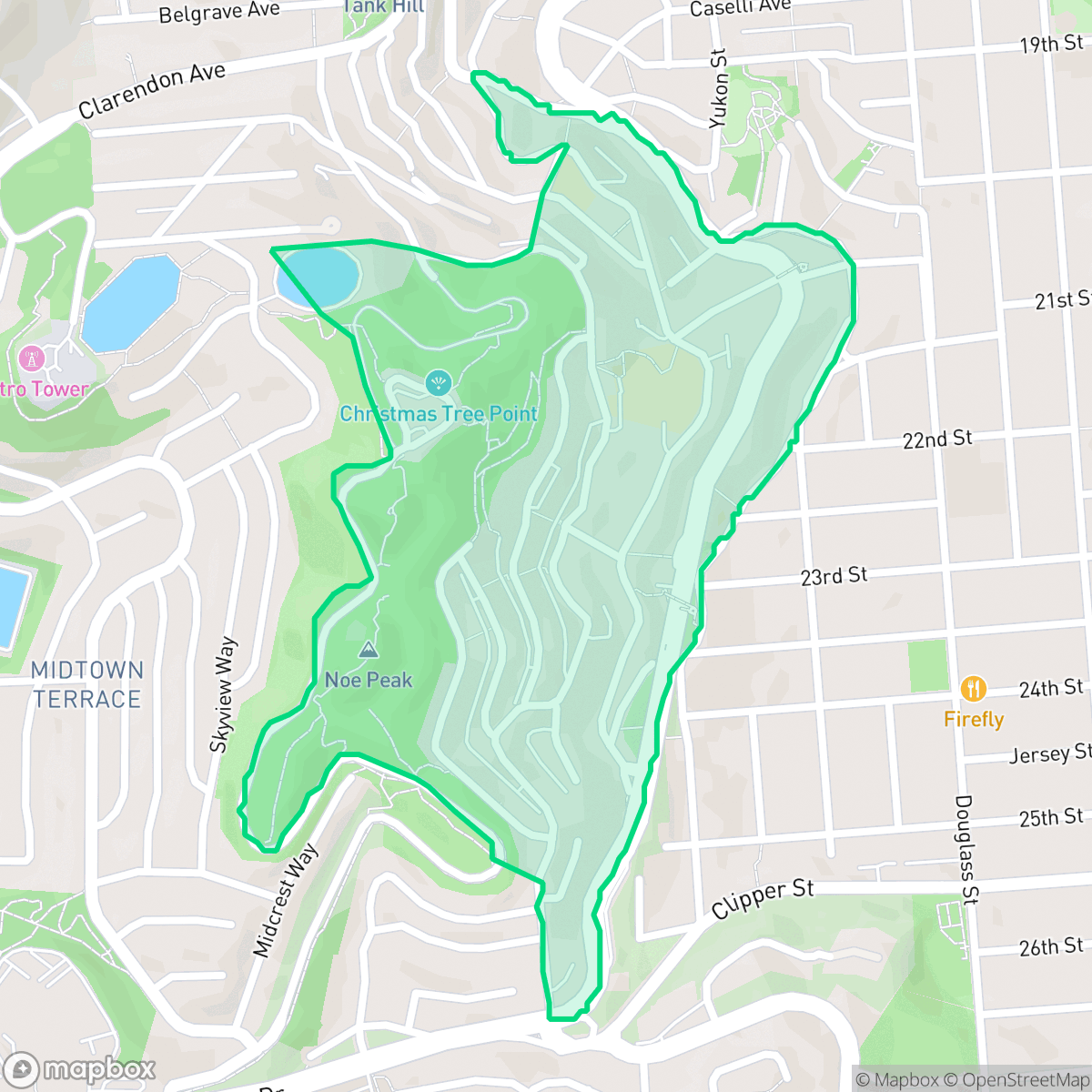
Historically known to the Ohlone as a lookout and to Spanish settlers as 'Los Pechos de la Chola' ('Breasts of the Indian Maiden'), the Twin Peaks area served as part of the Rancho San Miguel before transitioning into a residential neighborhood. The peaks, which act as a natural barrier against coastal fog, were famously the site of architect Daniel Burnham’s studio during his 1905 urban planning efforts for San Francisco. While the summits remain a protected 31-acre natural area—home to the endangered Mission Blue butterfly—the surrounding slopes underwent significant development in the 1960s. This era saw the controversial upzoning of the eastern slopes, leading to the construction of dense, multi-story apartment complexes like Vista Francisco, which distinguish the neighborhood's architecture from the single-family homes typical of neighboring hilltop communities.
The area offers a distinct living experience characterized by its hilly terrain and significant green canopy. Unlike many parts of San Francisco, the neighborhood is free from industrial activity, fostering a peaceful environment. The architecture is marked by premium, tiered hillside homes that maximize the unique geography. While the area is quiet and suburban in rhythm, it remains highly connected through a comprehensive network of sidewalks and forest trails, making it an ideal environment for those who prioritize outdoor access and scenic vistas.
Prospective residents should note that the neighborhood functions as a dense residential cluster with closely spaced homes, offering limited privacy in some sections. While the location provides excellent health insurance coverage and a stable, balanced demographic, it sits within a designated floodplain that may require insurance considerations. Families should also be aware that the local school district is currently experiencing significant financial and operational instability, which has impacted community confidence in the public education system.
Neighborhood Scores Across 15 Qualities
Residential structures are closely spaced with minimal separation between homes. This density is consistent with the broader San Francisco average, often featuring narrow setbacks or shared walls.
Continuous sidewalks and integrated forest trail systems provide excellent pedestrian connectivity throughout the area. This network of pathways and clear crossings is slightly more comprehensive than the San Francisco average, according to iHuus data.
Well-maintained hillside homes with complex architecture and tiered landscaping create a visually pleasing environment. According to iHuus data, the area features more premium residential aesthetics and spacious property layouts than the typical San Francisco neighborhood.
Extensive forest trails and interconnected green spaces like Mount Sutro Open Space provide much more area for walking dogs than the typical San Francisco neighborhood. Large wooded areas and accessible parks ensure residents have easy access to safe, traffic-free paths for pets.
Frequent open land and a significant forested canopy provide a more semi-rural feel than the dense urban core of San Francisco. This area features a mix of hilly open space and significant green buffers that are much more prevalent here than the city average.
Residential life here follows a calm, suburban rhythm with a lower level of activity than the San Francisco average. While various dining and social spots exist, they are primarily concentrated in specific pockets rather than being widely accessible on foot.
Steady traffic sounds from nearby busy streets are a regular presence, though the area remains significantly quieter than the San Francisco average according to iHuus data.
Air quality remains mostly clean with infrequent periods of elevated readings, though levels are slightly lower than the San Francisco average according to iHuus data.
Industrial facilities, warehouses, and heavy manufacturing sites are entirely absent from this area. This lack of heavy industry is even more pronounced here than in the rest of San Francisco, according to iHuus data.
Nearly all residents are covered by health insurance, which is significantly higher than the San Francisco average according to iHuus data.
Voting patterns and census indicators reflect a highly liberal political orientation, which is consistent with the broader San Francisco average according to iHuus data.
Residents live alongside a diverse mix of young professionals, families, and seniors. According to iHuus data, this age distribution is consistent with the broader San Francisco area.
Properties in this area are located within a designated floodplain, which may necessitate flood insurance. According to iHuus data, the risk level in Twin Peaks is slightly higher than the San Francisco average.
Address-Level Insights for Twin Peaks


iHuus Neighborhood Intelligence Insights
Get address-level neighborhood insights for Twin Peaks
- Street-level scores — see how individual blocks compare, not just neighborhood averages
- Micro-zone boundaries — identify quiet pockets, flood boundaries, and walkable clusters before you visit
- 15 dimensions in full — walkability, noise, air quality, school quality, insurance coverage, population age profile, urban/rural index, and more
- Boundary risk alerts — know if your address sits near a block boundary where scores drop, the kind of detail no listing will ever mention
- School insights — individual school ratings and insights, not just district-level data
- Compare before you commit — side-by-side data across neighborhoods, down to block precision
No credit card required
Compare with Any Neighborhood
| Dimension | Twin Peaks | Alamo Square |
|---|---|---|
| 🚶 Walkabilityavg 9.91 | ||
| 🔊 Acoustic Comfortavg 3.4 | ||
| 🤫 Privacy Indexavg 2.14 | ||
| 🎨 Visual Appealavg 6.26 | ||
| 🐕 Dog Friendlinessavg 6.55 | ||
| 🗺️ Urban-Rural Indexavg 4.07 | ||
| ✨ Neighborhood Vibeavg 6.4 | ||
| 🏥 Health Insurance Coverageavg 7.87 | ||
| 🌿 Air Qualityavg 7.78 | ||
| 🏭 Industrial Proximityavg 9.37 | ||
| 🌊 Flood Safetyavg 1.89 | ||
| 🗳️ Ideological Leanavg 9.92 | ||
| 👥 Population Age Profileavg 5.18 | ||
| 🔥 Fire Safetyavg 0.01 | ||
| 🏫 School Quality |
Twin Peaks Rankings
School Districts Serving Twin Peaks
School Insights for Twin Peaks
Below average outcomes; significant attendance and academic challenges.
School Insights
See what's really behind every school rating near Twin Peaks
- Individual school ratings — each school's own score with outcome context, not just a district average
- Enrollment & class size data — student-to-teacher ratio and how it compares to the state average
- Full demographics breakdown — ethnicity and gender composition for every school in the enrollment zone
- Every school in the district — all schools within the enrollment boundary ranked by rating, not just the closest one
- Grade levels & benchmarks — elementary through high school, with below/above state-average flags
No credit card required