Treasure Island, San Francisco
Updated · 1,628 residents
Treasure Island is a quiet, remote enclave in the San Francisco Bay known for its unique blend of industrial infrastructure and expansive waterfront views. While the area offers a highly walkable environment with a relaxed pace, residents should be prepared for significant noise levels and limited privacy due to the current development landscape.
Key Highlights
About Treasure Island
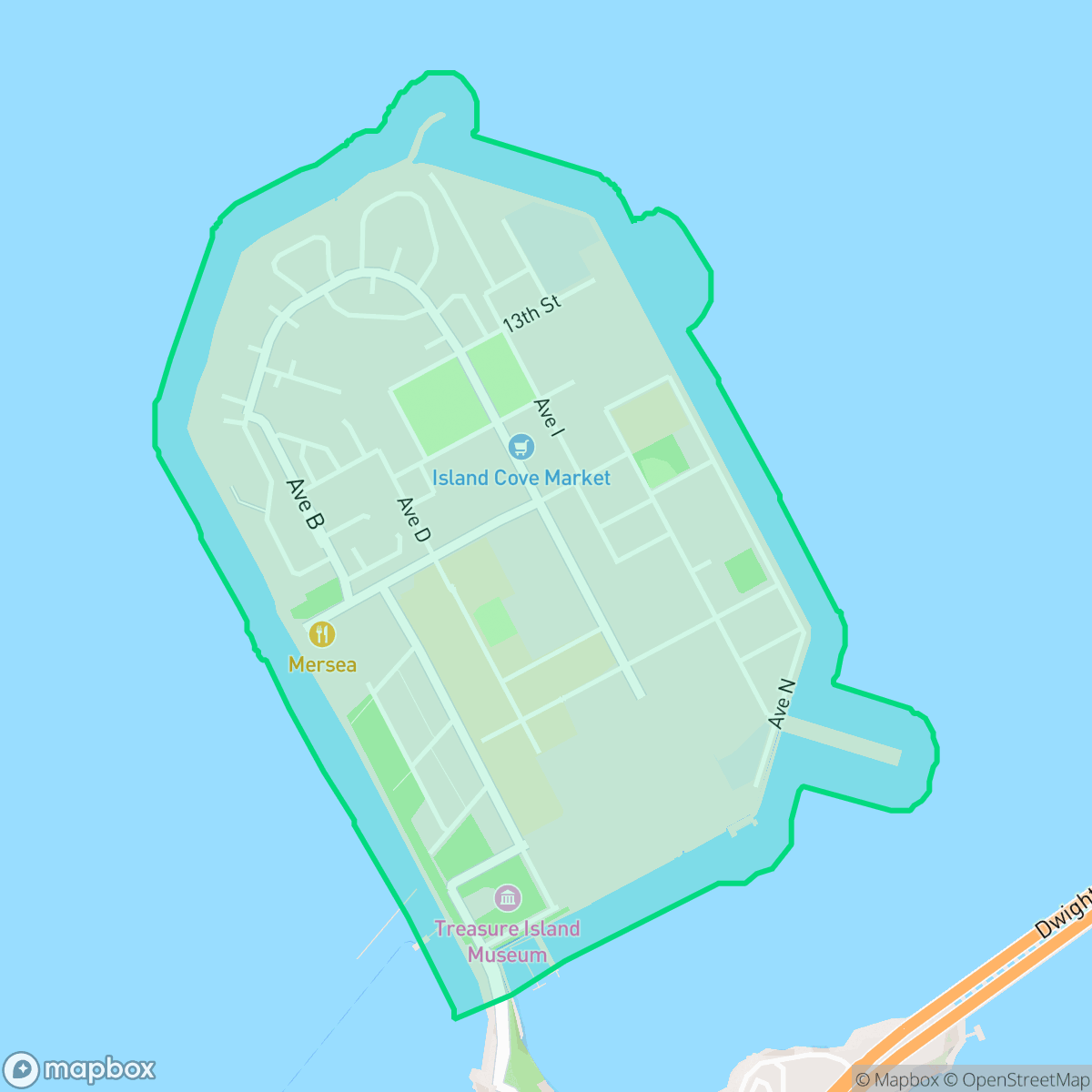
Treasure Island is a 400-acre artificial island in the San Francisco Bay, constructed by the Army Corps of Engineers from 1936 to 1937 using dredged bay mud. Built to host the 1939–1940 Golden Gate International Exposition, it was envisioned as a "Magic City" celebrating Pacific unity, showcasing Art Deco and Art Moderne architecture alongside the iconic 80-foot-tall statue of the goddess Pacifica. Originally planned to transition into a municipal airport for Pan American World Airways' "flying boats," the island was instead seized by the U.S. Navy in 1942. It served as a major military training and embarkation hub during World War II and the Cold War before closing in 1997. Today, the historic Art Moderne Administration Building (Building 1) remains a prominent landmark as the neighborhood undergoes a massive residential redevelopment.
The neighborhood functions as a distinct, low-density urban environment that balances multi-story residential blocks with light industrial zones and community sports fields. According to iHuus data, the area maintains a quiet, suburban coastline character where residents can access local dining destinations like Mersea and Treasure Island Wines. The atmosphere is defined by a steady rhythm of residential life mixed with active commercial daytime traffic, offering a stark contrast to the dense, high-energy corridors of downtown San Francisco.
Prospective residents should consider significant trade-offs regarding acoustic comfort and environmental safety. The area experiences high noise levels and faces challenges related to flood and fire safety, which are important factors for long-term planning. Additionally, local schools are part of the San Francisco Unified School District, which is currently navigating financial and operational difficulties. This neighborhood is best suited for those who prioritize a unique, waterfront living experience and a slower pace of life over proximity to traditional urban amenities.
Neighborhood Scores Across 15 Qualities
Residential spacing provides more separation between neighbors than is typical for San Francisco. According to iHuus data, the area features mixed density with some visible buffers between adjacent structures.
Pedestrian infrastructure is characterized by wide sidewalks and ample crossings, though ease of walking is slightly lower than the San Francisco average. According to iHuus data, the area features several pedestrian-priority zones that support local movement.
Standard residential structures with minimal greenery and simple architecture define the area. According to iHuus data, the visual landscape is slightly less varied than the San Francisco average.
Accessible green spaces and wide, low-traffic paths make this area more accommodating for pet owners than the San Francisco average, according to iHuus data.
Large industrial zones and warehouses dominate the landscape, creating a much more open and less densely vegetated environment than the typical San Francisco urban core. According to iHuus data, the area features significant amounts of open land and infrastructure rather than dense residential greenery.
Low density and significant open space create a tranquil environment, but the area lacks the vibrant activity found in most other San Francisco neighborhoods. According to iHuus data, the lack of local businesses and frequent social density makes this much quieter than the city average.
Constant auditory disturbances from heavy maritime and industrial activity make this area significantly noisier than the San Francisco average. Residents should expect persistent ambient sounds from nearby transit and logistics operations.
Air quality remains consistently high with infrequent periods of poor ventilation. Residents can expect air quality that is slightly better than the San Francisco average according to iHuus data.
Maritime logistics, warehouses, and a wastewater treatment plant contribute to significant industrial activity and truck traffic. This level of industrial proximity is notably higher than the San Francisco average, according to iHuus data.
Health insurance access among residents is lower than the San Francisco average, according to iHuus data. This indicates a higher proportion of uninsured individuals living in the area compared to most of the city.
Voting patterns and census indicators reflect a highly liberal leaning that is just slightly below the city average. According to iHuus data, the area maintains a political profile consistent with the broader San Francisco landscape.
Residents live alongside a varied demographic of young professionals, families, and seniors. This population distribution is slightly lower than the San Francisco average, according to iHuus data.
Address-Level Insights for Treasure Island


iHuus Neighborhood Intelligence Insights
Get address-level neighborhood insights for Treasure Island
- Street-level scores — see how individual blocks compare, not just neighborhood averages
- Micro-zone boundaries — identify quiet pockets, flood boundaries, and walkable clusters before you visit
- 15 dimensions in full — walkability, noise, air quality, school quality, insurance coverage, population age profile, urban/rural index, and more
- Boundary risk alerts — know if your address sits near a block boundary where scores drop, the kind of detail no listing will ever mention
- School insights — individual school ratings and insights, not just district-level data
- Compare before you commit — side-by-side data across neighborhoods, down to block precision
No credit card required
Compare with Any Neighborhood
| Dimension | Treasure Island | Alamo Square |
|---|---|---|
| 🚶 Walkabilityavg 9.91 | ||
| 🔊 Acoustic Comfortavg 3.4 | ||
| 🤫 Privacy Indexavg 2.14 | ||
| 🎨 Visual Appealavg 6.26 | ||
| 🐕 Dog Friendlinessavg 6.55 | ||
| 🗺️ Urban-Rural Indexavg 4.07 | ||
| ✨ Neighborhood Vibeavg 6.4 | ||
| 🏥 Health Insurance Coverageavg 7.87 | ||
| 🌿 Air Qualityavg 7.78 | ||
| 🏭 Industrial Proximityavg 9.37 | ||
| 🌊 Flood Safetyavg 1.89 | ||
| 🗳️ Ideological Leanavg 9.92 | ||
| 👥 Population Age Profileavg 5.18 | ||
| 🔥 Fire Safetyavg 0.01 | ||
| 🏫 School Quality |
Treasure Island Rankings
School Districts Serving Treasure Island
School Insights for Treasure Island
Below average outcomes; significant attendance and academic challenges.
School Insights
See what's really behind every school rating near Treasure Island
- Individual school ratings — each school's own score with outcome context, not just a district average
- Enrollment & class size data — student-to-teacher ratio and how it compares to the state average
- Full demographics breakdown — ethnicity and gender composition for every school in the enrollment zone
- Every school in the district — all schools within the enrollment boundary ranked by rating, not just the closest one
- Grade levels & benchmarks — elementary through high school, with below/above state-average flags
No credit card required