Tenderloin, San Francisco
Updated · 13,563 residents
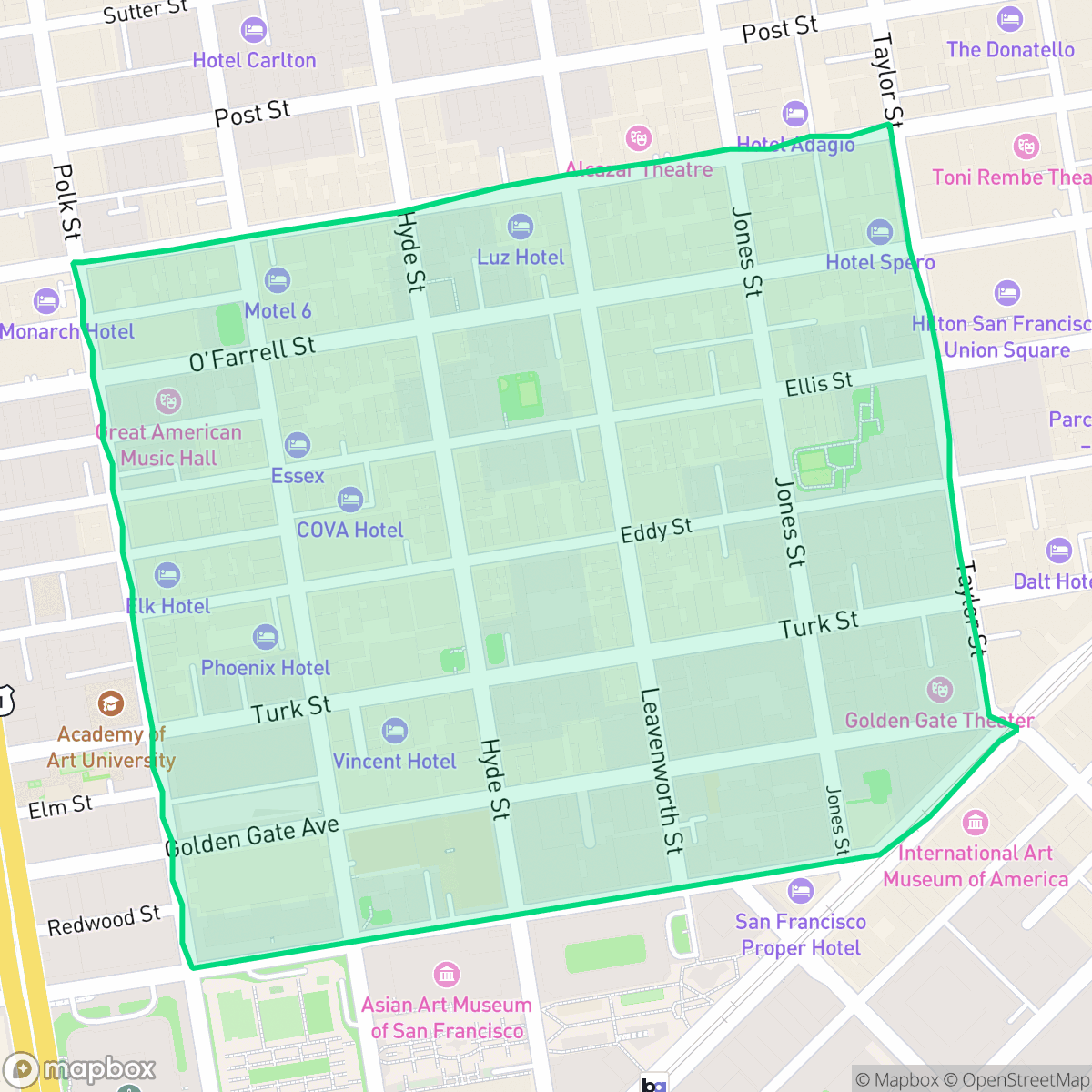
Located in the heart of San Francisco, the Tenderloin is a dense, highly walkable district defined by its historic architecture and vibrant urban energy. While residents benefit from exceptional access to city transit and diverse culinary options, the area is characterized by high-density living, limited green space, and significant road traffic noise.
Key Highlights
About Tenderloin
Originally known as St. Ann’s Valley in the mid-19th century, San Francisco's Tenderloin neighborhood was rebuilt with dense brick and concrete single-room occupancy (SRO) hotels and apartment buildings following the 1906 earthquake. This rebuilding era created the architecturally cohesive Uptown Tenderloin Historic District, which features notable landmarks like the Cadillac Hotel, the Moorish-Revival Alhambra Apartments, and the Alcazar Theatre. Informally named by the 1890s—likely referencing the lucrative police bribes associated with its vice district—the neighborhood evolved into a bustling hub of nightlife, jazz clubs, and speakeasies. The Tenderloin also became a pioneering center for LGBTQ+ activism, most famously marked by the 1966 Compton’s Cafeteria Riot, a historic transgender-led uprising against police harassment that predated New York's Stonewall riots.
This central neighborhood serves as a dense urban hub, featuring a grid of multi-story residential buildings and commercial storefronts. It stands out for its high level of walkability, allowing residents to navigate the city easily without a vehicle. Culinary destinations like Brenda's French Soul Food and Arsicault Bakery contribute to a lively atmosphere that reflects the district's diverse, progressive character.
Prospective residents should be aware of the trade-offs inherent in this high-density environment. The area experiences notable noise from road traffic and offers limited opportunities for pet owners due to a lack of dedicated green space. Given the compact nature of the housing and the urban intensity, it is best suited for those who prioritize proximity to city amenities and a central location over quiet, suburban-style living.
Neighborhood Scores Across 15 Qualities
Buildings are extremely close together with shared walls or very narrow alleys separating structures. This level of density is typical for the area and is roughly in line with the city average according to iHuus data.
Extremely easy to navigate on foot due to a dense grid of wide sidewalks and clearly marked pedestrian crossings. This level of walkability is slightly above the San Francisco average, providing safe and accessible routes across every block.
High-density architecture and flat rooftops characterize this area, offering a functional urban aesthetic that is slightly below the San Francisco average. According to iHuus data, the skyline consists of standard residential apartments and institutional buildings without private luxury amenities.
Dense concrete surroundings and narrow sidewalks make on-street walking difficult for pets. While nearby civic parks offer some relief, the immediate area has significantly less greenery than the San Francisco average according to iHuus data.
Hyper-dense building layouts and continuous multi-story structures characterize this area. This environment features significantly more pavement and fewer green spaces than the typical San Francisco neighborhood, according to iHuus data.
Frequent social activity and a high density of diverse dining options create a level of liveliness that is notably higher than the San Francisco average. According to iHuus data, this district offers an intense urban atmosphere centered around varied culinary destinations and local landmarks.
Persistent ambient noise from nearby transit corridors and heavy traffic is common here. According to iHuus data, acoustic comfort levels are notably lower than the San Francisco average.
Air quality remains consistently high with infrequent periods of poor circulation. According to iHuus data, the air quality in this area is slightly better than the San Francisco average.
Industrial activity and heavy manufacturing are absent from this area. According to iHuus data, the neighborhood consists entirely of residential and commercial structures, which is slightly more removed from industrial zones than the San Francisco average.
Health insurance coverage among residents is significantly lower than the San Francisco average, according to iHuus data. This disparity indicates a high proportion of the local population lacks employer-sponsored or private medical coverage.
Voting patterns and census indicators reflect a deeply liberal political environment that aligns with the broader San Francisco average.
Residents live alongside a diverse range of age groups, including young adults, families, and seniors. This demographic spread is roughly in line with the average found across San Francisco.
Address-Level Insights for Tenderloin


iHuus Neighborhood Intelligence Insights
Get address-level neighborhood insights for Tenderloin
- Street-level scores — see how individual blocks compare, not just neighborhood averages
- Micro-zone boundaries — identify quiet pockets, flood boundaries, and walkable clusters before you visit
- 15 dimensions in full — walkability, noise, air quality, school quality, insurance coverage, population age profile, urban/rural index, and more
- Boundary risk alerts — know if your address sits near a block boundary where scores drop, the kind of detail no listing will ever mention
- School insights — individual school ratings and insights, not just district-level data
- Compare before you commit — side-by-side data across neighborhoods, down to block precision
No credit card required
Compare with Any Neighborhood
| Dimension | Tenderloin | Alamo Square |
|---|---|---|
| 🚶 Walkabilityavg 9.91 | ||
| 🔊 Acoustic Comfortavg 3.4 | ||
| 🤫 Privacy Indexavg 2.14 | ||
| 🎨 Visual Appealavg 6.26 | ||
| 🐕 Dog Friendlinessavg 6.55 | ||
| 🗺️ Urban-Rural Indexavg 4.07 | ||
| ✨ Neighborhood Vibeavg 6.4 | ||
| 🏥 Health Insurance Coverageavg 7.87 | ||
| 🌿 Air Qualityavg 7.78 | ||
| 🏭 Industrial Proximityavg 9.37 | ||
| 🌊 Flood Safetyavg 1.89 | ||
| 🗳️ Ideological Leanavg 9.92 | ||
| 👥 Population Age Profileavg 5.18 | ||
| 🔥 Fire Safetyavg 0.01 | ||
| 🏫 School Quality |
Tenderloin Rankings
School Districts Serving Tenderloin
School Insights for Tenderloin
Below average outcomes; significant attendance and academic challenges.
School Insights
See what's really behind every school rating near Tenderloin
- Individual school ratings — each school's own score with outcome context, not just a district average
- Enrollment & class size data — student-to-teacher ratio and how it compares to the state average
- Full demographics breakdown — ethnicity and gender composition for every school in the enrollment zone
- Every school in the district — all schools within the enrollment boundary ranked by rating, not just the closest one
- Grade levels & benchmarks — elementary through high school, with below/above state-average flags
No credit card required