Telegraph Hill, San Francisco
Updated · 6,685 residents
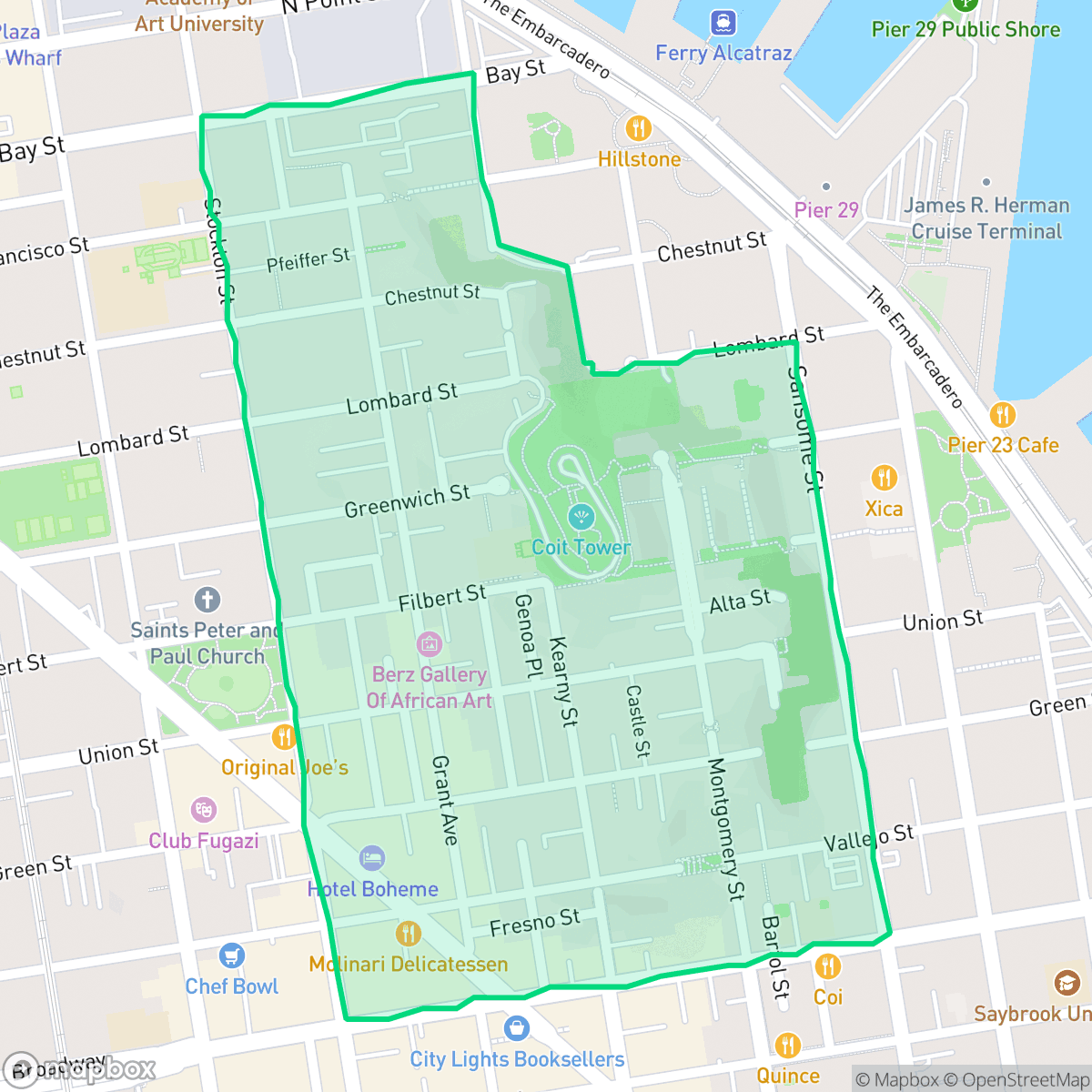
Telegraph Hill is a dense, highly walkable neighborhood in San Francisco defined by its steep, pedestrian-only stairways and proximity to the waterfront. While the area offers excellent access to diverse dining and social hubs, residents experience limited privacy due to the tight, row-style housing and moderate noise levels from road traffic.
Key Highlights
About Telegraph Hill
Originally known as Loma Alta, Telegraph Hill was renamed after a semaphore signal station was erected in 1849, followed by California’s first marine telegraph in 1853. During the Gold Rush, its eastern cliffs were heavily quarried for ship ballast and waterfront fill, creating a rugged topography bypassed by early transit. This isolation fostered a close-knit community of waterfront workers who built modest Gothic Revival cottages, leaving the neighborhood with San Francisco's largest concentration of pre-1870 structures. Accessible via the lush, pedestrian-only Filbert and Greenwich Steps, the hill evolved to feature iconic 1930s modernist architecture, including Richard Neutra’s Kahn House and the Streamline Moderne Malloch Building. At its apex in Pioneer Park stands the Art Deco Coit Tower, completed in 1933.
The neighborhood functions as a purely residential and light commercial enclave, characterized by a dense urban fabric with multi-story buildings and a lack of open soil. Its location provides immediate access to the waterfront and major city transit, making it an exceptionally walkable environment. Residents benefit from high air quality and a lack of industrial hazards, contributing to a stable atmosphere despite the surrounding city density. The area maintains a lively social scene, supported by popular local cafes and a variety of dining options ranging from sushi to casual pizza spots.
Prospective residents should note that the area features minimal private space, as buildings are constructed closely together with shared walls. While the neighborhood is well-connected, the hilly terrain and specific safety considerations regarding flood and fire risks are important factors to consider. It is best suited for those who prioritize urban convenience and pedestrian access over expansive private living quarters, as the high-density layout is designed for those who spend much of their time engaging with the surrounding city.
Neighborhood Scores Across 15 Qualities
Buildings are positioned in very close proximity with minimal separation between structures. This level of density is similar to the city average, where many units feature shared walls or narrow gaps between residences.
Extensive sidewalk networks and waterfront promenades make most daily trips easy to complete on foot. This neighborhood offers a level of walkability that is slightly above the San Francisco average according to iHuus data.
Visual aesthetics range from high-end waterfront luxury with rooftop amenities to dense, standard urban housing. This level of visual appeal is roughly consistent with the San Francisco average according to iHuus data.
Access to pet-friendly areas is primarily centered around Washington Square Park and the waterfront piers. While these provide essential walking paths, the overall availability of open green space is slightly below the San Francisco average.
Heavy gray infrastructure and multi-story buildings dominate the landscape with very little open greenery or soil. This area is significantly more built-up than the San Francisco average, according to iHuus data.
Local social hubs and dining options provide a steady presence near the waterfront, though the overall level of activity sits slightly below the San Francisco average. According to iHuus data, the area features a mix of coastal dining and light industrial zones that offer a quieter atmosphere than more central city districts.
Local traffic from nearby busy thoroughfares creates a persistent ambient hum. This level of acoustic activity is higher than the city average, according to iHuus data.
Air quality is consistently good with rare instances of elevated readings. According to iHuus data, the atmosphere in this area remains slightly cleaner than the San Francisco average.
Heavy industrial sites and warehouses are absent from this area, providing a residential atmosphere similar to the broader San Francisco average. Residents will find no large-scale manufacturing or hazardous industrial facilities within the neighborhood boundaries.
Health insurance access is significantly lower than the San Francisco average, according to iHuus data. Residents may face challenges accessing medical services without private or supplemental coverage.
Voting patterns and census indicators show a deeply liberal political landscape that is consistent with the broader San Francisco average, according to iHuus data.
Residents live alongside a balanced spread of young adults, families, and older populations. This demographic variety is notably more diverse than the city average, according to iHuus data.
Properties in this area are located within a designated floodplain, making flood insurance a common requirement for residents. According to iHuus data, the risk level in Telegraph Hill is slightly higher than the San Francisco average.
Address-Level Insights for Telegraph Hill


iHuus Neighborhood Intelligence Insights
Get address-level neighborhood insights for Telegraph Hill
- Street-level scores — see how individual blocks compare, not just neighborhood averages
- Micro-zone boundaries — identify quiet pockets, flood boundaries, and walkable clusters before you visit
- 15 dimensions in full — walkability, noise, air quality, school quality, insurance coverage, population age profile, urban/rural index, and more
- Boundary risk alerts — know if your address sits near a block boundary where scores drop, the kind of detail no listing will ever mention
- School insights — individual school ratings and insights, not just district-level data
- Compare before you commit — side-by-side data across neighborhoods, down to block precision
No credit card required
Compare with Any Neighborhood
| Dimension | Telegraph Hill | Alamo Square |
|---|---|---|
| 🚶 Walkabilityavg 9.91 | ||
| 🔊 Acoustic Comfortavg 3.4 | ||
| 🤫 Privacy Indexavg 2.14 | ||
| 🎨 Visual Appealavg 6.26 | ||
| 🐕 Dog Friendlinessavg 6.55 | ||
| 🗺️ Urban-Rural Indexavg 4.07 | ||
| ✨ Neighborhood Vibeavg 6.4 | ||
| 🏥 Health Insurance Coverageavg 7.87 | ||
| 🌿 Air Qualityavg 7.78 | ||
| 🏭 Industrial Proximityavg 9.37 | ||
| 🌊 Flood Safetyavg 1.89 | ||
| 🗳️ Ideological Leanavg 9.92 | ||
| 👥 Population Age Profileavg 5.18 | ||
| 🔥 Fire Safetyavg 0.01 | ||
| 🏫 School Quality |
Telegraph Hill Rankings
School Districts Serving Telegraph Hill
School Insights for Telegraph Hill
Below average outcomes; significant attendance and academic challenges.
School Insights
See what's really behind every school rating near Telegraph Hill
- Individual school ratings — each school's own score with outcome context, not just a district average
- Enrollment & class size data — student-to-teacher ratio and how it compares to the state average
- Full demographics breakdown — ethnicity and gender composition for every school in the enrollment zone
- Every school in the district — all schools within the enrollment boundary ranked by rating, not just the closest one
- Grade levels & benchmarks — elementary through high school, with below/above state-average flags
No credit card required