Sunnyside, San Francisco
Updated · 6,114 residents
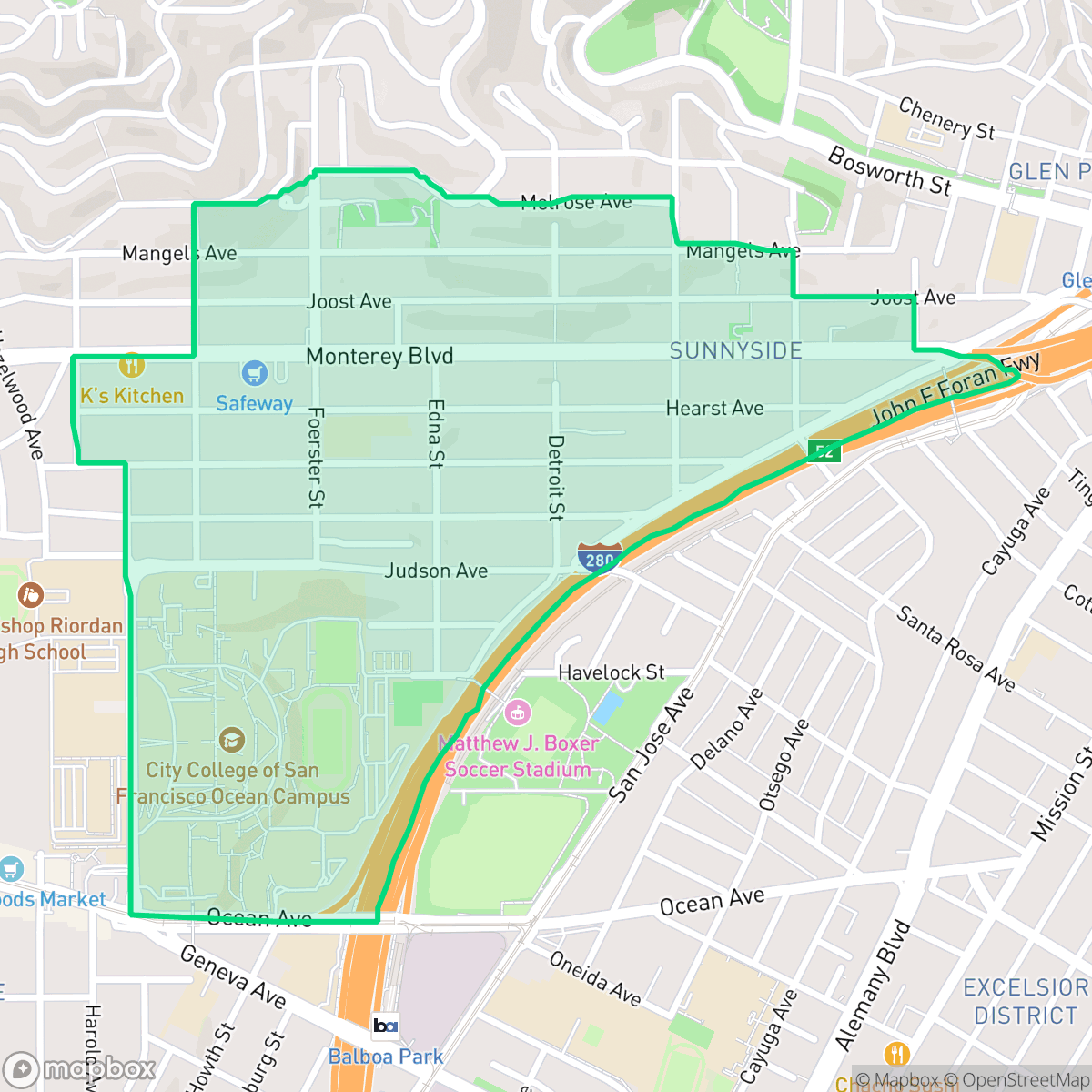
Sunnyside is a highly walkable, dense residential neighborhood defined by its mix of historic cottages and mid-century homes. While it offers excellent access to local amenities and parks, the area is notably loud due to nearby highway traffic and features limited privacy between tightly packed residences.
Key Highlights
About Sunnyside
Laid out in 1891 by the Sunnyside Land Company, the south-central San Francisco neighborhood of Sunnyside was carved from the former dairy pastures of Rancho San Miguel. To attract buyers to the remote tract, company president Behrend Joost established San Francisco’s first electric streetcar line, the San Francisco and San Mateo Electric Railway, in 1892. Though initially slow to grow, the neighborhood expanded significantly after the 1906 earthquake and during the 1920s building boom. Today, Sunnyside features a diverse architectural mix of Victorian cottages, 1920s stucco homes, and mid-century duplexes. The neighborhood’s most prominent landmark is the Sunnyside Conservatory on Monterey Boulevard (originally Sunnyside Avenue), an octagonal glasshouse built in 1902 by inventor William Augustus Merralls and designated as San Francisco Landmark #78.
The neighborhood functions as a dense, urban community with a strong local identity and a high level of walkability. Residents enjoy convenient access to local staples such as the Roxie Food Center, Tasty Coffee, and Monterey Pizza, alongside open recreational spaces like Balboa Park. According to iHuus data, the area maintains a high standard for air quality and health insurance coverage, contributing to a stable environment for its diverse population. The architectural landscape remains varied, reflecting the area's development history through a blend of Victorian, stucco, and mid-century structures.
Prospective residents should consider certain trade-offs, particularly regarding acoustic comfort, as the proximity to major highway infrastructure results in elevated noise levels. The housing layout, characterized by dense row-style construction, offers minimal privacy and very small private outdoor spaces. While the broader San Francisco Unified School District faces significant fiscal and operational challenges, Sunnyside Elementary stands out as a high-performing local option. This neighborhood is best suited for those who prioritize pedestrian access to daily services and community-oriented spaces over quietude or expansive private yards.
Neighborhood Scores Across 15 Qualities
Closely spaced homes and narrow gaps between structures create a sense of density similar to the rest of San Francisco. According to iHuus data, many properties feature minimal setbacks or shared walls, which reduces visual and acoustic separation between neighbors.
Continuous sidewalk networks and well-marked crosswalks make navigating the area easy on foot. While the freeway creates some fragmentation, the neighborhood remains nearly as walkable as the rest of San Francisco according to iHuus data.
Residential lots feature consistent, boxy rooflines and small, well-kept yards. This level of visual variety is slightly below the San Francisco average according to iHuus data.
Proximity to Balboa Park and various athletic fields provides ample space for pets; according to iHuus data, this level of access is slightly above the city average.
Residential streets and green spaces are distributed in roughly equal measure, making this area more suburban than the San Francisco average. While some pockets feature dense urban housing and major highway infrastructure, much of the neighborhood contains a significant tree canopy alongside low-rise residential structures.
Social activity is higher than the city average, characterized by a noticeable concentration of diverse dining, cafes, and community hubs. Many blocks offer a balanced mix of mid-rise urban density and accessible green space, according to iHuus data.
Frequent noise from nearby transit corridors and major roadways makes this area significantly noisier than the San Francisco average. According to iHuus data, proximity to busy thoroughfares and rail lines contributes to a less quiet residential environment.
Air quality remains consistently high with rare instances of elevated readings. According to iHuus data, the air in Sunnyside is slightly cleaner than the San Francisco average.
Industrial activity and large warehouses are entirely absent from this area, making it more residential than the San Francisco average. According to iHuus data, the land use is limited to residential, recreational, and transport infrastructure without heavy industrial hazards.
Health insurance access is very high among Sunnyside residents, significantly outpacing the San Francisco average according to iHuus data.
Voting patterns and census indicators show a deeply liberal political leaning that is consistent with the broader San Francisco area, according to iHuus data.
A balanced range of young adults, families, and seniors live here, mirroring the general demographic spread found across San Francisco. According to iHuus data, this creates a multi-generational community with a stable residential character.
Flood risk is notably higher than the San Francisco average due to the area's location within a designated floodplain. Residents may find that flood insurance is typically required for properties in this neighborhood, according to iHuus data.
Address-Level Insights for Sunnyside


iHuus Neighborhood Intelligence Insights
Get address-level neighborhood insights for Sunnyside
- Street-level scores — see how individual blocks compare, not just neighborhood averages
- Micro-zone boundaries — identify quiet pockets, flood boundaries, and walkable clusters before you visit
- 15 dimensions in full — walkability, noise, air quality, school quality, insurance coverage, population age profile, urban/rural index, and more
- Boundary risk alerts — know if your address sits near a block boundary where scores drop, the kind of detail no listing will ever mention
- School insights — individual school ratings and insights, not just district-level data
- Compare before you commit — side-by-side data across neighborhoods, down to block precision
No credit card required
Compare with Any Neighborhood
| Dimension | Sunnyside | Alamo Square |
|---|---|---|
| 🚶 Walkabilityavg 9.91 | ||
| 🔊 Acoustic Comfortavg 3.4 | ||
| 🤫 Privacy Indexavg 2.14 | ||
| 🎨 Visual Appealavg 6.26 | ||
| 🐕 Dog Friendlinessavg 6.55 | ||
| 🗺️ Urban-Rural Indexavg 4.07 | ||
| ✨ Neighborhood Vibeavg 6.4 | ||
| 🏥 Health Insurance Coverageavg 7.87 | ||
| 🌿 Air Qualityavg 7.78 | ||
| 🏭 Industrial Proximityavg 9.37 | ||
| 🌊 Flood Safetyavg 1.89 | ||
| 🗳️ Ideological Leanavg 9.92 | ||
| 👥 Population Age Profileavg 5.18 | ||
| 🔥 Fire Safetyavg 0.01 | ||
| 🏫 School Quality |
Sunnyside Rankings
School Districts Serving Sunnyside
School Insights for Sunnyside
Below average outcomes; significant attendance and academic challenges.
School Insights
See what's really behind every school rating near Sunnyside
- Individual school ratings — each school's own score with outcome context, not just a district average
- Enrollment & class size data — student-to-teacher ratio and how it compares to the state average
- Full demographics breakdown — ethnicity and gender composition for every school in the enrollment zone
- Every school in the district — all schools within the enrollment boundary ranked by rating, not just the closest one
- Grade levels & benchmarks — elementary through high school, with below/above state-average flags
No credit card required