St. Francis Wood, San Francisco
Updated · 2,049 residents
St. Francis Wood is a tranquil, highly walkable residential enclave defined by its mature landscaping and grand, period-revival architecture. While the area offers a serene suburban atmosphere with excellent pedestrian infrastructure, it maintains a quiet profile with limited commercial activity within immediate walking distance.
Key Highlights
About St. Francis Wood
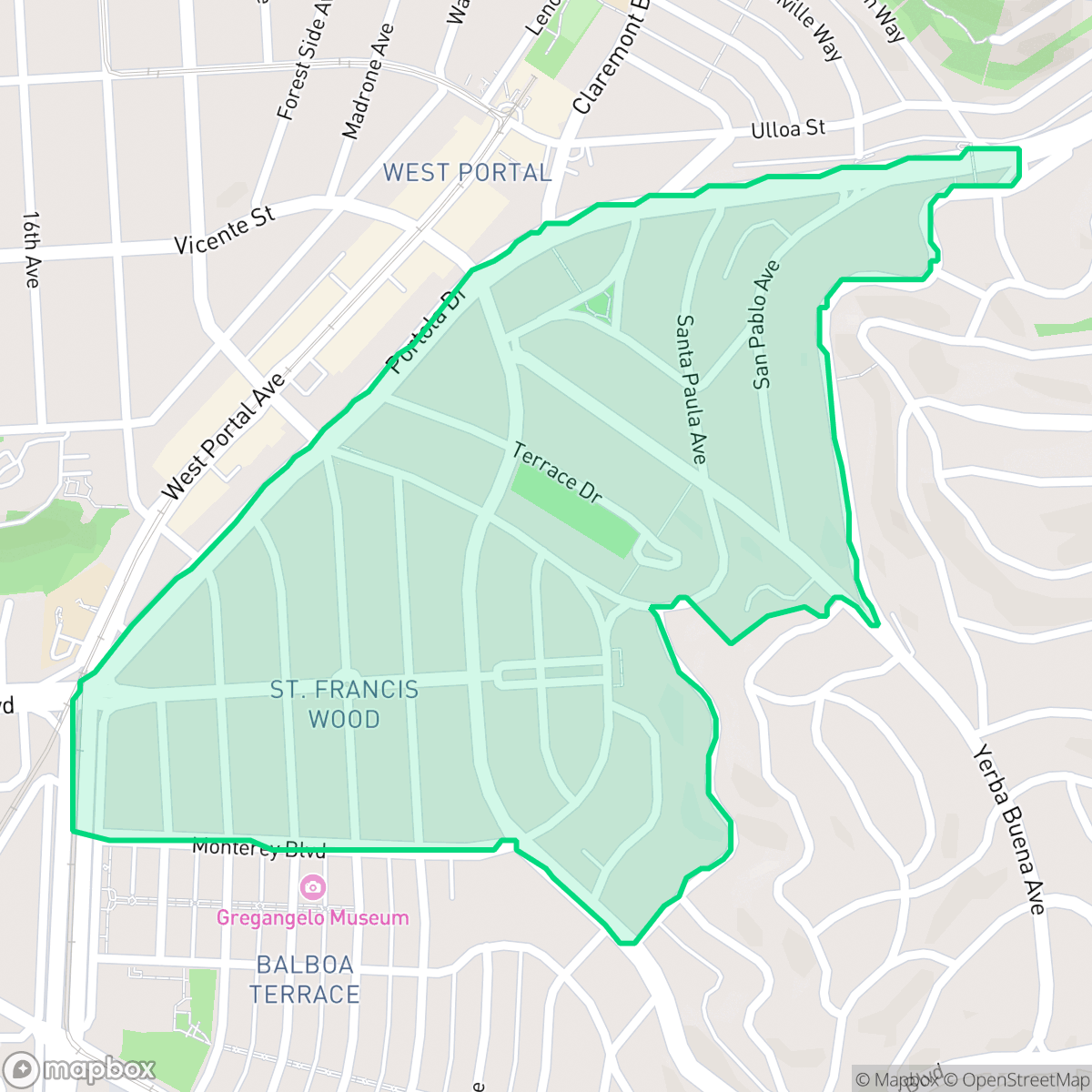
Established in 1912 on former Adolph Sutro estate land, St. Francis Wood is a premier San Francisco "residence park" reflecting the City Beautiful movement. Developed by the Mason-McDuffie Company, the neighborhood features a curvilinear street plan designed by the renowned Olmsted Brothers to follow the area’s natural topography. John Galen Howard, the first supervising architect, designed the Beaux-Arts entrance gates and central fountain along St. Francis Boulevard, while Henry Gutterson designed the monumental upper fountain. Prominent architects, including Julia Morgan and Bernard Maybeck, designed its Period Revival homes. Notably, the development pioneered underground utility lines but also initially enforced racially restrictive covenants until the 1960s. Recognized for its preserved architectural heritage and Italian Renaissance-inspired gardens, St. Francis Wood was added to the National Register of Historic Places in 2022.
This neighborhood functions as a quiet, affluent residential pocket characterized by its curvilinear layout and expansive, well-maintained properties. According to iHuus data, the area provides a high level of visual appeal, supported by mature greenery and consistent sidewalk coverage that makes the environment exceptionally easy to navigate on foot. Residents benefit from a clean, residential-focused atmosphere that is entirely free from industrial interference, creating a stable environment for those seeking a retreat from the dense urban core of San Francisco. Prospective residents should consider that the quiet nature of the neighborhood translates to a lower level of daily liveliness, as local dining and retail options are sparse. While the streets are pedestrian-friendly, the acoustic environment is influenced by road traffic, which averages around 59 decibels. Additionally, families should be aware that the local school district is currently navigating significant financial and operational challenges. The area is best suited for those who prioritize architectural beauty, walkable streets, and a suburban feel over immediate proximity to nightlife or commercial hubs.
Neighborhood Scores Across 15 Qualities
Housing density is higher than the San Francisco average, featuring a mix of detached lots and closely spaced structures. Residents may find narrow side yards and minimal buffers between some neighboring homes.
Pedestrian infrastructure is exceptionally well-developed, featuring continuous sidewalks on both sides of most streets and clear crosswalks. This level of connectivity is slightly above the San Francisco average, according to iHuus data.
Large, well-maintained homes and mature landscaping provide a more scenic environment than the San Francisco average. Many properties feature expansive lots and architectural variety, according to iHuus data.
Tree-lined streets and proximity to a large forested park offer excellent walking opportunities for pets. According to iHuus data, the neighborhood provides slightly more accessible green space and wider paths for dogs than the city average.
Lush residential pockets and significant green patches provide a more open, semi-rural feel than the typical dense urban environment found elsewhere in San Francisco. This landscape features a low-rise layout where landscaped yards and greenery are much more prevalent than the city average.
Residential streets and green spaces provide a serene setting with occasional pockets of activity near local cafes and eateries. This area is slightly less active than the San Francisco average, as most businesses and amenities are concentrated in specific clusters rather than throughout the entire neighborhood.
Frequent noise from nearby transit corridors and major roadways is common here. According to iHuus data, acoustic levels in this area are typical of the broader San Francisco average.
Air quality remains consistently high with rare instances of elevated readings. Levels in this area are slightly better than the San Francisco average, according to iHuus data.
Industrial activity and warehouses are entirely absent from this area. According to iHuus data, the neighborhood lacks any heavy industry or hazardous facilities, making it even more secluded from industrial zones than the San Francisco average.
Health insurance enrollment is nearly universal among residents, significantly outpacing the San Francisco average according to iHuus data.
Voting patterns and census indicators reflect a strongly liberal political leaning, which is consistent with the broader San Francisco average according to iHuus data.
Residents live alongside a balanced mix of young adults, families, and older individuals. According to iHuus data, this age distribution is slightly more varied than the average found across San Francisco.
Properties in this area are situated within a designated floodplain, which carries a higher risk of flooding than the San Francisco average. According to iHuus data, residents may find that flood insurance is typically a requirement for homes in this zone.
Address-Level Insights for St. Francis Wood


iHuus Neighborhood Intelligence Insights
Get address-level neighborhood insights for St. Francis Wood
- Street-level scores — see how individual blocks compare, not just neighborhood averages
- Micro-zone boundaries — identify quiet pockets, flood boundaries, and walkable clusters before you visit
- 15 dimensions in full — walkability, noise, air quality, school quality, insurance coverage, population age profile, urban/rural index, and more
- Boundary risk alerts — know if your address sits near a block boundary where scores drop, the kind of detail no listing will ever mention
- School insights — individual school ratings and insights, not just district-level data
- Compare before you commit — side-by-side data across neighborhoods, down to block precision
No credit card required
Compare with Any Neighborhood
| Dimension | St. Francis Wood | Alamo Square |
|---|---|---|
| 🚶 Walkabilityavg 9.91 | ||
| 🔊 Acoustic Comfortavg 3.4 | ||
| 🤫 Privacy Indexavg 2.14 | ||
| 🎨 Visual Appealavg 6.26 | ||
| 🐕 Dog Friendlinessavg 6.55 | ||
| 🗺️ Urban-Rural Indexavg 4.07 | ||
| ✨ Neighborhood Vibeavg 6.4 | ||
| 🏥 Health Insurance Coverageavg 7.87 | ||
| 🌿 Air Qualityavg 7.78 | ||
| 🏭 Industrial Proximityavg 9.37 | ||
| 🌊 Flood Safetyavg 1.89 | ||
| 🗳️ Ideological Leanavg 9.92 | ||
| 👥 Population Age Profileavg 5.18 | ||
| 🔥 Fire Safetyavg 0.01 | ||
| 🏫 School Quality |
St. Francis Wood Rankings
School Districts Serving St. Francis Wood
School Insights for St. Francis Wood
Below average outcomes; significant attendance and academic challenges.
School Insights
See what's really behind every school rating near St. Francis Wood
- Individual school ratings — each school's own score with outcome context, not just a district average
- Enrollment & class size data — student-to-teacher ratio and how it compares to the state average
- Full demographics breakdown — ethnicity and gender composition for every school in the enrollment zone
- Every school in the district — all schools within the enrollment boundary ranked by rating, not just the closest one
- Grade levels & benchmarks — elementary through high school, with below/above state-average flags
No credit card required