South of Market, San Francisco
Updated · 26,062 residents
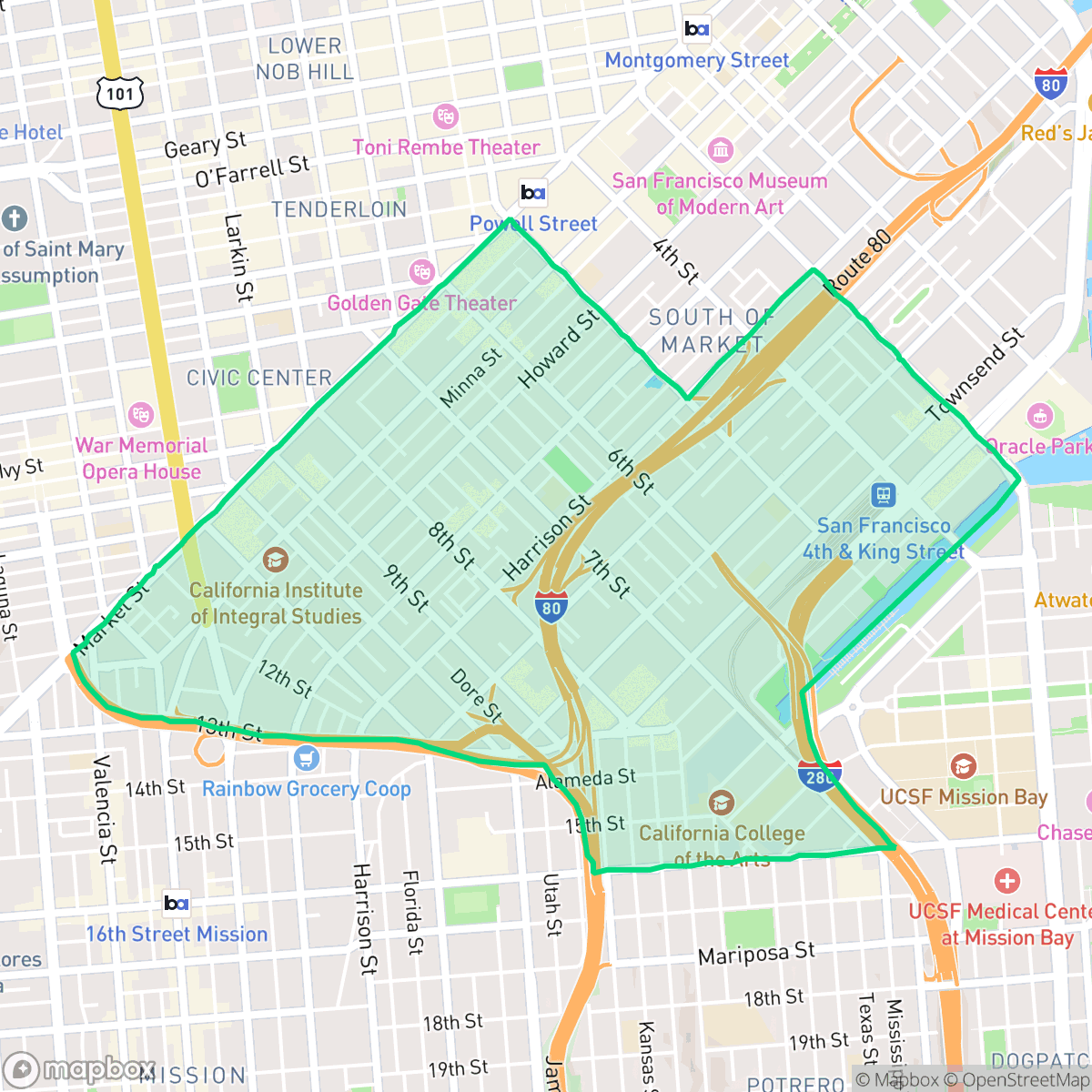
South of Market is a high-energy urban core defined by exceptional walkability and a dense, concrete-heavy landscape. While it offers a vibrant array of dining and social hubs, residents should anticipate significant noise from road traffic and limited privacy due to the area's high-density development.
Key Highlights
About South of Market
Originally settled during the Gold Rush as a tent city called "Happy Valley," San Francisco’s South of Market (SoMa) neighborhood was historically known as "South of the Slot," referencing the cable car lines along Market Street that physically and socially divided the working-class district from the wealthier north. While early enclaves like Rincon Hill and South Park housed the elite, a late 19th-century boom in heavy industry, shipping, and rail lines transformed the area into a dense, blue-collar hub of warehouses, iron foundries, and immigrant communities. The 1906 earthquake devastated the neighborhood, leaving only a few landmarks like the Old Mint. Rebuilt with light industrial warehouses, SoMa underwent massive mid-century urban renewal, eventually evolving into a cultural hub for the LGBTQ+ and leather communities, the Filipino diaspora (SOMA Pilipinas), and the late-1990s dot-com boom.
The neighborhood serves as a primary urban hub characterized by its dense grid of high-rise buildings, commercial centers, and proximity to major freeway interchanges. It maintains a high level of activity, featuring a diverse selection of restaurants, cafes, and community spaces that contribute to a lively, fast-paced atmosphere. According to iHuus data, the area is exceptionally accessible to pedestrians, making it a convenient base for those who prioritize proximity to city services and nightlife over quiet, suburban-style living.
Residents often navigate significant trade-offs, particularly regarding acoustic comfort and access to nature. The environment is dominated by concrete, with very few public parks or green verges, which can be challenging for pet owners. Furthermore, noise levels are consistently high due to heavy road traffic, and the local school district currently faces significant operational and financial instability. The neighborhood is best suited for professionals and those who thrive in a high-density, action-oriented urban setting where convenience and connectivity are paramount.
Neighborhood Scores Across 15 Qualities
Minimal privacy is expected due to shared walls and buildings separated only by narrow alleys. This level of density is consistent with the city average for San Francisco.
Extensive sidewalk networks, clear crosswalks, and waterfront trails make navigating the area on foot seamless. This level of pedestrian infrastructure is slightly above the San Francisco average, according to iHuus data.
The skyline is characterized by a mix of modern high-density apartments and large institutional structures. While the area features well-maintained rooftops and professional landscaping, it lacks the private greenery and luxury estate features found in higher-rated districts.
Dense urban pavement and high concrete density significantly limit access to soft ground and green verges for pets. While some waterfront paths and small parks like Yerba Buena Gardens are accessible, overall dog friendliness is well below the San Francisco average.
Highly developed with extensive high-rise buildings and minimal greenery, this area represents a significantly more concentrated urban environment than the San Francisco average. Extensive pavement and large-scale commercial infrastructure dominate the landscape, according to iHuus data.
Dense high-rise blocks and diverse dining options create a vibrant atmosphere that is notably more active than the city average. According to iHuus data, this energetic landscape features a concentrated mix of social hubs, cultural landmarks, and culinary destinations.
Persistent sound from nearby railroad tracks and major freeway corridors makes this area significantly louder than the San Francisco average. Residents can expect frequent disturbances from heavy transit and industrial activity, according to iHuus data.
Air quality is consistently good with only infrequent periods of elevated readings. According to iHuus data, the air quality in this area is slightly better than the San Francisco average.
Heavy industrial manufacturing is absent from the area, though some noise and traffic from nearby warehouses, maritime piers, and railyards may be present. This level of industrial proximity is slightly higher than the San Francisco average.
Health insurance access among residents is significantly lower than the San Francisco average. This disparity suggests a higher prevalence of uninsured individuals within the area, according to iHuus data.
Voting patterns and census indicators show a deeply liberal political leaning that is consistent with the rest of San Francisco. This political profile aligns closely with the citywide average according to iHuus data.
Residents encounter a balanced demographic of young professionals, families, and older adults. This age distribution is largely consistent with the broader San Francisco area, according to iHuus data.
Significant flood risk exists here because portions of the area fall within a designated floodplain. According to iHuus data, this risk level is notably higher than the San Francisco city average.
Address-Level Insights for South of Market


iHuus Neighborhood Intelligence Insights
Get address-level neighborhood insights for South of Market
- Street-level scores — see how individual blocks compare, not just neighborhood averages
- Micro-zone boundaries — identify quiet pockets, flood boundaries, and walkable clusters before you visit
- 15 dimensions in full — walkability, noise, air quality, school quality, insurance coverage, population age profile, urban/rural index, and more
- Boundary risk alerts — know if your address sits near a block boundary where scores drop, the kind of detail no listing will ever mention
- School insights — individual school ratings and insights, not just district-level data
- Compare before you commit — side-by-side data across neighborhoods, down to block precision
No credit card required
Compare with Any Neighborhood
| Dimension | South of Market | Alamo Square |
|---|---|---|
| 🚶 Walkabilityavg 9.91 | ||
| 🔊 Acoustic Comfortavg 3.4 | ||
| 🤫 Privacy Indexavg 2.14 | ||
| 🎨 Visual Appealavg 6.26 | ||
| 🐕 Dog Friendlinessavg 6.55 | ||
| 🗺️ Urban-Rural Indexavg 4.07 | ||
| ✨ Neighborhood Vibeavg 6.4 | ||
| 🏥 Health Insurance Coverageavg 7.87 | ||
| 🌿 Air Qualityavg 7.78 | ||
| 🏭 Industrial Proximityavg 9.37 | ||
| 🌊 Flood Safetyavg 1.89 | ||
| 🗳️ Ideological Leanavg 9.92 | ||
| 👥 Population Age Profileavg 5.18 | ||
| 🔥 Fire Safetyavg 0.01 | ||
| 🏫 School Quality |
South of Market Rankings
School Districts Serving South of Market
School Insights for South of Market
Below average outcomes; significant attendance and academic challenges.
School Insights
See what's really behind every school rating near South of Market
- Individual school ratings — each school's own score with outcome context, not just a district average
- Enrollment & class size data — student-to-teacher ratio and how it compares to the state average
- Full demographics breakdown — ethnicity and gender composition for every school in the enrollment zone
- Every school in the district — all schools within the enrollment boundary ranked by rating, not just the closest one
- Grade levels & benchmarks — elementary through high school, with below/above state-average flags
No credit card required