South Beach, San Francisco
Updated · 9,849 residents
South Beach is a dense, high-rise waterfront neighborhood defined by its exceptional walkability and proximity to Oracle Park. While the area offers a vibrant urban lifestyle, residents should expect significant noise from nearby transit and limited private green space.
Key Highlights
About South Beach
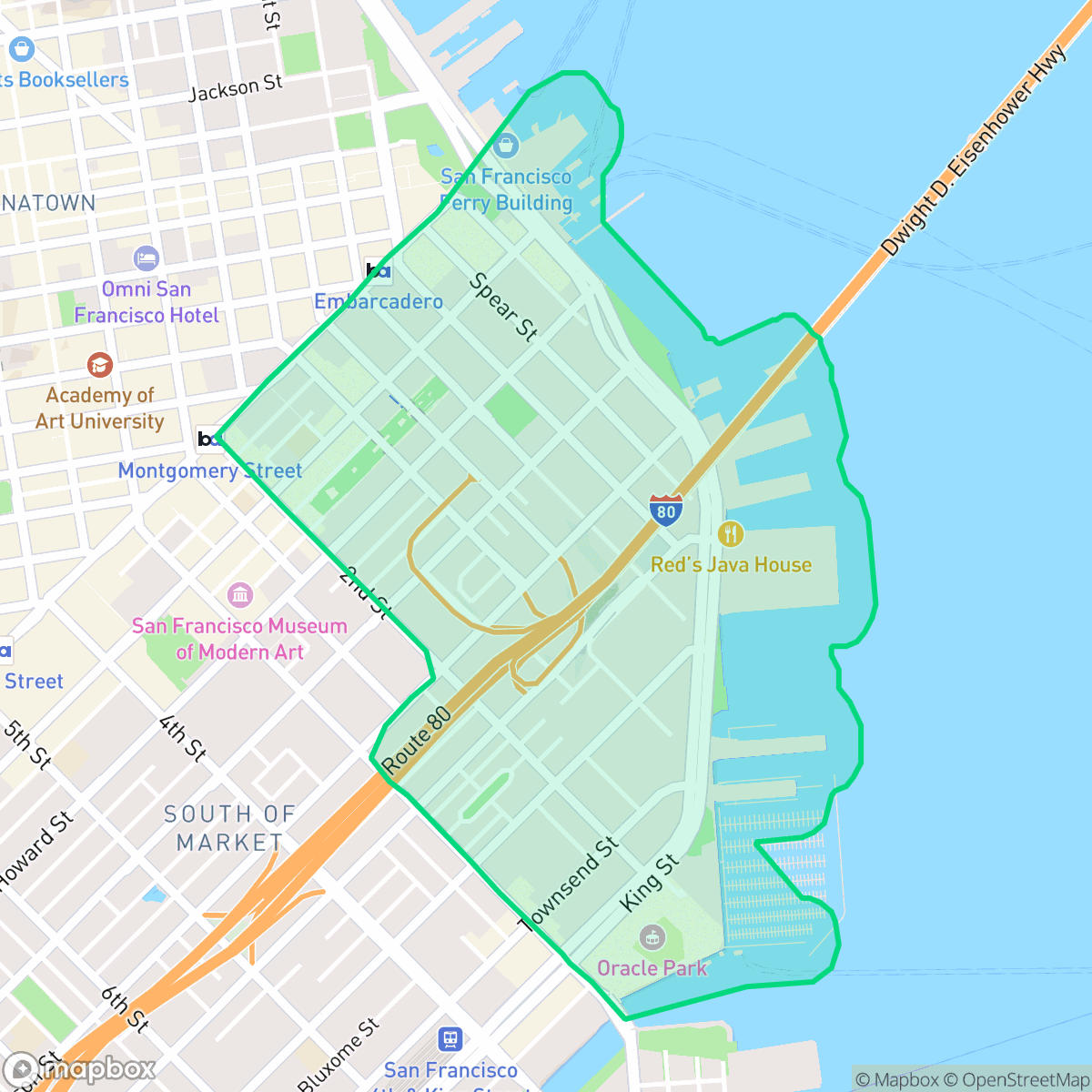
South Beach, situated along San Francisco’s eastern waterfront, originated as a vital industrial hub defined by maritime trade, warehouses, and railroad spurs. Historically known as the South End, the area served as a major port for steam schooners and Pacific Mail steamers, playing a key role in the city's Gold Rush-era expansion. Following decades of industrial decline, the neighborhood underwent a significant transformation beginning in the 1980s, shifting from a district of dilapidated piers and brick warehouses into a modern residential and commercial center. This evolution is marked by the adaptive reuse of historic structures, such as the Oriental Warehouse, alongside new landmarks like Oracle Park. Today, the area preserves remnants of its maritime past through institutions like the South End Rowing Club and Red’s Java House, which stand as links to its gritty, industrial origins.
The area functions as a modern, high-density residential and commercial hub along the eastern waterfront. It is characterized by its modern apartment complexes and proximity to major transit corridors, making it a highly accessible location for those who prefer to navigate on foot. According to iHuus data, the neighborhood provides a consistent level of social and dining activity that mirrors the broader city experience, balanced by views of the marina and the bay.
Prospective residents should consider the trade-offs of living in such a concentrated urban environment, which includes limited privacy due to high-density building configurations and frequent auditory disturbances from nearby freeways and rail lines. While the air quality is generally favorable, the neighborhood is situated within a floodplain, and families with children may need to navigate the challenges of the local school district. This setting is best suited for young professionals and those who prioritize central access over suburban quiet or expansive private outdoor space.
Neighborhood Scores Across 15 Qualities
High-density buildings and shared walls create very low levels of personal privacy. According to iHuus data, this lack of separation is consistent with the rest of the city.
A comprehensive sidewalk network and pedestrian-priority infrastructure make navigating the district on foot exceptionally easy. This level of accessibility for pedestrians is slightly above the San Francisco average according to iHuus data.
Modern high-density apartment complexes and upscale marinas define the visual landscape, though the area lacks the private greenery and estate-style amenities found in more suburban neighborhoods. This urban density is slightly below the city average for visual variety.
Dense concrete surroundings and high-rise developments offer few street-level grass verges, making the area less dog-friendly than the San Francisco average. While waterfront paths and nearby stadium parks provide some walking options, accessible greenery is sparse throughout much of the district.
High-rise buildings and extensive pavement characterize this area, which features significantly higher urban density than the San Francisco average. Natural greenery and vegetation are very limited throughout the neighborhood according to iHuus data.
Diverse dining and social venues provide a steady level of activity that is consistent with the city average. According to iHuus data, the landscape features a mix of waterfront social hubs and high-rise corridors that maintain a steady presence of local activity.
Constant auditory disturbance from nearby freeways and railroad tracks makes this area significantly louder than the San Francisco average. According to iHuus data, residents can expect frequent heavy traffic and transit-related sounds throughout the day.
Air quality remains consistently good with infrequent periods of elevated readings. According to iHuus data, the atmosphere in this area is slightly cleaner than the San Francisco average.
Large-scale industrial activity is notably less prevalent here than in most parts of San Francisco. While some maritime piers and warehouses introduce moderate daytime traffic, the area is primarily composed of high-rise commercial and residential structures without heavy industrial hazards.
Health insurance access is significantly lower in this area than the San Francisco average. According to iHuus data, a small portion of the local population maintains coverage.
Voting patterns and census indicators show a highly liberal political leaning that aligns with the city average. According to iHuus data, the area's ideological profile is consistent with the broader San Francisco landscape.
Residents primarily consist of young adults, though the area maintains a balanced mix of families and older individuals. According to iHuus data, the age distribution skews slightly younger than the San Francisco average.
Property in this area sits within a recognized floodplain, which carries a higher risk of flooding than most of San Francisco. According to iHuus data, residents may find that flood insurance is a typical requirement for buildings in this zone.
Address-Level Insights for South Beach


iHuus Neighborhood Intelligence Insights
Get address-level neighborhood insights for South Beach
- Street-level scores — see how individual blocks compare, not just neighborhood averages
- Micro-zone boundaries — identify quiet pockets, flood boundaries, and walkable clusters before you visit
- 15 dimensions in full — walkability, noise, air quality, school quality, insurance coverage, population age profile, urban/rural index, and more
- Boundary risk alerts — know if your address sits near a block boundary where scores drop, the kind of detail no listing will ever mention
- School insights — individual school ratings and insights, not just district-level data
- Compare before you commit — side-by-side data across neighborhoods, down to block precision
No credit card required
Compare with Any Neighborhood
| Dimension | South Beach | Alamo Square |
|---|---|---|
| 🚶 Walkabilityavg 9.91 | ||
| 🔊 Acoustic Comfortavg 3.4 | ||
| 🤫 Privacy Indexavg 2.14 | ||
| 🎨 Visual Appealavg 6.26 | ||
| 🐕 Dog Friendlinessavg 6.55 | ||
| 🗺️ Urban-Rural Indexavg 4.07 | ||
| ✨ Neighborhood Vibeavg 6.4 | ||
| 🏥 Health Insurance Coverageavg 7.87 | ||
| 🌿 Air Qualityavg 7.78 | ||
| 🏭 Industrial Proximityavg 9.37 | ||
| 🌊 Flood Safetyavg 1.89 | ||
| 🗳️ Ideological Leanavg 9.92 | ||
| 👥 Population Age Profileavg 5.18 | ||
| 🔥 Fire Safetyavg 0.01 | ||
| 🏫 School Quality |
South Beach Rankings
School Districts Serving South Beach
School Insights for South Beach
Below average outcomes; significant attendance and academic challenges.
School Insights
See what's really behind every school rating near South Beach
- Individual school ratings — each school's own score with outcome context, not just a district average
- Enrollment & class size data — student-to-teacher ratio and how it compares to the state average
- Full demographics breakdown — ethnicity and gender composition for every school in the enrollment zone
- Every school in the district — all schools within the enrollment boundary ranked by rating, not just the closest one
- Grade levels & benchmarks — elementary through high school, with below/above state-average flags
No credit card required