Silver Terrace, San Francisco
Updated · 7,621 residents
Silver Terrace is an exceptionally walkable, high-density neighborhood characterized by its compact, mid-century residential blocks and proximity to diverse commercial corridors. While it offers residents convenient access to local dining and transit, the area experiences significant road noise and limited private green space.
Key Highlights
About Silver Terrace
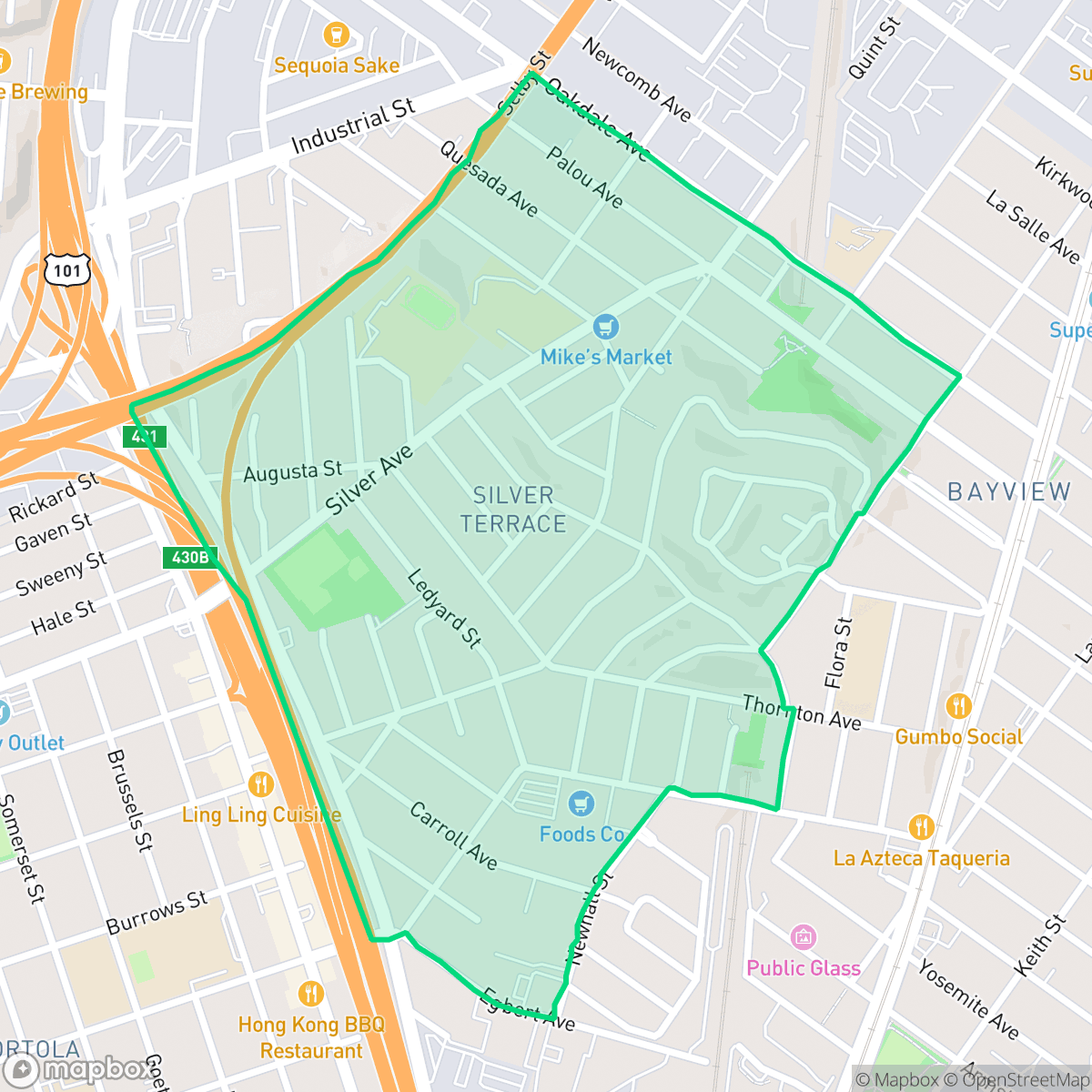
Located on a ridge in southeastern San Francisco, Silver Terrace owes its name to Joseph S. Silver, who claimed title to the area in the late 1850s following the Gold Rush. Originally part of the Mexican-era Rancho Rincon de las Salinas y Potrero Viejo, the land was later subdivided by homestead associations in the 1870s. Today, the neighborhood is primarily residential, characterized by a hillside setting with expansive bay views and a housing stock largely built between 1940 and 1969. It is bordered by the bustling San Bruno Avenue commercial corridor, reflecting a diverse cultural tapestry with strong Asian and Latino influences. Silver Terrace remains a quiet, family-oriented enclave that blends mid-century urban-suburban living with easy access to the surrounding city.
The neighborhood is a dense, urban enclave defined by a consistent grid layout that makes daily errands easy to complete on foot. It maintains a vibrant, working-class atmosphere, bolstered by a variety of accessible dining options along its borders. The architectural landscape consists primarily of closely situated homes, reflecting the area's efficient use of space and its long-standing role as a residential hub for the southeastern portion of the city.
Prospective residents should note the high density and lack of private outdoor areas, which may be challenging for pet owners or those seeking quiet retreats. The area is situated near industrial zones and major traffic arteries, resulting in elevated ambient noise levels. Additionally, while the community benefits from good air quality, the presence of nearby environmental sites and the current fiscal challenges within the local school district are important considerations for families planning a long-term stay.
Neighborhood Scores Across 15 Qualities
Close proximity between buildings and shared walls characterize the residential layout. This level of structural separation is consistent with the average across San Francisco.
Pedestrian travel is easy due to a consistent grid of well-defined sidewalks and frequent marked crosswalks. According to iHuus data, walking conditions in this area are comparable to the city average.
Standard high-density housing dominates the landscape, featuring boxy rooflines and minimal yard space. This visual profile is slightly below the city average for San Francisco, according to iHuus data.
Green spaces and sidewalk verges are notably sparse, making off-leash exercise difficult. According to iHuus data, the area lacks the accessible parkland found in many other San Francisco neighborhoods.
Low-rise residential blocks and large industrial warehouses characterize this area. The built environment is slightly less dense than the San Francisco average, featuring significant highway infrastructure and limited open green space.
Local social hubs and diverse dining options provide a noticeable level of activity, performing slightly above the city average for liveliness. While some industrial blocks offer concentrated pockets of energy, many businesses are not within easy walking distance of residential areas according to iHuus data.
Constant noise from nearby airport runways and heavy rail infrastructure makes this area significantly louder than the San Francisco average. Residents should expect frequent, high-decibel acoustic disruptions according to iHuus data.
Air quality in Silver Terrace remains consistently clear with very few instances of elevated pollution. According to iHuus data, these conditions are slightly better than the average found throughout San Francisco.
Light industrial and commercial units exist alongside residential areas, resulting in significantly lower industrial density than the San Francisco average. Residents may encounter transit traffic and utility odors near local service stations, while nearby large-scale industrial zones and a Superfund site present potential environmental considerations according to iHuus data.
Health insurance coverage levels in Silver Terrace are consistent with the average seen across San Francisco. According to iHuus data, most residents have access to medical coverage.
Voting patterns and census indicators in Silver Terrace align closely with the broader political landscape of San Francisco. According to iHuus data, the area reflects the same predominant liberal lean found throughout the city.
Residents live alongside a diverse range of age groups, including young professionals, families, and seniors. This demographic distribution is consistent with the broader San Francisco population according to iHuus data.
Flood vulnerability in this area is significantly higher than the San Francisco average, according to iHuus data. Residents may face increased risks during extreme weather events.
Address-Level Insights for Silver Terrace


iHuus Neighborhood Intelligence Insights
Get address-level neighborhood insights for Silver Terrace
- Street-level scores — see how individual blocks compare, not just neighborhood averages
- Micro-zone boundaries — identify quiet pockets, flood boundaries, and walkable clusters before you visit
- 15 dimensions in full — walkability, noise, air quality, school quality, insurance coverage, population age profile, urban/rural index, and more
- Boundary risk alerts — know if your address sits near a block boundary where scores drop, the kind of detail no listing will ever mention
- School insights — individual school ratings and insights, not just district-level data
- Compare before you commit — side-by-side data across neighborhoods, down to block precision
No credit card required
Compare with Any Neighborhood
| Dimension | Silver Terrace | Alamo Square |
|---|---|---|
| 🚶 Walkabilityavg 9.91 | ||
| 🔊 Acoustic Comfortavg 3.4 | ||
| 🤫 Privacy Indexavg 2.14 | ||
| 🎨 Visual Appealavg 6.26 | ||
| 🐕 Dog Friendlinessavg 6.55 | ||
| 🗺️ Urban-Rural Indexavg 4.07 | ||
| ✨ Neighborhood Vibeavg 6.4 | ||
| 🏥 Health Insurance Coverageavg 7.87 | ||
| 🌿 Air Qualityavg 7.78 | ||
| 🏭 Industrial Proximityavg 9.37 | ||
| 🌊 Flood Safetyavg 1.89 | ||
| 🗳️ Ideological Leanavg 9.92 | ||
| 👥 Population Age Profileavg 5.18 | ||
| 🔥 Fire Safetyavg 0.01 | ||
| 🏫 School Quality |
Silver Terrace Rankings
School Districts Serving Silver Terrace
School Insights for Silver Terrace
Below average outcomes; significant attendance and academic challenges.
School Insights
See what's really behind every school rating near Silver Terrace
- Individual school ratings — each school's own score with outcome context, not just a district average
- Enrollment & class size data — student-to-teacher ratio and how it compares to the state average
- Full demographics breakdown — ethnicity and gender composition for every school in the enrollment zone
- Every school in the district — all schools within the enrollment boundary ranked by rating, not just the closest one
- Grade levels & benchmarks — elementary through high school, with below/above state-average flags
No credit card required