Sherwood Forest, San Francisco
Updated · 646 residents
Sherwood Forest is a quiet, upscale enclave on the slopes of Mount Davidson known for its unique architectural heritage and semi-rural atmosphere. Residents enjoy a highly walkable environment with abundant greenery, though the area experiences persistent background noise from nearby traffic and high residential density.
Key Highlights
About Sherwood Forest
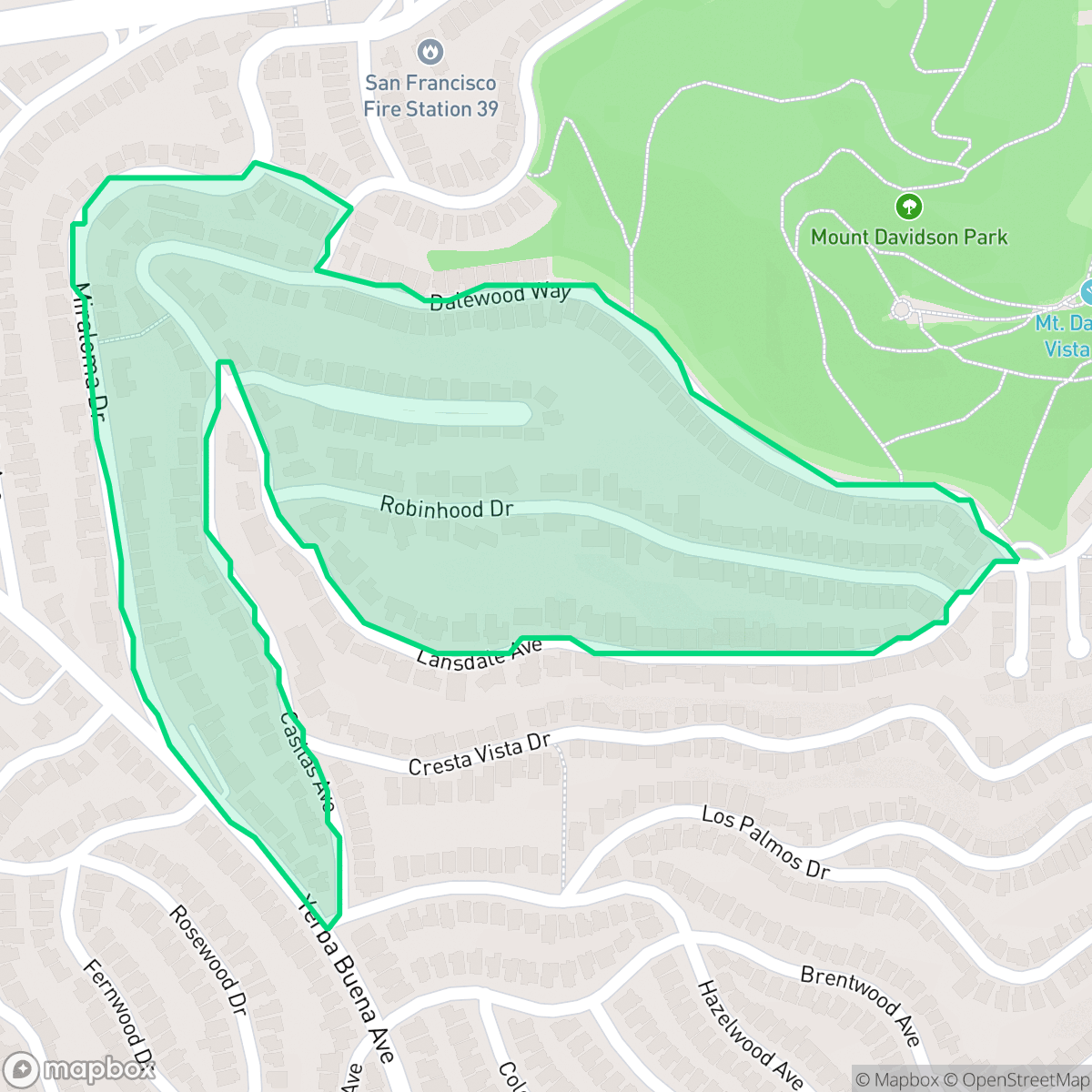
Sherwood Forest is a small, secluded residential neighborhood of approximately 200 homes on the southwestern slope of Mount Davidson. Developed starting in the 1930s, the area is themed around Robin Hood folklore, featuring streets like Robinhood Drive—the city's highest residential street—and is still illuminated by original globe streetlights. The neighborhood was built among trees planted by Adolph Sutro and is known for its custom homes designed by notable architects such as Julia Morgan, Timothy Pflueger, and Harold G. Stoner. Historically nicknamed "Pill Hill" due to the many physicians who resided there, the enclave maintains a quiet, distinct character with large lots and panoramic ocean views. It remains one of San Francisco's smallest and most obscure neighborhoods, having retained its mid-century charm despite its proximity to larger residential developments.
The neighborhood offers a tranquil, suburban environment defined by its lush, tree-filled landscape and a diverse demographic mix of young professionals, families, and seniors. According to iHuus data, the area maintains excellent air quality and a semi-rural feel that stands out from the typical urban density of the city. The visual character is marked by well-maintained, custom-designed homes that feature complex rooflines and expansive views of the surrounding landscape. Residents benefit from a purely residential environment that is entirely free from industrial activity, fostering a cohesive community identity.
While the neighborhood is highly pedestrian-friendly with continuous sidewalk networks, residents should note that the high building density results in close quarters between properties. The area experiences persistent background noise from nearby traffic, which contrasts with its otherwise subdued energy. Families should be aware that local schools fall under the San Francisco Unified School District, which currently faces significant financial and operational challenges despite maintaining some high-performing academic pockets. This enclave is best suited for those who prioritize a quiet, upscale residential setting with easy access to outdoor greenery.
Neighborhood Scores Across 15 Qualities
Residential properties are positioned in close quarters with minimal separation between structures. This level of density is notably higher than the San Francisco average, according to iHuus data.
Continuous sidewalk networks and low-traffic residential streets with clear crossings make navigating this area easy on foot. According to iHuus data, walkability here is slightly above the San Francisco average.
Large, well-maintained homes and frequent upscale amenities provide a visual quality that is slightly above the San Francisco average. According to iHuus data, the area features complex rooflines and expansive views in certain sections.
Access to large forested parks and athletic fields provides ample space for pets, making the area slightly more dog friendly than the San Francisco average. While some street-side areas feature narrow sidewalks, the abundance of connected green space and greenery supports easy walking for animals.
Frequent open land and woodland areas provide a more secluded atmosphere than the typical San Francisco urban landscape. According to iHuus data, the neighborhood features a much higher presence of greenery and scattered homes compared to the city average.
Suburban streets and green spaces provide a serene atmosphere with occasional local dining and essential services. This area offers a more subdued energy compared to the higher activity levels found across the rest of San Francisco.
Local traffic from a nearby busy street creates a persistent background noise. This level of acoustic activity is notably higher than the city average.
Air quality remains consistently high with rare instances of elevated readings. This level of freshness is slightly better than the average found across San Francisco, according to iHuus data.
Industrial activity is non-existent here, as the area contains no warehouses or factories. This neighborhood offers a cleaner environment than the San Francisco average due to the total absence of heavy industry or hazard sites.
Health insurance access is exceptionally high among residents, notably surpassing the San Francisco city average according to iHuus data.
Voting patterns and census indicators reflect a very strong liberal leaning that aligns with the citywide average, according to iHuus data.
A diverse range of age groups resides here, including young professionals, families, and seniors. According to iHuus data, this demographic spread is slightly more balanced than the citywide average.
Address-Level Insights for Sherwood Forest


iHuus Neighborhood Intelligence Insights
Get address-level neighborhood insights for Sherwood Forest
- Street-level scores — see how individual blocks compare, not just neighborhood averages
- Micro-zone boundaries — identify quiet pockets, flood boundaries, and walkable clusters before you visit
- 15 dimensions in full — walkability, noise, air quality, school quality, insurance coverage, population age profile, urban/rural index, and more
- Boundary risk alerts — know if your address sits near a block boundary where scores drop, the kind of detail no listing will ever mention
- School insights — individual school ratings and insights, not just district-level data
- Compare before you commit — side-by-side data across neighborhoods, down to block precision
No credit card required
Compare with Any Neighborhood
| Dimension | Sherwood Forest | Alamo Square |
|---|---|---|
| 🚶 Walkabilityavg 9.91 | ||
| 🔊 Acoustic Comfortavg 3.4 | ||
| 🤫 Privacy Indexavg 2.14 | ||
| 🎨 Visual Appealavg 6.26 | ||
| 🐕 Dog Friendlinessavg 6.55 | ||
| 🗺️ Urban-Rural Indexavg 4.07 | ||
| ✨ Neighborhood Vibeavg 6.4 | ||
| 🏥 Health Insurance Coverageavg 7.87 | ||
| 🌿 Air Qualityavg 7.78 | ||
| 🏭 Industrial Proximityavg 9.37 | ||
| 🌊 Flood Safetyavg 1.89 | ||
| 🗳️ Ideological Leanavg 9.92 | ||
| 👥 Population Age Profileavg 5.18 | ||
| 🔥 Fire Safetyavg 0.01 | ||
| 🏫 School Quality |
Sherwood Forest Rankings
School Districts Serving Sherwood Forest
School Insights for Sherwood Forest
Below average outcomes; significant attendance and academic challenges.
School Insights
See what's really behind every school rating near Sherwood Forest
- Individual school ratings — each school's own score with outcome context, not just a district average
- Enrollment & class size data — student-to-teacher ratio and how it compares to the state average
- Full demographics breakdown — ethnicity and gender composition for every school in the enrollment zone
- Every school in the district — all schools within the enrollment boundary ranked by rating, not just the closest one
- Grade levels & benchmarks — elementary through high school, with below/above state-average flags
No credit card required