Sea Cliff, San Francisco
Updated · 1,965 residents
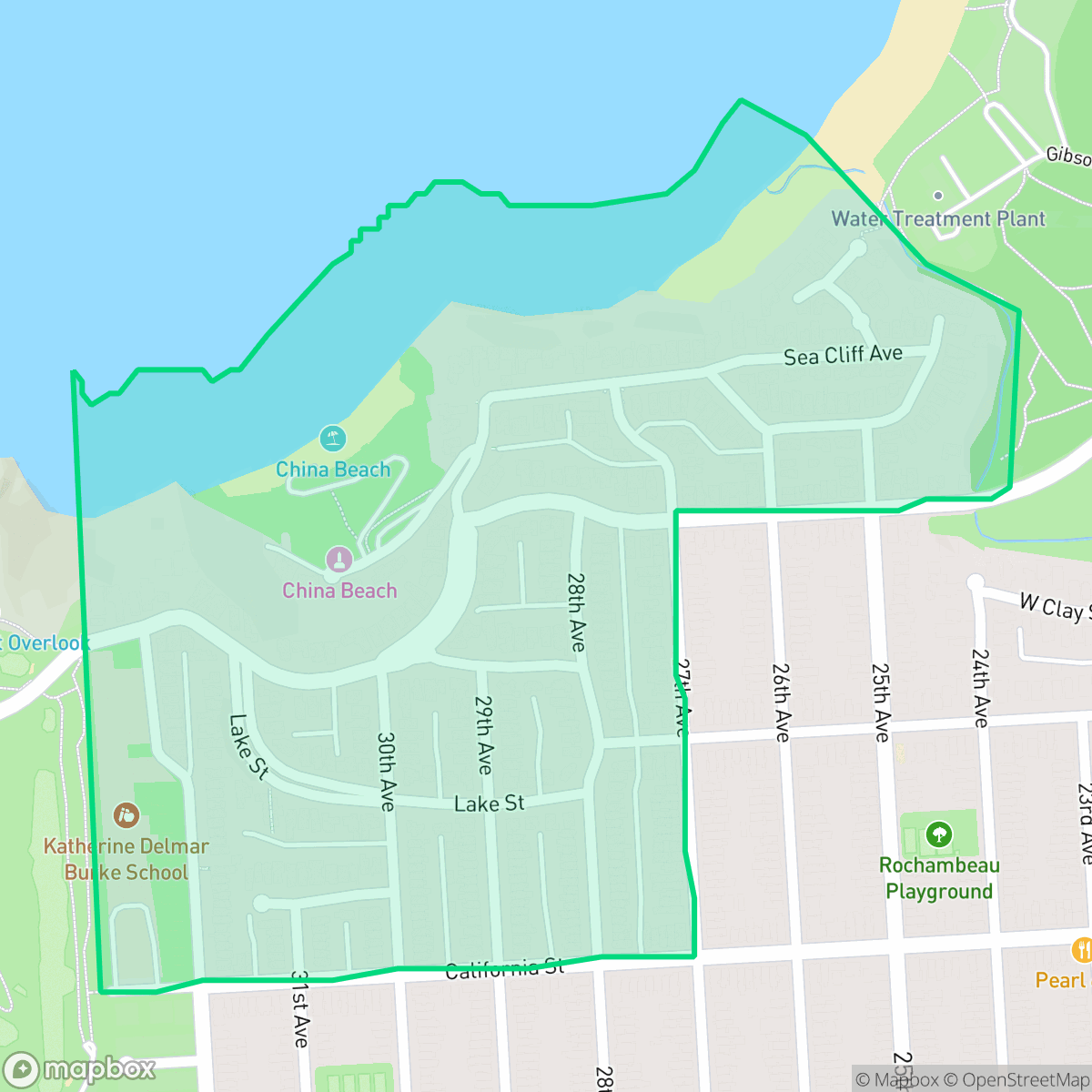
Sea Cliff is a coastal residential enclave in San Francisco characterized by its dramatic ocean views and high walkability. The area offers a quiet, serene environment with direct access to public beaches and recreational spaces, though residents experience limited privacy due to the close proximity of neighboring homes.
Key Highlights
About Sea Cliff
Nestled on the bluffs of northwest San Francisco, Sea Cliff was officially established in 1913 as one of the city's premier master-planned "residence parks," designed by landscape architect Mark Daniels. Long before its development, the coastal area was known to the Spanish as Coyote Gulch, and in the mid-1800s, Chinese fishermen camped at the cove now known as China Beach. The neighborhood quickly evolved into an exclusive enclave of grand estates showcasing diverse architectural styles, from Mediterranean Revival to Craftsman. Renowned architects like Julia Morgan, Willis Polk, and Albert Farr designed several of Sea Cliff’s landmark homes. Over the decades, the neighborhood’s dramatic ocean views and secluded character have attracted prominent residents, including photographer Ansel Adams, actor Robin Williams, and tech entrepreneur Jack Dorsey.
The neighborhood maintains a distinct atmosphere defined by its dense residential grid and immediate proximity to the Pacific coastline. It serves as a quiet retreat, benefiting from low ambient noise levels and an absence of industrial activity. Residents enjoy a highly walkable environment that connects directly to local beaches and parkland, making it an ideal location for those who prioritize outdoor access and a tranquil living experience.
While the area offers significant aesthetic appeal and high-quality recreational access, prospective residents should note the trade-offs in privacy, as homes are situated in a dense configuration with minimal separation. According to iHuus data, the neighborhood provides a stable environment with high health insurance coverage, though it is served by the San Francisco Unified School District, which currently faces significant fiscal and operational challenges. This location is best suited for individuals or families who value a calm, coastal lifestyle and are comfortable with the density inherent to this part of the city.
Neighborhood Scores Across 15 Qualities
Residential structures often feature very narrow gaps or shared walls, particularly within the southern grid. This density is slightly higher than the San Francisco average, according to iHuus data.
Pedestrian navigation is seamless due to wide sidewalks, numerous marked crosswalks, and dedicated trails through the greenbelt. This infrastructure provides a level of walkability that is slightly above the San Francisco average.
Manicured yards and large coastal estates provide a more polished aesthetic than the city average. According to iHuus data, the presence of luxury amenities and well-maintained residential blocks enhances the area's visual character.
Abundant coastal parks, forested trails, and direct beach access provide much more space for pets than the typical San Francisco neighborhood. According to iHuus data, the proximity to large open landscapes and golf course greenery makes this an ideal area for dog owners.
Large coastal nature preserves and frequent open land create a semi-rural feel that is significantly more open than the typical San Francisco urban grid. Residents benefit from a mix of dense residential pockets and expansive greenery, according to iHuus data.
Residential blocks offer a calm atmosphere with easy access to parks and a few local dining options. This level of activity is consistent with the city average, providing a peaceful environment without the high density of San Francisco's urban core.
Minimal noise levels from traffic or transit characterize this area, which remains significantly quieter than most parts of San Francisco. According to iHuus data, residents can expect a calm environment with only occasional distant sounds.
Air quality in this area fluctuates between acceptable and unhealthy levels, appearing lower than the San Francisco average according to iHuus data. Residents in sensitive groups may experience occasional concern during certain periods.
Industrial activity and warehouses are entirely absent from this area, making it more residential than the San Francisco average. According to iHuus data, the neighborhood consists solely of residential, recreational, and institutional uses with no detected industrial hazards.
Health insurance access among residents is exceptionally high, significantly outpacing the San Francisco average according to iHuus data.
Voting patterns and census indicators reflect a deeply liberal political landscape that is consistent with the citywide average.
A balanced variety of age groups resides here, ranging from young adults to older residents. This demographic distribution is largely consistent with the broader San Francisco area, according to iHuus data.
Properties in this area are situated within a designated floodplain, which indicates a higher vulnerability to flooding than the San Francisco average. According to iHuus data, residents may find that flood insurance is a typical requirement for homes in this neighborhood.
Address-Level Insights for Sea Cliff


iHuus Neighborhood Intelligence Insights
Get address-level neighborhood insights for Sea Cliff
- Street-level scores — see how individual blocks compare, not just neighborhood averages
- Micro-zone boundaries — identify quiet pockets, flood boundaries, and walkable clusters before you visit
- 15 dimensions in full — walkability, noise, air quality, school quality, insurance coverage, population age profile, urban/rural index, and more
- Boundary risk alerts — know if your address sits near a block boundary where scores drop, the kind of detail no listing will ever mention
- School insights — individual school ratings and insights, not just district-level data
- Compare before you commit — side-by-side data across neighborhoods, down to block precision
No credit card required
Compare with Any Neighborhood
| Dimension | Sea Cliff | Alamo Square |
|---|---|---|
| 🚶 Walkabilityavg 9.91 | ||
| 🔊 Acoustic Comfortavg 3.4 | ||
| 🤫 Privacy Indexavg 2.14 | ||
| 🎨 Visual Appealavg 6.26 | ||
| 🐕 Dog Friendlinessavg 6.55 | ||
| 🗺️ Urban-Rural Indexavg 4.07 | ||
| ✨ Neighborhood Vibeavg 6.4 | ||
| 🏥 Health Insurance Coverageavg 7.87 | ||
| 🌿 Air Qualityavg 7.78 | ||
| 🏭 Industrial Proximityavg 9.37 | ||
| 🌊 Flood Safetyavg 1.89 | ||
| 🗳️ Ideological Leanavg 9.92 | ||
| 👥 Population Age Profileavg 5.18 | ||
| 🔥 Fire Safetyavg 0.01 | ||
| 🏫 School Quality |
Sea Cliff Rankings
School Districts Serving Sea Cliff
School Insights for Sea Cliff
Below average outcomes; significant attendance and academic challenges.
School Insights
See what's really behind every school rating near Sea Cliff
- Individual school ratings — each school's own score with outcome context, not just a district average
- Enrollment & class size data — student-to-teacher ratio and how it compares to the state average
- Full demographics breakdown — ethnicity and gender composition for every school in the enrollment zone
- Every school in the district — all schools within the enrollment boundary ranked by rating, not just the closest one
- Grade levels & benchmarks — elementary through high school, with below/above state-average flags
No credit card required