Presidio, San Francisco
Updated · 6,881 residents
The Presidio offers a unique blend of national park landscapes and residential living, featuring exceptional walkability and world-class access to dog-friendly trails. While the area provides high visual appeal and a quiet, institutional atmosphere, residents should be prepared for moderate road noise and a density that limits private outdoor space.
Key Highlights
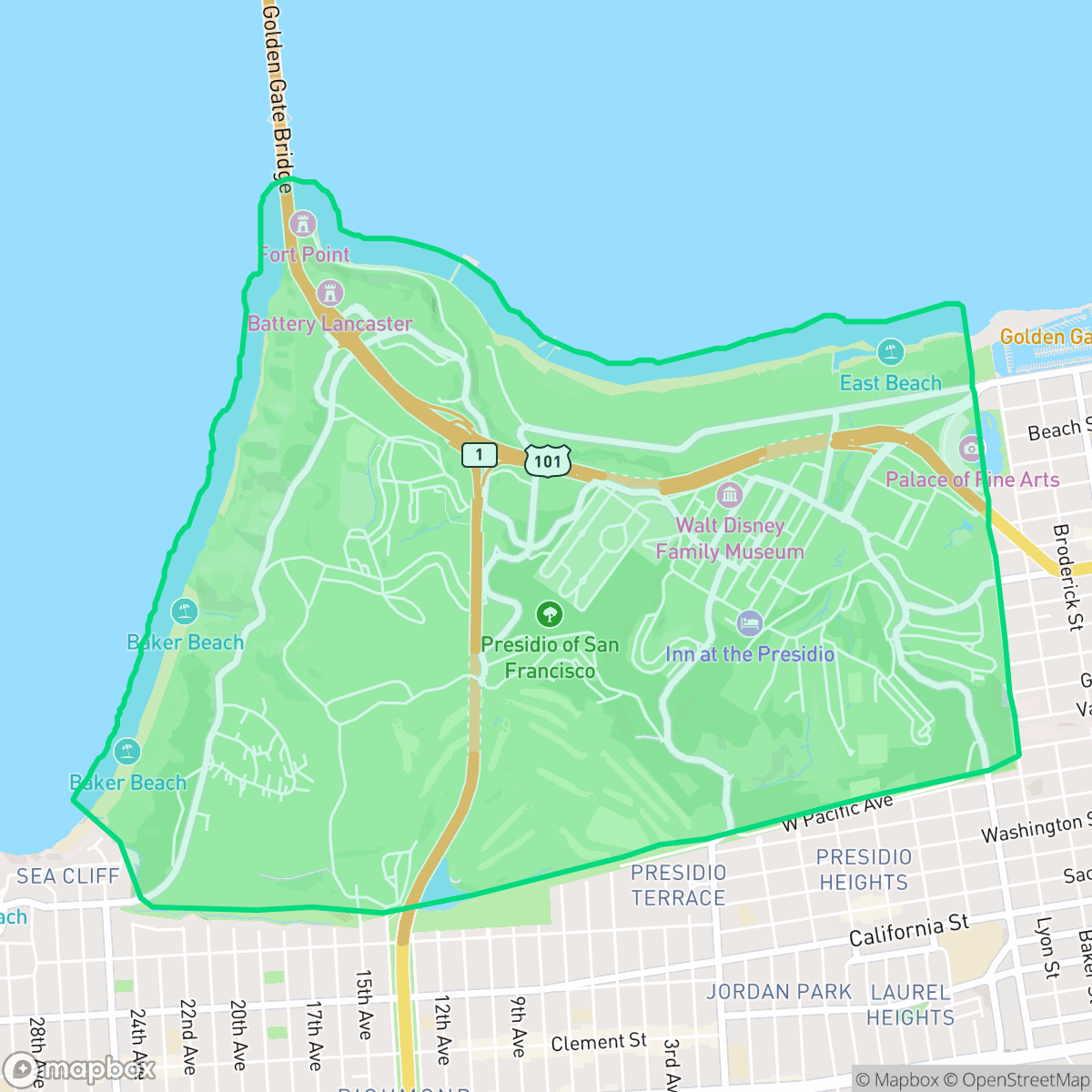
About Presidio
Originally the traditional territory of the Yelamu Ohlone people, the Presidio of San Francisco was established in 1776 as a Spanish military outpost. It subsequently served under Mexican rule and as a major U.S. Army post from 1846 to 1994, playing a key role in every major American conflict through Desert Storm. Designated a National Historic Landmark District in 1962, the neighborhood boasts an exceptional collection of military architecture in Spanish Colonial, Spanish Revival, and Colonial Revival styles. Key landmarks include the Presidio Officers’ Club—one of San Francisco’s oldest buildings, featuring original 18th-century adobe walls—and Fort Point, a Civil War-era brick fortification at the foot of the Golden Gate Bridge. Today, this former military base is a vibrant national park managed by the Presidio Trust, blending historic barracks, scenic open spaces, and restored ecological habitats.
This neighborhood serves as a rare urban sanctuary where dense residential pockets meet expansive coastal parkland. The area maintains a high level of visual appeal due to its well-preserved historic architecture and proximity to the Golden Gate Bridge. Unlike typical city neighborhoods, it offers a serene environment with zero industrial presence and excellent access to nature, making it a premier destination for outdoor enthusiasts and those seeking a quiet, institutional aesthetic.
Living here requires balancing the benefits of a highly walkable, dog-friendly environment with the realities of urban noise levels from nearby traffic. The area is best suited for individuals or families who prioritize access to recreation and green space over proximity to commercial nightlife. Prospective residents should note that while the neighborhood excels in safety and health coverage, the local school district currently faces significant operational challenges that may impact educational planning.
Neighborhood Scores Across 15 Qualities
Shared walls and zero-lot-line construction are common throughout the area, resulting in a density slightly higher than the San Francisco average. Minimal separation between many buildings means residents have very little private buffer from neighboring structures.
Continuous sidewalk grids and dedicated pedestrian paths through parklands ensure easy movement on foot. This level of accessibility is slightly above the city average for San Francisco.
Large, well-maintained residences and manicured landscapes provide a premium aesthetic that is notably higher than the city average. Proximity to coastal landmarks and parklands contributes to a highly polished visual environment.
Immediate access to vast wooded trails, coastal parks, and open green spaces makes this area significantly more dog friendly than the San Francisco average. According to iHuus data, the neighborhood offers abundant opportunities for exercise through its integrated network of forested paths and large public lawns.
Residential streets and coastal parklands exist in roughly equal measure, creating a landscape more balanced between nature and urban density than the typical San Francisco neighborhood. According to iHuus data, this area offers a more suburban feel compared to the city average.
Varying pockets of activity range from serene, rural landscapes to lively urban blocks with diverse dining options. This balance of quiet green space and accessible social hubs is largely in line with the city average, according to iHuus data.
Steady traffic sounds from nearby thoroughfares are present; however, acoustic comfort levels remain higher than the San Francisco average according to iHuus data.
Air quality remains mostly clean with rare instances of elevated readings, appearing roughly in line with the San Francisco average according to iHuus data.
Industrial activity and warehouses are entirely absent from this area. According to iHuus data, the neighborhood is exclusively composed of residential, recreational, and cultural zones, making it even more free of industrial hazards than the San Francisco average.
Health insurance access is exceptionally high among residents, significantly surpassing the San Francisco average according to iHuus data.
Voting patterns and census indicators reflect a deeply liberal political leaning that is consistent with the rest of San Francisco. This political alignment is typical of the broader city average, according to iHuus data.
Residents represent a balanced mix of young adults, families, and seniors. This demographic spread is roughly in line with the broader San Francisco average, according to iHuus data.
Residual flood risk exists within this area due to its location in a 500-year floodplain. According to iHuus data, the level of safety is considerably higher than the San Francisco city average.
Address-Level Insights for Presidio


iHuus Neighborhood Intelligence Insights
Get address-level neighborhood insights for Presidio
- Street-level scores — see how individual blocks compare, not just neighborhood averages
- Micro-zone boundaries — identify quiet pockets, flood boundaries, and walkable clusters before you visit
- 15 dimensions in full — walkability, noise, air quality, school quality, insurance coverage, population age profile, urban/rural index, and more
- Boundary risk alerts — know if your address sits near a block boundary where scores drop, the kind of detail no listing will ever mention
- School insights — individual school ratings and insights, not just district-level data
- Compare before you commit — side-by-side data across neighborhoods, down to block precision
No credit card required
Compare with Any Neighborhood
| Dimension | Presidio | Alamo Square |
|---|---|---|
| 🚶 Walkabilityavg 9.91 | ||
| 🔊 Acoustic Comfortavg 3.4 | ||
| 🤫 Privacy Indexavg 2.14 | ||
| 🎨 Visual Appealavg 6.26 | ||
| 🐕 Dog Friendlinessavg 6.55 | ||
| 🗺️ Urban-Rural Indexavg 4.07 | ||
| ✨ Neighborhood Vibeavg 6.4 | ||
| 🏥 Health Insurance Coverageavg 7.87 | ||
| 🌿 Air Qualityavg 7.78 | ||
| 🏭 Industrial Proximityavg 9.37 | ||
| 🌊 Flood Safetyavg 1.89 | ||
| 🗳️ Ideological Leanavg 9.92 | ||
| 👥 Population Age Profileavg 5.18 | ||
| 🔥 Fire Safetyavg 0.01 | ||
| 🏫 School Quality |
Presidio Rankings
School Districts Serving Presidio
School Insights for Presidio
Below average outcomes; significant attendance and academic challenges.
School Insights
See what's really behind every school rating near Presidio
- Individual school ratings — each school's own score with outcome context, not just a district average
- Enrollment & class size data — student-to-teacher ratio and how it compares to the state average
- Full demographics breakdown — ethnicity and gender composition for every school in the enrollment zone
- Every school in the district — all schools within the enrollment boundary ranked by rating, not just the closest one
- Grade levels & benchmarks — elementary through high school, with below/above state-average flags
No credit card required