Presidio Heights, San Francisco
Updated · 4,564 residents
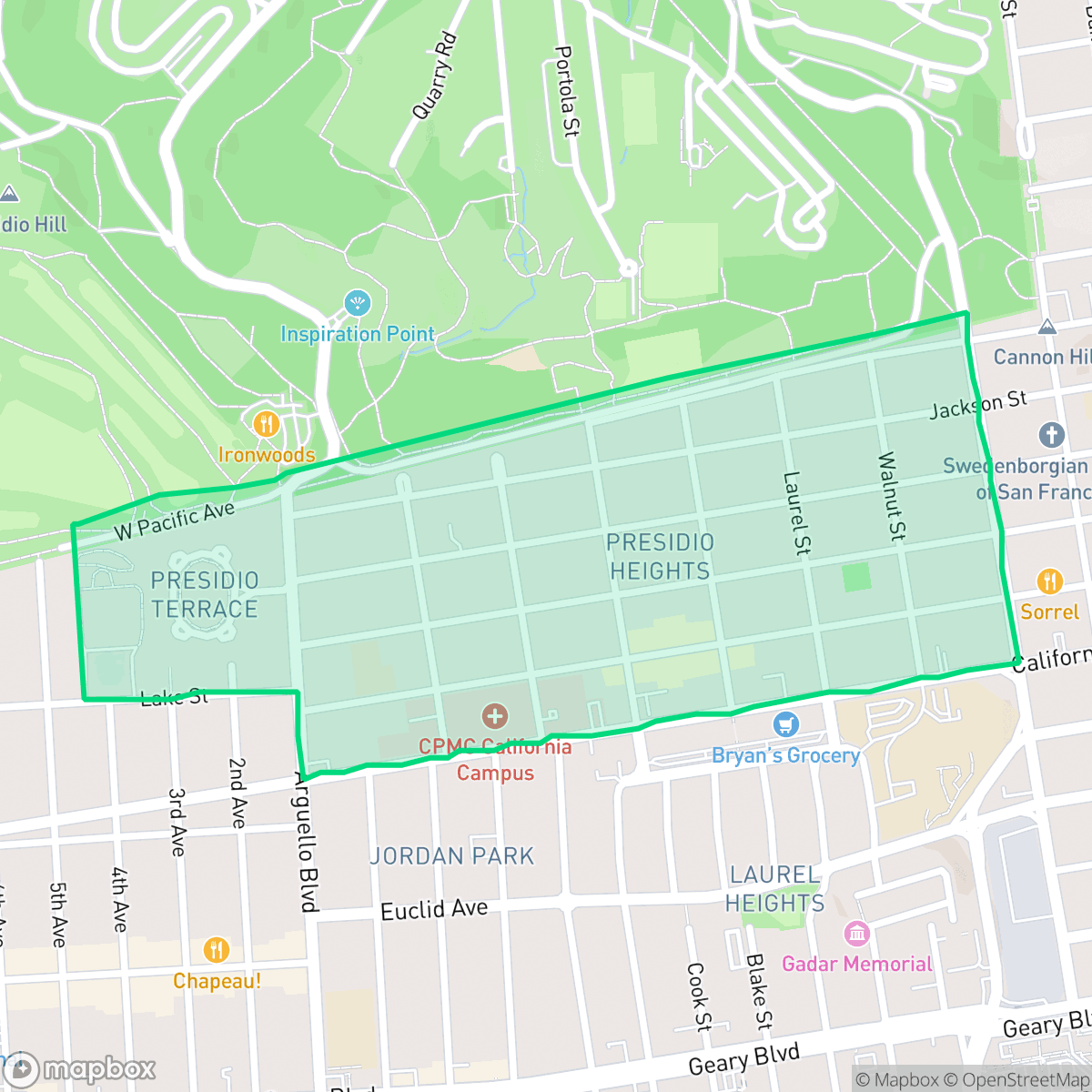
Presidio Heights is a quiet, upscale neighborhood defined by its dense, walkable grid and proximity to expansive parkland. It offers a refined atmosphere with boutique dining along Sacramento Street, though residential privacy is limited by the area's tightly packed row-house construction.
Key Highlights
About Presidio Heights
Developed as an exclusive enclave after the 1906 earthquake, Presidio Heights became a haven for wealthy San Franciscans seeking stable, elevated ground. The neighborhood is renowned for its quiet, tree-lined streets and grand early 20th-century architecture, including Tudor, Edwardian, and Shingle-style estates. Its northern boundary is defined by the historic Presidio Wall (built 1902–1913). Along the 3200 and 3300 blocks of Pacific Avenue, a premier collection of Shingle Style homes stands as a testament to master architects like Bernard Maybeck, Julia Morgan, and Willis Polk. The neighborhood’s social and commercial life centers on the elegant, low-key boutique corridor of Sacramento Street and the historic Julius Kahn Playground, established in 1923 to serve military families from the adjacent Presidio.
The area functions as a calm, residential enclave that balances urban convenience with access to nature. Residents benefit from high walkability and a lack of industrial activity, making it a peaceful environment for daily errands. The local commercial scene is centered on Sacramento Street, where a variety of dining establishments and cafes serve the community. The neighborhood maintains excellent air quality and a strong sense of community stability, supported by high levels of health insurance coverage among the population according to iHuus data.
Prospective residents should note that the neighborhood features high-density housing with limited yard space, resulting in minimal visual privacy between neighbors. While the area is highly walkable and dog-friendly, the urban layout contributes to a moderate level of road noise. It is best suited for individuals or families who prioritize access to neighborhood amenities and park space over expansive private outdoor areas, and who appreciate a mature, well-established urban environment.
Neighborhood Scores Across 15 Qualities
Close proximity between homes and shared walls create minimal buffers between neighbors. This level of density is roughly in line with the rest of San Francisco.
Pedestrians benefit from a continuous sidewalk grid and clear crosswalks that prioritize foot traffic. This level of accessibility is slightly above the San Francisco average.
Large homes with unique architectural details and proximity to major parklands provide a landscape that is more visually pleasing than the San Francisco average. According to iHuus data, the area features spacious driveways and premium amenities that contribute to a high-quality streetscape.
Immediate access to the Presidio trails and expansive green spaces makes this area significantly more accommodating for pets than the San Francisco average. Wide sidewalks and proximity to large hilltop parks provide safe, low-traffic routes for walking dogs.
Street layouts provide a balanced mix of residential density and green space, offering a more suburban character than much of the surrounding city. According to iHuus data, the area transitions from an urban grid into large park and golf course landscapes.
Residential streets offer a blend of tranquil, green spaces and localized dining options, though the area is slightly less active than the San Francisco average. According to iHuus data, the neighborhood features a mix of calm, mid-rise blocks and scenic landscapes near the Presidio, providing access to notable cafes and eateries without constant urban density.
Acoustic levels remain significantly lower than the San Francisco average, characterized by infrequent traffic sounds and minimal ambient noise. According to iHuus data, residents can expect a tranquil environment with only sporadic distant vehicle or train sounds.
Air quality remains consistently high with rare instances of elevated readings. Levels in this area are slightly better than the San Francisco average, according to iHuus data.
No warehouses, industrial facilities, or hazardous sites are present within the neighborhood. This area is exclusively residential and recreational, offering a cleaner environment than the city average according to iHuus data.
Health insurance enrollment is nearly universal among residents, significantly outpacing the San Francisco average according to iHuus data.
Voting patterns and census indicators reflect a deeply liberal political landscape that aligns with the broader San Francisco average.
Residents experience a diverse mix of age groups, ranging from young professionals to families and seniors. This distribution of age groups is consistent with the broader San Francisco population, according to iHuus data.
Flood risk in this area is notably higher than the San Francisco average, though official assessments from FEMA remain incomplete for this specific location.
Address-Level Insights for Presidio Heights


iHuus Neighborhood Intelligence Insights
Get address-level neighborhood insights for Presidio Heights
- Street-level scores — see how individual blocks compare, not just neighborhood averages
- Micro-zone boundaries — identify quiet pockets, flood boundaries, and walkable clusters before you visit
- 15 dimensions in full — walkability, noise, air quality, school quality, insurance coverage, population age profile, urban/rural index, and more
- Boundary risk alerts — know if your address sits near a block boundary where scores drop, the kind of detail no listing will ever mention
- School insights — individual school ratings and insights, not just district-level data
- Compare before you commit — side-by-side data across neighborhoods, down to block precision
No credit card required
Compare with Any Neighborhood
| Dimension | Presidio Heights | Alamo Square |
|---|---|---|
| 🚶 Walkabilityavg 9.91 | ||
| 🔊 Acoustic Comfortavg 3.4 | ||
| 🤫 Privacy Indexavg 2.14 | ||
| 🎨 Visual Appealavg 6.26 | ||
| 🐕 Dog Friendlinessavg 6.55 | ||
| 🗺️ Urban-Rural Indexavg 4.07 | ||
| ✨ Neighborhood Vibeavg 6.4 | ||
| 🏥 Health Insurance Coverageavg 7.87 | ||
| 🌿 Air Qualityavg 7.78 | ||
| 🏭 Industrial Proximityavg 9.37 | ||
| 🌊 Flood Safetyavg 1.89 | ||
| 🗳️ Ideological Leanavg 9.92 | ||
| 👥 Population Age Profileavg 5.18 | ||
| 🔥 Fire Safetyavg 0.01 | ||
| 🏫 School Quality |
Presidio Heights Rankings
School Districts Serving Presidio Heights
School Insights for Presidio Heights
Below average outcomes; significant attendance and academic challenges.
School Insights
See what's really behind every school rating near Presidio Heights
- Individual school ratings — each school's own score with outcome context, not just a district average
- Enrollment & class size data — student-to-teacher ratio and how it compares to the state average
- Full demographics breakdown — ethnicity and gender composition for every school in the enrollment zone
- Every school in the district — all schools within the enrollment boundary ranked by rating, not just the closest one
- Grade levels & benchmarks — elementary through high school, with below/above state-average flags
No credit card required