Portola, San Francisco
Updated · 16,996 residents
Portola is a highly walkable, dense residential area characterized by tightly packed row houses and a consistent grid layout. While it offers excellent air quality and convenient access to local services along San Bruno Avenue, residents should expect significant noise from nearby road traffic and limited privacy due to the close proximity of neighboring homes.
Key Highlights
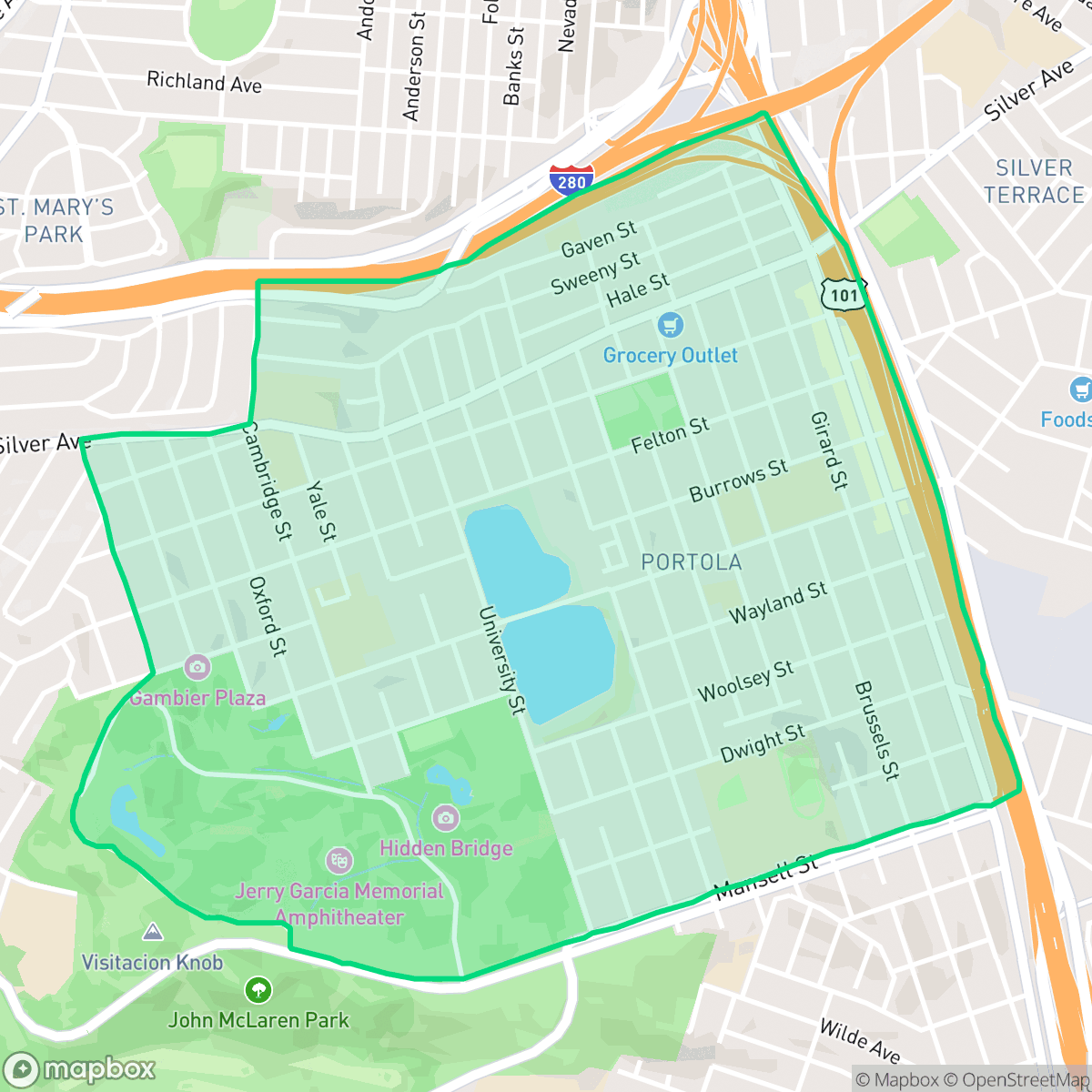
About Portola
Laid out in 1869 by the University Homestead Association—which gave the area collegiate street names like Harvard and Yale—San Francisco’s Portola neighborhood developed rapidly after the 1906 earthquake. Initially settled by Jewish immigrants, earning it the nickname "Little Jerusalem," it soon welcomed waves of Italian and Maltese settlers, becoming one of the nation's few Maltese enclaves. Portola is historically celebrated as San Francisco's "Garden District" due to its early 20th-century commercial flower farms and greenhouses, which supplied much of the city's floral crop. Local life centered around San Bruno Avenue, affectionately called "The Road," which still serves as the neighborhood's commercial spine. Distinctive local landmarks include the historic 1927 Avenue Theater and the towering aqua-blue La Grande water tank overlooking nearby McLaren Park.
The current character of the neighborhood is defined by a dense, low-rise residential environment that prioritizes a walkable grid layout. According to iHuus data, the area maintains a stable social fabric with high rates of health insurance coverage, making daily errands along the commercial spine of San Bruno Avenue easily accessible to residents. While the architectural density results in minimal private outdoor space and limited acoustic comfort due to ambient road noise, the neighborhood benefits from high air quality and a lack of industrial hazards. The community remains a tightly knit environment where residents share high-density living quarters, reflecting its long-standing history as a diverse residential enclave. This area is well-suited for those who prioritize pedestrian access and proximity to urban amenities over quiet seclusion. Prospective residents should note that while the neighborhood provides easy access to nearby green spaces like McLaren Park, the local school district currently faces significant financial and operational challenges. The combination of its central location and consistent urban infrastructure makes it a practical choice for those who rely on city services and value a traditional, high-density residential lifestyle.
Neighborhood Scores Across 15 Qualities
Dense residential configurations and shared walls create minimal structural separation between buildings. This level of privacy is slightly below the San Francisco average, according to iHuus data.
Continuous sidewalks, clear crosswalks, and pedestrian bridges over the freeway provide a safe and easy environment for navigating on foot. This level of pedestrian infrastructure is slightly above the city average.
Uniform, high-density housing and small yards characterize this area, which sits slightly below the city average for visual variety. According to iHuus data, the landscape consists mostly of standard boxy roofs and compact lots without significant private greenery or luxury amenities.
Access to large public parks and wooded trails provides reliable exercise opportunities for pets. According to iHuus data, the availability of green space here is slightly above the city average.
Residential blocks and green spaces are distributed in roughly equal measure, creating a more suburban feel than the typical San Francisco urban core. This balance of street grid and open space is more prominent here than the city average according to iHuus data.
Local social hubs and diverse dining options create a steady rhythm of activity that is consistent with the city average. While some blocks near major highways offer concentrated pockets of energy, other residential areas remain quiet and suburban in character.
Frequent noise from nearby freeway and railroad corridors characterizes this area. According to iHuus data, acoustic comfort levels are lower than the San Francisco average.
Air quality remains consistently high with rare instances of elevated readings. This level of freshness is slightly above the San Francisco average according to iHuus data.
Industrial activity and warehouses are virtually non-existent in this area, offering a residential environment that is slightly cleaner of heavy industry than the San Francisco average. According to iHuus data, the neighborhood consists almost entirely of residential and recreational zones without detectable industrial hazards.
Health insurance coverage is relatively high among residents, though it sits slightly below the San Francisco city average according to iHuus data.
Voting patterns and census indicators show a strongly liberal political leaning that is consistent with the rest of San Francisco. According to iHuus data, the area's ideological landscape matches the city average.
A balanced variety of young adults, families, and older residents characterizes this area. According to iHuus data, the demographic spread is more diverse than the city average.
Property flooding from coastal wave action is a significant concern here, as this area sits in a high-hazard zone with risk levels substantially higher than the San Francisco average. Residents should anticipate elevated or potentially prohibitive flood insurance costs according to iHuus data.
Address-Level Insights for Portola


iHuus Neighborhood Intelligence Insights
Get address-level neighborhood insights for Portola
- Street-level scores — see how individual blocks compare, not just neighborhood averages
- Micro-zone boundaries — identify quiet pockets, flood boundaries, and walkable clusters before you visit
- 15 dimensions in full — walkability, noise, air quality, school quality, insurance coverage, population age profile, urban/rural index, and more
- Boundary risk alerts — know if your address sits near a block boundary where scores drop, the kind of detail no listing will ever mention
- School insights — individual school ratings and insights, not just district-level data
- Compare before you commit — side-by-side data across neighborhoods, down to block precision
No credit card required
Compare with Any Neighborhood
| Dimension | Portola | Alamo Square |
|---|---|---|
| 🚶 Walkabilityavg 9.91 | ||
| 🔊 Acoustic Comfortavg 3.4 | ||
| 🤫 Privacy Indexavg 2.14 | ||
| 🎨 Visual Appealavg 6.26 | ||
| 🐕 Dog Friendlinessavg 6.55 | ||
| 🗺️ Urban-Rural Indexavg 4.07 | ||
| ✨ Neighborhood Vibeavg 6.4 | ||
| 🏥 Health Insurance Coverageavg 7.87 | ||
| 🌿 Air Qualityavg 7.78 | ||
| 🏭 Industrial Proximityavg 9.37 | ||
| 🌊 Flood Safetyavg 1.89 | ||
| 🗳️ Ideological Leanavg 9.92 | ||
| 👥 Population Age Profileavg 5.18 | ||
| 🔥 Fire Safetyavg 0.01 | ||
| 🏫 School Quality |
Portola Rankings
School Districts Serving Portola
School Insights for Portola
Below average outcomes; significant attendance and academic challenges.
School Insights
See what's really behind every school rating near Portola
- Individual school ratings — each school's own score with outcome context, not just a district average
- Enrollment & class size data — student-to-teacher ratio and how it compares to the state average
- Full demographics breakdown — ethnicity and gender composition for every school in the enrollment zone
- Every school in the district — all schools within the enrollment boundary ranked by rating, not just the closest one
- Grade levels & benchmarks — elementary through high school, with below/above state-average flags
No credit card required