Pine Lake Park, San Francisco
Updated · 1,742 residents
Pine Lake Park is a highly walkable residential enclave in southwest San Francisco, defined by its proximity to the expansive green spaces of Stern Grove and Pine Lake. While the neighborhood offers excellent access to outdoor recreation and high-quality local health coverage, residents experience significant noise from nearby road traffic and limited privacy due to high-density housing layouts.
Key Highlights
About Pine Lake Park
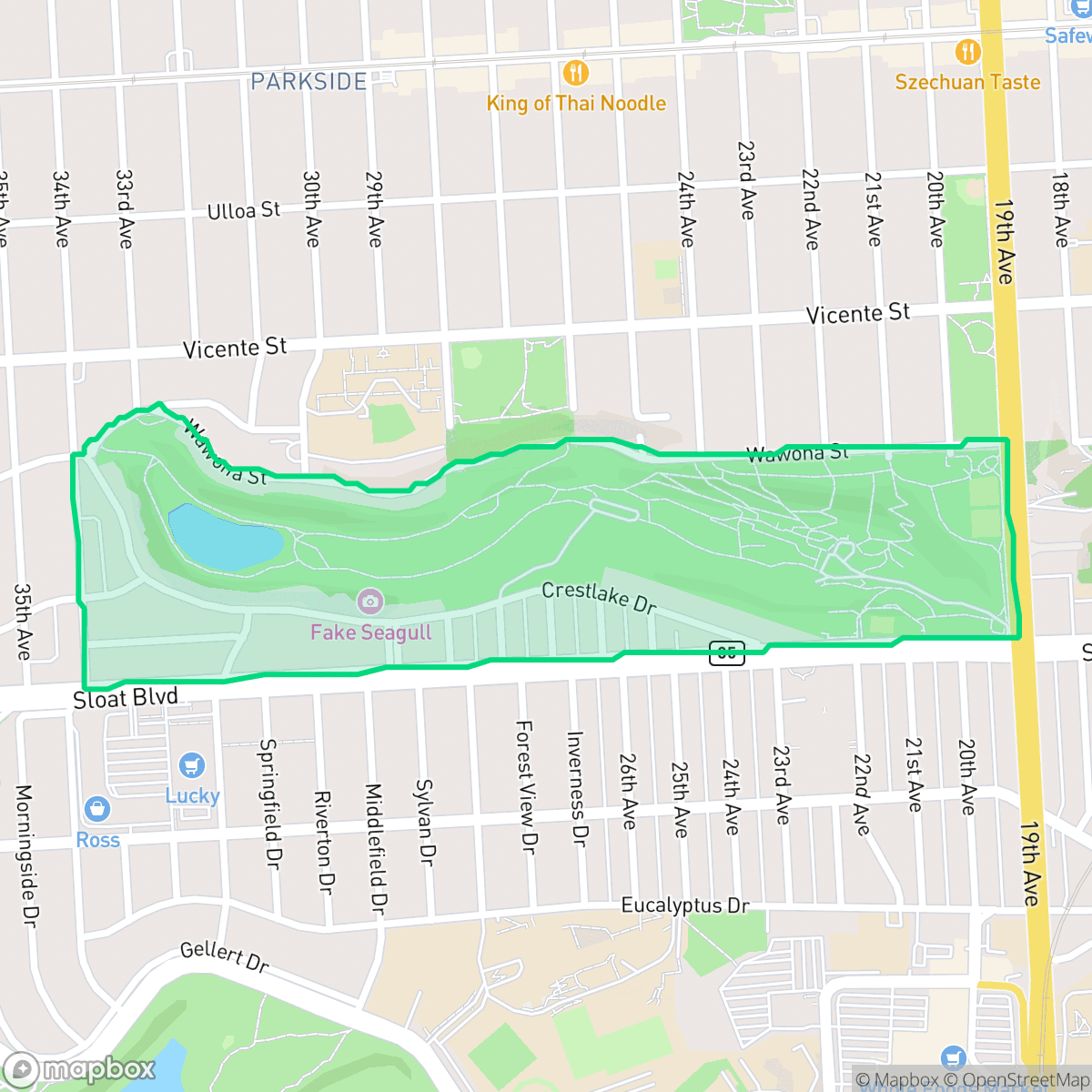
Developed in 1927 by the Parkside Realty Company, Pine Lake Park (originally marketed as "Pinelake Park") is a residential enclave in southwest San Francisco situated between Crestlake Drive and Sloat Boulevard. Conceived as an exclusive development, it featured wider lots, front-yard setbacks, and detached homes, many built in the 1930s in Period Revival styles by prominent builder A.J. Herzig. The neighborhood borders its namesake park, which contains Pine Lake—historically known as Laguna Puerca (Pig Lake)—and the adjacent Sigmund Stern Grove. This forested valley was homesteaded in 1847 by the Greene family, who planted its signature eucalyptus trees and built the historic 1892 Trocadero Inn, a Victorian roadhouse that still stands as a local landmark.
The neighborhood is characterized by a dense grid of residential streets that prioritize walkability and access to nature. Situated near the intersection of major thoroughfares, the area serves as a quiet retreat for residents who value proximity to the recreational trails and forested areas of Sigmund Stern Grove. According to iHuus data, the community benefits from high levels of health insurance coverage and a lack of industrial hazards, contributing to a stable environment for its inhabitants. The architectural landscape consists primarily of mid-century period homes, maintaining a uniform appearance that reflects its early twentieth-century development origins. Residents enjoy a high degree of connectivity to local amenities, making it a functional choice for those who prefer to navigate the city on foot. However, the area presents specific trade-offs regarding acoustic comfort and housing density. The high volume of road traffic contributes to elevated noise levels, which may impact those sensitive to auditory disturbances. Furthermore, the prevalence of closely spaced homes results in limited private outdoor space, and the neighborhood faces challenges regarding flood and fire safety. This area is best suited for individuals who prioritize outdoor access and a walkable lifestyle over absolute quiet or spacious, detached living arrangements.
Neighborhood Scores Across 15 Qualities
Residential structures are situated in close proximity with minimal separation between buildings. This density of housing is consistent with the broader city average.
Pedestrian infrastructure is exceptional here, featuring wide sidewalks on both sides of the street and ample marked crosswalks. This level of accessibility is slightly higher than the San Francisco average, making it easy to navigate the dense street grid on foot.
Dense, middle-class tract housing dominates the area, characterized by uniform boxy roofs and small yards. This level of visual variety is slightly below the San Francisco average according to iHuus data.
Expansive trails and a central lake provide significant open space for pets. According to iHuus data, the abundance of accessible green space makes this area much more dog friendly than the San Francisco average.
Open land and scattered woodland are much more prevalent here than in the typical San Francisco urban landscape. According to iHuus data, residents will find a landscape of fields and trees that feels significantly less dense than the city average.
Residential blocks offer a mix of green spaces and suburban tranquility, though the area is slightly less active than the San Francisco average. While local landmarks like Larsen Park and nearby eateries provide some variety, many daily amenities require a short drive.
Constant noise from nearby heavy rail or airport activity makes this area significantly louder than the city average. Residents can expect minimal acoustic comfort due to persistent transit-related sound.
Air quality remains consistently high with very few instances of pollution. According to iHuus data, these levels are slightly better than the San Francisco average.
Industrial activity is absent here, as the area consists entirely of residential and recreational zones. This lack of warehouses or heavy facilities makes the neighborhood even more free of industrial proximity than the San Francisco average.
Health insurance access is exceptionally high among residents, significantly surpassing the San Francisco average according to iHuus data.
Voting patterns and census indicators show a very strong liberal leaning, closely mirroring the broader political landscape of San Francisco.
Residents live in a community with a diverse mix of young adults, families, and seniors. According to iHuus data, this age distribution is slightly more varied than the average found across San Francisco.
Address-Level Insights for Pine Lake Park


iHuus Neighborhood Intelligence Insights
Get address-level neighborhood insights for Pine Lake Park
- Street-level scores — see how individual blocks compare, not just neighborhood averages
- Micro-zone boundaries — identify quiet pockets, flood boundaries, and walkable clusters before you visit
- 15 dimensions in full — walkability, noise, air quality, school quality, insurance coverage, population age profile, urban/rural index, and more
- Boundary risk alerts — know if your address sits near a block boundary where scores drop, the kind of detail no listing will ever mention
- School insights — individual school ratings and insights, not just district-level data
- Compare before you commit — side-by-side data across neighborhoods, down to block precision
No credit card required
Compare with Any Neighborhood
| Dimension | Pine Lake Park | Alamo Square |
|---|---|---|
| 🚶 Walkabilityavg 9.91 | ||
| 🔊 Acoustic Comfortavg 3.4 | ||
| 🤫 Privacy Indexavg 2.14 | ||
| 🎨 Visual Appealavg 6.26 | ||
| 🐕 Dog Friendlinessavg 6.55 | ||
| 🗺️ Urban-Rural Indexavg 4.07 | ||
| ✨ Neighborhood Vibeavg 6.4 | ||
| 🏥 Health Insurance Coverageavg 7.87 | ||
| 🌿 Air Qualityavg 7.78 | ||
| 🏭 Industrial Proximityavg 9.37 | ||
| 🌊 Flood Safetyavg 1.89 | ||
| 🗳️ Ideological Leanavg 9.92 | ||
| 👥 Population Age Profileavg 5.18 | ||
| 🔥 Fire Safetyavg 0.01 | ||
| 🏫 School Quality |
Pine Lake Park Rankings
School Districts Serving Pine Lake Park
School Insights for Pine Lake Park
Below average outcomes; significant attendance and academic challenges.
School Insights
See what's really behind every school rating near Pine Lake Park
- Individual school ratings — each school's own score with outcome context, not just a district average
- Enrollment & class size data — student-to-teacher ratio and how it compares to the state average
- Full demographics breakdown — ethnicity and gender composition for every school in the enrollment zone
- Every school in the district — all schools within the enrollment boundary ranked by rating, not just the closest one
- Grade levels & benchmarks — elementary through high school, with below/above state-average flags
No credit card required