Parnassus - Ashbury, San Francisco
Updated · 5,682 residents
Parnassus - Ashbury is a dense, highly walkable enclave defined by its steep topography and well-preserved historic architecture. Residents benefit from excellent air quality and immediate access to green spaces, though the area is characterized by high-density housing with limited individual privacy.
Key Highlights
About Parnassus - Ashbury
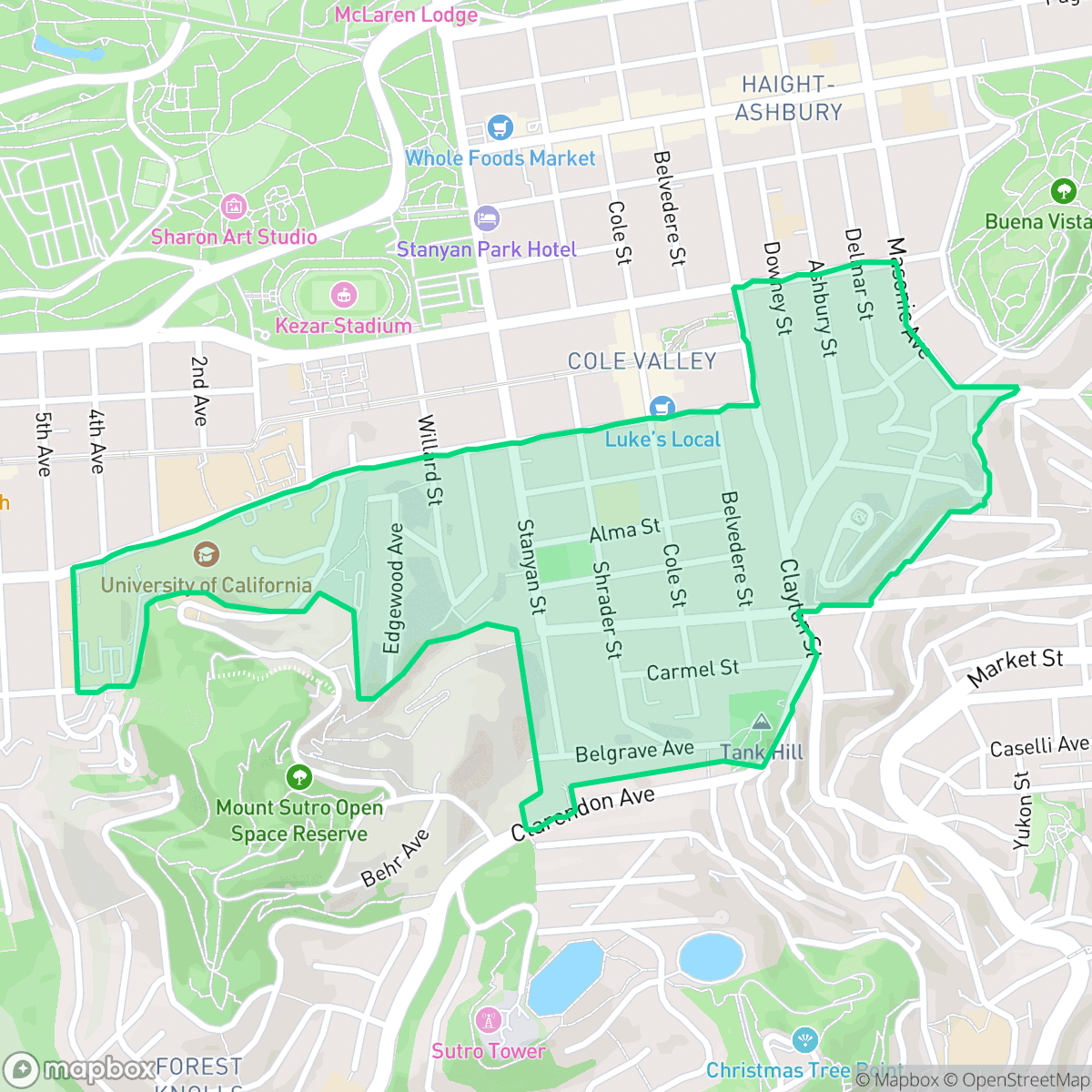
The elevated Parnassus - Ashbury neighborhood in San Francisco is defined by its dramatic topography, historic architecture, and institutional roots. Rising up the slopes of Mount Sutro, the area’s development accelerated in the late 19th century. In 1895, Mayor Adolph Sutro donated 13 acres of land on Mount Parnassus to establish the Affiliated Colleges, which became the anchoring campus of the University of California, San Francisco (UCSF). Spared from the fires of the 1906 earthquake, the neighborhood boasts a remarkably preserved stock of Victorian, Edwardian, and Period-Revival homes. Notable local landmarks include Tank Hill, which offers panoramic views of the city, and the Chautauqua House on Masonic Avenue, the historic 1960s headquarters of the American Indian Historical Society. Today, it remains a quiet residential enclave blending academic energy with historic charm.
The neighborhood functions as a quiet residential corridor that balances academic proximity with a dense urban grid. Its layout supports a high degree of pedestrian access, with continuous sidewalks and clear crossings throughout the area. While the streets are primarily residential, local amenities such as Grattan Playground and various neighborhood cafes provide essential community hubs. The area is notable for its lack of industrial activity, contributing to a clean and stable environment for its residents.
Prospective residents should note that the neighborhood features high-density living with many homes sharing walls, which results in a lower level of individual privacy. While the area offers a peaceful atmosphere with moderate traffic noise, the reliance on dense townhomes is a defining trade-off for those seeking more space. It is well-suited for individuals who prioritize walkability and access to nature over suburban-style seclusion, particularly those affiliated with the nearby university or families drawn to the neighborhood's high-performing elementary school.
Neighborhood Scores Across 15 Qualities
Residential structures often feature shared walls or very narrow gaps between buildings. This level of density is typical for the area and remains consistent with the city average.
Extensive sidewalk networks and frequent pedestrian crossings make navigating the area on foot very easy. According to iHuus data, the neighborhood features a dense grid and integrated trail systems that offer superior pedestrian connectivity compared to the city average.
Large, well-maintained homes with complex rooflines and significant property values define much of the area. This level of visual interest and upscale residential character sits well above the San Francisco average, according to iHuus data.
Extensive access to Mount Sutro Open Space and Golden Gate Park provides abundant trail and parkland options, making the area significantly more dog friendly than most parts of San Francisco. Residents benefit from immediate proximity to large forested areas and open green spaces for walking and recreation.
Significant forest canopy and proximity to large regional parks provide a much more open and wooded feel than the typical San Francisco urban grid. According to iHuus data, the area features frequent open land and a transition from dense residential blocks into forested landscapes.
Suburban streets and green spaces offer occasional lively pockets of dining and cafes, though the overall activity level is lower than the San Francisco average. Residents can find diverse eateries and parks, but many essential businesses are not within immediate walking distance.
Steady traffic sounds from nearby thoroughfares are present, though the acoustic environment remains more tranquil than the typical San Francisco street. According to iHuus data, noise levels are higher than the city average.
Air quality remains consistently clear with rare instances of elevated readings, performing slightly better than the San Francisco average according to iHuus data.
Residential and recreational spaces dominate this area with no detected warehouses, heavy machinery, or industrial hazards. This lack of industrial presence is even more pronounced here than in many other parts of San Francisco, according to iHuus data.
Health insurance enrollment among residents is exceptionally high, significantly surpassing the San Francisco average according to iHuus data.
Voting patterns and census indicators reflect a predominantly liberal community, which is slightly more pronounced than the average seen across San Francisco.
Residents live alongside a balanced demographic of young professionals, families, and seniors. This age distribution is slightly more varied than the broader San Francisco average, according to iHuus data.
Significant flood risk exists here as parts of the neighborhood fall within a designated floodplain; according to iHuus data, this level of risk is slightly above the city average.
Address-Level Insights for Parnassus - Ashbury


iHuus Neighborhood Intelligence Insights
Get address-level neighborhood insights for Parnassus - Ashbury
- Street-level scores — see how individual blocks compare, not just neighborhood averages
- Micro-zone boundaries — identify quiet pockets, flood boundaries, and walkable clusters before you visit
- 15 dimensions in full — walkability, noise, air quality, school quality, insurance coverage, population age profile, urban/rural index, and more
- Boundary risk alerts — know if your address sits near a block boundary where scores drop, the kind of detail no listing will ever mention
- School insights — individual school ratings and insights, not just district-level data
- Compare before you commit — side-by-side data across neighborhoods, down to block precision
No credit card required
Compare with Any Neighborhood
| Dimension | Parnassus - Ashbury | Alamo Square |
|---|---|---|
| 🚶 Walkabilityavg 9.91 | ||
| 🔊 Acoustic Comfortavg 3.4 | ||
| 🤫 Privacy Indexavg 2.14 | ||
| 🎨 Visual Appealavg 6.26 | ||
| 🐕 Dog Friendlinessavg 6.55 | ||
| 🗺️ Urban-Rural Indexavg 4.07 | ||
| ✨ Neighborhood Vibeavg 6.4 | ||
| 🏥 Health Insurance Coverageavg 7.87 | ||
| 🌿 Air Qualityavg 7.78 | ||
| 🏭 Industrial Proximityavg 9.37 | ||
| 🌊 Flood Safetyavg 1.89 | ||
| 🗳️ Ideological Leanavg 9.92 | ||
| 👥 Population Age Profileavg 5.18 | ||
| 🔥 Fire Safetyavg 0.01 | ||
| 🏫 School Quality |
Parnassus - Ashbury Rankings
School Districts Serving Parnassus - Ashbury
School Insights for Parnassus - Ashbury
Below average outcomes; significant attendance and academic challenges.
School Insights
See what's really behind every school rating near Parnassus - Ashbury
- Individual school ratings — each school's own score with outcome context, not just a district average
- Enrollment & class size data — student-to-teacher ratio and how it compares to the state average
- Full demographics breakdown — ethnicity and gender composition for every school in the enrollment zone
- Every school in the district — all schools within the enrollment boundary ranked by rating, not just the closest one
- Grade levels & benchmarks — elementary through high school, with below/above state-average flags
No credit card required