Parkside, San Francisco
Updated · 18,218 residents
Parkside is a residential enclave in San Francisco defined by its dense grid of stucco row houses and exceptional walkability. The area maintains a quiet, suburban atmosphere with convenient access to green spaces like Pine Lake Park, though residents experience limited privacy due to the closely packed housing structures.
Key Highlights
About Parkside
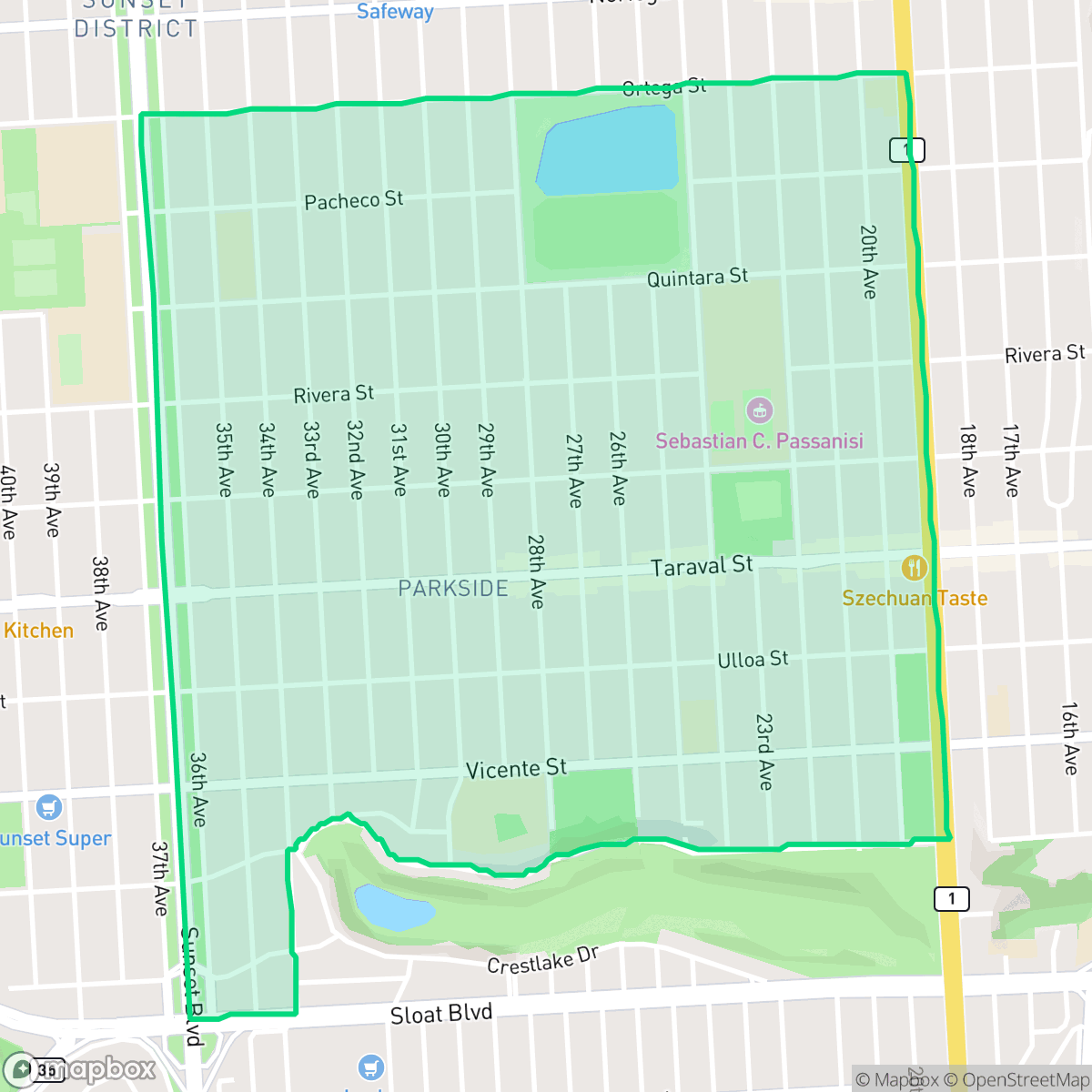
Established in July 1905 when a syndicate led by William Crocker purchased land from the Adolph Sutro estate, San Francisco’s Parkside neighborhood was named for the lush vegetation around Laguna Puerca (now Pine Lake). Originally an isolated expanse of sand dunes inhabited by more rabbits than people, early residents formed the Parkside District Improvement Club to lobby for basic infrastructure. The neighborhood's first homes, built near Sigmund Stern Grove, were Craftsman- and Shingle-style cottages. During the 1920s and 1930s, merchant-builders transformed the area with rows of now-signature, stucco-fronted "cookie-cutter" houses. Taraval Street developed as the neighborhood’s primary commercial spine, anchored by the L Taraval streetcar line. Notable local landmarks include the historic Trocadero Clubhouse—the neighborhood's oldest building—and the scenic Pine Lake Park.
This neighborhood functions as a dense, low-rise urban grid characterized by uniform, stucco-fronted row houses. It serves as a purely residential and recreational environment, entirely free from industrial hazards or heavy commercial activity. The area is anchored by the commercial corridor of Taraval Street, which provides essential services and transit connectivity via the L Taraval line.
Prospective residents should note that the high-density layout results in minimal side-yard clearance and limited privacy between homes. While the environment is generally serene, the average ambient noise level is influenced by local road traffic. The area is well-suited for families seeking access to high-performing institutions like Robert Louis Stevenson Elementary, as well as those who prioritize a walkable lifestyle within a stable, established community.
Neighborhood Scores Across 15 Qualities
Residential structures often feature shared walls or very narrow gaps between buildings. According to iHuus data, this level of density results in privacy that is slightly below the San Francisco average.
Continuous sidewalks and frequent marked crosswalks make navigating the neighborhood on foot exceptionally easy. According to iHuus data, this area offers superior connectivity for pedestrians compared to the rest of San Francisco.
Dense, middle-class row houses and multi-story buildings characterize the area. This consistent landscape of small yards and boxy roofs is slightly below the San Francisco average for visual variety.
Expansive green spaces, including Sunset Reservoir and large central parklands, provide ample room for exercise. Access to trails and public parks is slightly above the San Francisco average according to iHuus data.
Streets and green spaces exist in roughly equal measure, providing a more suburban atmosphere than the denser urban center of San Francisco. According to iHuus data, this balance of low-rise residential grids and distributed open space makes the area feel less cramped than the city average.
Suburban streets and green spaces provide a serene environment with pockets of lively dining, though the overall energy is lower than the San Francisco average. While diverse eateries and playgrounds are accessible, many residential blocks lack a high density of nearby businesses.
Frequent noise from nearby transit corridors and major roadways is a notable feature of this area. According to iHuus data, acoustic comfort in Parkside is slightly below the city average.
Air quality in Parkside is mostly clean with rare instances of elevated readings. This level of air purity is slightly above the San Francisco average, according to iHuus data.
Industrial activity and warehouses are entirely absent from this area. According to iHuus data, the neighborhood contains no detectable industrial hazards or heavy machinery, making it even more residential than the San Francisco average.
Health insurance access is widespread among residents, remaining significantly above the San Francisco average according to iHuus data.
Voting patterns and census indicators show a highly liberal political leaning that is consistent with the broader San Francisco area, according to iHuus data.
A diverse age range of young professionals, families, and seniors characterizes the area. According to iHuus data, this demographic spread is slightly more balanced than the San Francisco average.
Located within a coastal high-hazard zone with potential wave action, this area faces significant flood vulnerability. According to iHuus data, the risk level is considerably higher than the San Francisco average, which may result in elevated or prohibitive insurance costs for residents.
Address-Level Insights for Parkside


iHuus Neighborhood Intelligence Insights
Get address-level neighborhood insights for Parkside
- Street-level scores — see how individual blocks compare, not just neighborhood averages
- Micro-zone boundaries — identify quiet pockets, flood boundaries, and walkable clusters before you visit
- 15 dimensions in full — walkability, noise, air quality, school quality, insurance coverage, population age profile, urban/rural index, and more
- Boundary risk alerts — know if your address sits near a block boundary where scores drop, the kind of detail no listing will ever mention
- School insights — individual school ratings and insights, not just district-level data
- Compare before you commit — side-by-side data across neighborhoods, down to block precision
No credit card required
Compare with Any Neighborhood
| Dimension | Parkside | Alamo Square |
|---|---|---|
| 🚶 Walkabilityavg 9.91 | ||
| 🔊 Acoustic Comfortavg 3.4 | ||
| 🤫 Privacy Indexavg 2.14 | ||
| 🎨 Visual Appealavg 6.26 | ||
| 🐕 Dog Friendlinessavg 6.55 | ||
| 🗺️ Urban-Rural Indexavg 4.07 | ||
| ✨ Neighborhood Vibeavg 6.4 | ||
| 🏥 Health Insurance Coverageavg 7.87 | ||
| 🌿 Air Qualityavg 7.78 | ||
| 🏭 Industrial Proximityavg 9.37 | ||
| 🌊 Flood Safetyavg 1.89 | ||
| 🗳️ Ideological Leanavg 9.92 | ||
| 👥 Population Age Profileavg 5.18 | ||
| 🔥 Fire Safetyavg 0.01 | ||
| 🏫 School Quality |
Parkside Rankings
School Districts Serving Parkside
School Insights for Parkside
Below average outcomes; significant attendance and academic challenges.
School Insights
See what's really behind every school rating near Parkside
- Individual school ratings — each school's own score with outcome context, not just a district average
- Enrollment & class size data — student-to-teacher ratio and how it compares to the state average
- Full demographics breakdown — ethnicity and gender composition for every school in the enrollment zone
- Every school in the district — all schools within the enrollment boundary ranked by rating, not just the closest one
- Grade levels & benchmarks — elementary through high school, with below/above state-average flags
No credit card required