Parkmerced, San Francisco
Updated · 3,207 residents
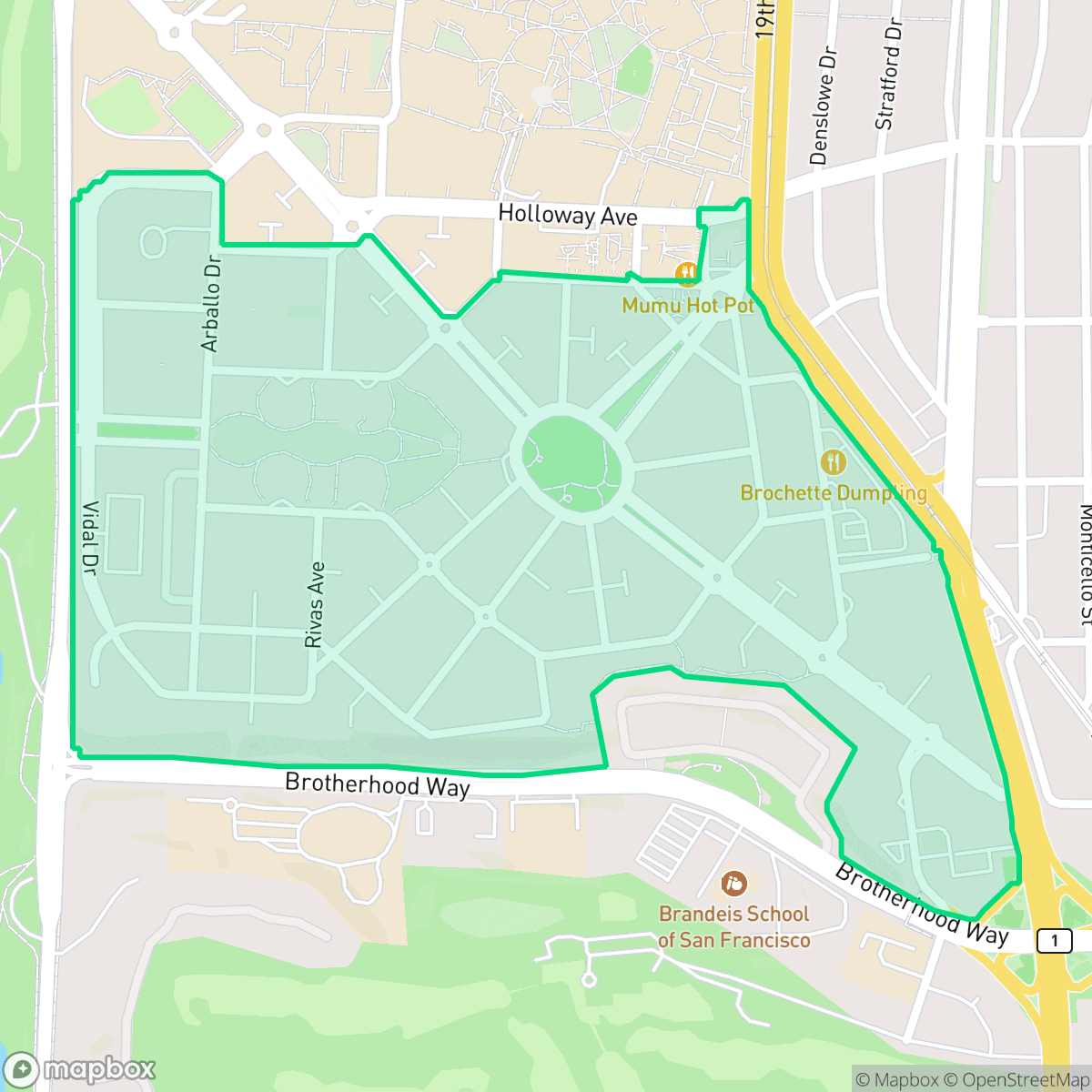
Parkmerced is a highly walkable community that blends dense apartment living with extensive green space, featuring a unique radial layout centered on Juan Bautista Circle. Residents benefit from excellent access to parks and high levels of health insurance coverage, though the neighborhood experiences moderate traffic noise and limited privacy due to its high-density design.
Key Highlights
About Parkmerced
Developed by the Metropolitan Life Insurance Company beginning in 1939, Parkmerced was designed as a self-contained "city within a city" for middle-income renters. Architect Leonard Schultze and pioneering landscape architect Thomas Church broke from San Francisco’s traditional street grid, utilizing radial geometry and Beaux Arts planning. The neighborhood’s unique, pie-shaped blocks and garden courtyards radiate from Juan Bautista Circle, a central three-acre oval park. Initially featuring low-rise garden apartments, the complex expanded in the early 1950s with eleven 13-story towers to accommodate returning World War II and Korean War veterans. Today, Parkmerced remains one of only four surviving large-scale, master-planned garden apartment complexes in the United States, serving as a distinct modernist architectural landmark.
The neighborhood functions as a dense, urban-suburban environment known for its exceptional walkability and proximity to nearby golf courses and public parks. It maintains a calm atmosphere despite its density, with local amenities such as grocers and restaurants located within easy reach of residents. The area is strictly residential with no industrial hazards, which contributes to high air quality and a secure environment for its inhabitants. The community is well-suited for those who prioritize pedestrian access and proximity to nature over the privacy of single-family homes.
Prospective residents should consider the trade-offs inherent in this high-density design, such as shared walls and limited privacy between units. While the neighborhood is exceptionally dog-friendly and well-connected for pedestrians, it is subject to moderate noise levels from nearby road traffic. Families should also be aware that local schools within the San Francisco Unified School District currently face significant financial and operational challenges, which may impact long-term educational planning for those moving to the area.
Neighborhood Scores Across 15 Qualities
Residential units are situated in close quarters with many shared walls and minimal separation between buildings. This level of density offers more privacy than the typical San Francisco neighborhood, according to iHuus data.
Wide sidewalks, clearly marked crosswalks, and a radial street design make navigating the neighborhood on foot highly efficient. While slightly below the city average for overall walkability, the area features a dense network of pedestrian pathways and low-traffic interior roads.
Residential views consist primarily of dense, functional apartment complexes and uniform row housing. According to iHuus data, the visual landscape is slightly less varied than the San Francisco average, characterized by boxy rooflines and shared communal spaces rather than private estates.
Abundant green space from the nearby golf course and interconnected campus lawns provide extensive walking areas for pets. According to iHuus data, these continuous paths and large parks offer significantly more dog walking opportunities than the city average.
Residential blocks feature a balanced mix of multi-story apartment complexes and significant green space. This layout provides a more suburban character than most of San Francisco, according to iHuus data.
Suburban blocks and green spaces provide a calm atmosphere with occasional social activity at local cafes and parks. This level of neighborhood liveliness is slightly below the city average, offering a more serene residential experience than more densely active urban hubs.
Frequent sounds from nearby transit corridors and heavy traffic dominate the environment. This level of acoustic disturbance is notably higher than the average for San Francisco, according to iHuus data.
Air quality remains consistently high with rare instances of elevated readings. This level of freshness is slightly better than the San Francisco average according to iHuus data.
Residential and recreational uses dominate the area with no detected warehouses or hazardous industrial facilities. While the presence of a nearby rail yard and transit maintenance facility may impact noise levels, the neighborhood lacks the industrial activity found in other parts of the city.
Health insurance accessibility is exceptionally high among Parkmerced residents, significantly surpassing the San Francisco city average according to iHuus data.
Voting patterns and census indicators show a deeply liberal political leaning that is consistent with the broader San Francisco average, according to iHuus data.
Residents live alongside a balanced blend of young professionals, families, and seniors. According to iHuus data, this age distribution is slightly more diverse than the typical San Francisco profile.
Properties are situated within a known floodplain, which may necessitate the purchase of flood insurance. According to iHuus data, the risk level in this area is slightly higher than the San Francisco average.
Address-Level Insights for Parkmerced


iHuus Neighborhood Intelligence Insights
Get address-level neighborhood insights for Parkmerced
- Street-level scores — see how individual blocks compare, not just neighborhood averages
- Micro-zone boundaries — identify quiet pockets, flood boundaries, and walkable clusters before you visit
- 15 dimensions in full — walkability, noise, air quality, school quality, insurance coverage, population age profile, urban/rural index, and more
- Boundary risk alerts — know if your address sits near a block boundary where scores drop, the kind of detail no listing will ever mention
- School insights — individual school ratings and insights, not just district-level data
- Compare before you commit — side-by-side data across neighborhoods, down to block precision
No credit card required
Compare with Any Neighborhood
| Dimension | Parkmerced | Alamo Square |
|---|---|---|
| 🚶 Walkabilityavg 9.91 | ||
| 🔊 Acoustic Comfortavg 3.4 | ||
| 🤫 Privacy Indexavg 2.14 | ||
| 🎨 Visual Appealavg 6.26 | ||
| 🐕 Dog Friendlinessavg 6.55 | ||
| 🗺️ Urban-Rural Indexavg 4.07 | ||
| ✨ Neighborhood Vibeavg 6.4 | ||
| 🏥 Health Insurance Coverageavg 7.87 | ||
| 🌿 Air Qualityavg 7.78 | ||
| 🏭 Industrial Proximityavg 9.37 | ||
| 🌊 Flood Safetyavg 1.89 | ||
| 🗳️ Ideological Leanavg 9.92 | ||
| 👥 Population Age Profileavg 5.18 | ||
| 🔥 Fire Safetyavg 0.01 | ||
| 🏫 School Quality |
Parkmerced Rankings
School Districts Serving Parkmerced
School Insights for Parkmerced
Below average outcomes; significant attendance and academic challenges.
School Insights
See what's really behind every school rating near Parkmerced
- Individual school ratings — each school's own score with outcome context, not just a district average
- Enrollment & class size data — student-to-teacher ratio and how it compares to the state average
- Full demographics breakdown — ethnicity and gender composition for every school in the enrollment zone
- Every school in the district — all schools within the enrollment boundary ranked by rating, not just the closest one
- Grade levels & benchmarks — elementary through high school, with below/above state-average flags
No credit card required