Panhandle, San Francisco
Updated · 7,146 residents
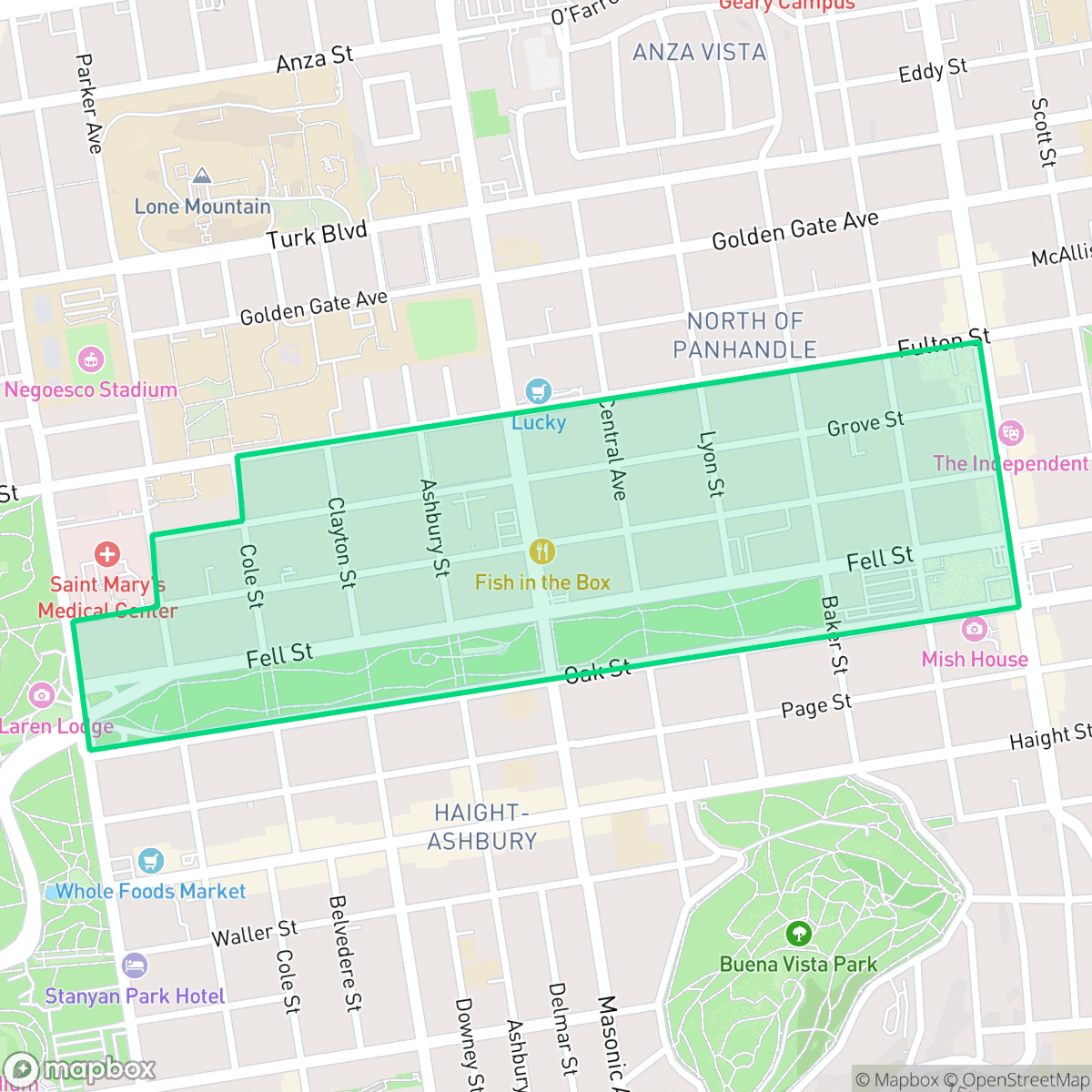
The Panhandle is a dense, highly walkable residential neighborhood defined by its namesake park and historic Victorian architecture. It offers excellent access to outdoor recreation and pet-friendly spaces, though residents should expect a standard urban environment with limited private outdoor space and noticeable traffic noise.
Key Highlights
About Panhandle
San Francisco’s Panhandle neighborhood developed around the narrow, eight-block-long park of the same name, originally part of the windswept "Outside Lands" known as the "Great Sand Bank". In 1870, the Panhandle was established as a compromise with local squatters, serving as "the Avenue" carriage entrance to Golden Gate Park. Park engineer William Hammond Hall used the fertile strip as an experimental laboratory to stabilize sand dunes, planting barley and lupin before cultivating the park's oldest Monterey pines, cypresses, and eucalyptus. The surrounding area quickly grew into a Victorian streetcar suburb. At the park's eastern end stands the 1904 William McKinley Memorial, dedicated by Theodore Roosevelt. In the 1950s and 1960s, a historic citizen-led "freeway revolt" successfully blocked plans to run a freeway through the park, preserving the neighborhood's character and its historic Victorian and Edwardian architecture.
The area is characterized by its dense, grid-like layout and immediate proximity to the green corridor of the park. It functions as a calm, residential enclave with a strong sense of community, supported by local institutions and high rates of health insurance coverage. According to iHuus data, the neighborhood provides high air quality and a complete lack of industrial activity, making it a clean, if compact, place to live. The neighborhood maintains a consistent, calm vibe with local cafes and eateries providing convenient, low-key dining options for residents.
Living here involves trade-offs common to high-density San Francisco districts. Privacy is limited due to tightly packed housing, and road traffic contributes to a moderate noise level throughout the day. While the local school district faces significant financial and administrative challenges, families may find stability in specific high-performing options like New Traditions Elementary. The neighborhood is well-suited for those who prioritize walkability and dog-friendly amenities over expansive private living spaces.
Neighborhood Scores Across 15 Qualities
Buildings are tightly packed with minimal separation between structures, resulting in a level of privacy that is slightly lower than the San Francisco average. Many residences feature shared walls or very narrow gaps between adjacent properties, according to iHuus data.
Pedestrian access is exceptionally easy due to a dense grid of continuous sidewalks and frequent crosswalks. This level of connectivity is slightly higher than the San Francisco average, making the area ideal for navigating without a vehicle.
Dense row housing and flat-roofed structures define the streetscape, which is largely consistent with the city average. According to iHuus data, the area features well-maintained residential blocks but lacks large private yards or luxury estates.
Immediate access to Golden Gate Park and its extensive trail networks provides much more green space for pets than the typical San Francisco neighborhood. According to iHuus data, the area features wide paths and large open fields that are well-connected to the surrounding streets.
Streets and green spaces exist in roughly equal measure, offering a more suburban balance of infrastructure and parks than the typical San Francisco density. This blend of multi-story residential buildings and significant park access provides a more open feel than the city average.
Local social hubs and diverse dining spots provide a steady level of activity, though the neighborhood feels slightly less bustling than the San Francisco average. Residents will find a mix of calm mid-rise blocks and lively patches of green space near community landmarks.
Frequent noise from nearby transit corridors and heavy traffic is a notable feature of the area. According to iHuus data, acoustic levels in this neighborhood are similar to the city average.
Air quality is consistently good with rare instances of elevated readings. According to iHuus data, the air quality in this area is slightly better than the San Francisco average.
Industrial presence is nonexistent in this area, as the landscape consists entirely of residential, recreational, and institutional spaces. According to iHuus data, this lack of warehouses or heavy machinery makes the neighborhood even more free of industrial hazards than the San Francisco average.
Health insurance access among residents is exceptionally high, significantly surpassing the San Francisco average according to iHuus data.
Voting patterns and census indicators show a deeply liberal political landscape that is consistent with the broader San Francisco average, according to iHuus data.
Residents live alongside a varied mix of young professionals, families, and seniors. This demographic spread is slightly lower than the city average, according to iHuus data.
Address-Level Insights for Panhandle


iHuus Neighborhood Intelligence Insights
Get address-level neighborhood insights for Panhandle
- Street-level scores — see how individual blocks compare, not just neighborhood averages
- Micro-zone boundaries — identify quiet pockets, flood boundaries, and walkable clusters before you visit
- 15 dimensions in full — walkability, noise, air quality, school quality, insurance coverage, population age profile, urban/rural index, and more
- Boundary risk alerts — know if your address sits near a block boundary where scores drop, the kind of detail no listing will ever mention
- School insights — individual school ratings and insights, not just district-level data
- Compare before you commit — side-by-side data across neighborhoods, down to block precision
No credit card required
Compare with Any Neighborhood
| Dimension | Panhandle | Alamo Square |
|---|---|---|
| 🚶 Walkabilityavg 9.91 | ||
| 🔊 Acoustic Comfortavg 3.4 | ||
| 🤫 Privacy Indexavg 2.14 | ||
| 🎨 Visual Appealavg 6.26 | ||
| 🐕 Dog Friendlinessavg 6.55 | ||
| 🗺️ Urban-Rural Indexavg 4.07 | ||
| ✨ Neighborhood Vibeavg 6.4 | ||
| 🏥 Health Insurance Coverageavg 7.87 | ||
| 🌿 Air Qualityavg 7.78 | ||
| 🏭 Industrial Proximityavg 9.37 | ||
| 🌊 Flood Safetyavg 1.89 | ||
| 🗳️ Ideological Leanavg 9.92 | ||
| 👥 Population Age Profileavg 5.18 | ||
| 🔥 Fire Safetyavg 0.01 | ||
| 🏫 School Quality |
Panhandle Rankings
School Districts Serving Panhandle
School Insights for Panhandle
Below average outcomes; significant attendance and academic challenges.
School Insights
See what's really behind every school rating near Panhandle
- Individual school ratings — each school's own score with outcome context, not just a district average
- Enrollment & class size data — student-to-teacher ratio and how it compares to the state average
- Full demographics breakdown — ethnicity and gender composition for every school in the enrollment zone
- Every school in the district — all schools within the enrollment boundary ranked by rating, not just the closest one
- Grade levels & benchmarks — elementary through high school, with below/above state-average flags
No credit card required