Pacific Heights, San Francisco
Updated · 19,318 residents
Pacific Heights is a dense, highly walkable urban enclave defined by its steep topography and vibrant local dining scene. While the area offers exceptional access to daily amenities and prestigious parks, residents experience a high-density environment with limited privacy between homes and noticeable noise from road traffic.
Key Highlights
About Pacific Heights
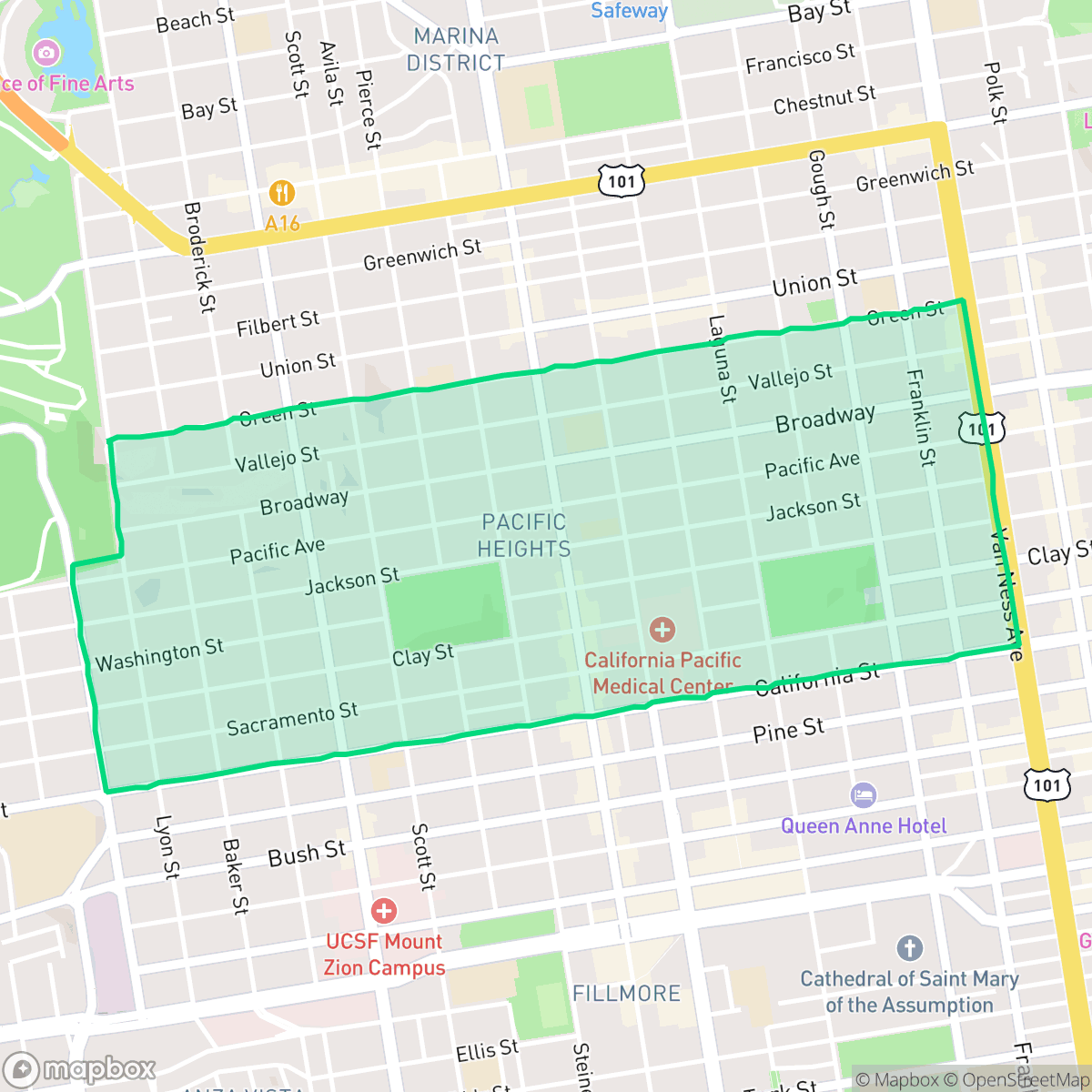
Originally a landscape of sand dunes and chaparral, San Francisco’s Pacific Heights evolved into a prestigious residential enclave after the Gold Rush, accelerated by late-19th-century cable car lines. Because Van Ness Avenue acted as a firebreak during the 1906 earthquake and fire, the neighborhood preserved an unmatched concentration of pre-1906 architecture. Today, its steep streets feature a rich tapestry of Victorian, Edwardian, and Classical Revival estates, including the 1886 Queen Anne-style Haas-Lilienthal House and Willis Polk's Bourn Mansion. Celebrated for its dramatic topography, the neighborhood is defined by the scenic Lyon Street Steps, the bustling commercial corridor of Fillmore Street, and "Billionaires’ Row" along Broadway, which offers panoramic views of the Golden Gate Bridge and San Francisco Bay.
The neighborhood functions as a central hub for urban living, characterized by a continuous street grid and a high concentration of multi-story residential buildings. Residents benefit from a diverse selection of restaurants and cafes along the Fillmore Street corridor, alongside recreational access to Lafayette Park. The area maintains a high level of livability through its consistent walkability and the absence of industrial hazards, supporting a stable population with excellent access to health insurance coverage. It is well-suited for those who prioritize proximity to city amenities and a fast-paced urban lifestyle over suburban quiet or expansive private outdoor space.
Living in this area involves navigating a dense, concrete-heavy landscape where buildings often share walls, resulting in a low privacy index. The acoustic environment is dominated by road traffic, which averages 63 decibels throughout the neighborhood. Prospective residents should be aware that while the area provides a high-quality urban experience, the high-density layout means that personal space is at a premium and street-level noise is a constant factor of daily life.
Neighborhood Scores Across 15 Qualities
Residential structures are often built with shared walls or minimal separation between buildings. This level of density is consistent with the broader San Francisco average.
Continuous sidewalks on both sides of the street and frequent, marked crosswalks create an exceptionally navigable environment. This level of connectivity and sidewalk quality is slightly above the San Francisco average according to iHuus data.
Large, well-maintained multi-story homes and proximity to manicured urban parks provide a visual landscape that is slightly more upscale than the San Francisco average. According to iHuus data, the area features prestigious architecture and premium amenities that distinguish it from standard high-density urban housing.
Direct access to Lafayette Park and Jefferson Square provides reliable green space for pets. While the area is densely built, the presence of these large public parks makes it slightly less dog friendly than the San Francisco average.
Continuous street walls and multi-story residential buildings create a highly developed environment. This area is significantly more built-up and dense than the San Francisco average, with very little unbuilt ground space or private greenery.
Diverse dining and social hubs provide a level of activity that is notably higher than the San Francisco average. Residents can access various cafes and eateries, though the density of walkable businesses varies depending on the specific block.
Persistent noise from nearby major transit corridors and flight paths is more prevalent here than the city average, according to iHuus data. Residents may experience regular auditory disturbances from heavy vehicle traffic and aerial activity.
Air quality remains consistently high with very few instances of pollutants. According to iHuus data, levels in this area are slightly better than the San Francisco average.
Industrial presence is non-existent here, as the area consists entirely of residential, commercial, and recreational spaces. This lack of heavy industry and warehouses is even more pronounced than the city average, according to iHuus data.
Health insurance access is exceptionally high for residents here, significantly exceeding the San Francisco average according to iHuus data.
Voting patterns and census indicators show a strong liberal leaning that is consistent with the city average. Residents will find a political landscape that closely mirrors the broader San Francisco area, according to iHuus data.
A balanced mix of young professionals, families, and older residents characterizes the local population. This demographic spread is largely in line with the broader San Francisco average, according to iHuus data.
Flood risk in this area is notably higher than the San Francisco average due to its location within a designated floodplain. Residents should be aware that flood insurance is typically required for properties in this zone according to iHuus data.
Address-Level Insights for Pacific Heights


iHuus Neighborhood Intelligence Insights
Get address-level neighborhood insights for Pacific Heights
- Street-level scores — see how individual blocks compare, not just neighborhood averages
- Micro-zone boundaries — identify quiet pockets, flood boundaries, and walkable clusters before you visit
- 15 dimensions in full — walkability, noise, air quality, school quality, insurance coverage, population age profile, urban/rural index, and more
- Boundary risk alerts — know if your address sits near a block boundary where scores drop, the kind of detail no listing will ever mention
- School insights — individual school ratings and insights, not just district-level data
- Compare before you commit — side-by-side data across neighborhoods, down to block precision
No credit card required
Compare with Any Neighborhood
| Dimension | Pacific Heights | Alamo Square |
|---|---|---|
| 🚶 Walkabilityavg 9.91 | ||
| 🔊 Acoustic Comfortavg 3.4 | ||
| 🤫 Privacy Indexavg 2.14 | ||
| 🎨 Visual Appealavg 6.26 | ||
| 🐕 Dog Friendlinessavg 6.55 | ||
| 🗺️ Urban-Rural Indexavg 4.07 | ||
| ✨ Neighborhood Vibeavg 6.4 | ||
| 🏥 Health Insurance Coverageavg 7.87 | ||
| 🌿 Air Qualityavg 7.78 | ||
| 🏭 Industrial Proximityavg 9.37 | ||
| 🌊 Flood Safetyavg 1.89 | ||
| 🗳️ Ideological Leanavg 9.92 | ||
| 👥 Population Age Profileavg 5.18 | ||
| 🔥 Fire Safetyavg 0.01 | ||
| 🏫 School Quality |
Pacific Heights Rankings
School Districts Serving Pacific Heights
School Insights for Pacific Heights
Below average outcomes; significant attendance and academic challenges.
School Insights
See what's really behind every school rating near Pacific Heights
- Individual school ratings — each school's own score with outcome context, not just a district average
- Enrollment & class size data — student-to-teacher ratio and how it compares to the state average
- Full demographics breakdown — ethnicity and gender composition for every school in the enrollment zone
- Every school in the district — all schools within the enrollment boundary ranked by rating, not just the closest one
- Grade levels & benchmarks — elementary through high school, with below/above state-average flags
No credit card required