Outer Richmond, San Francisco
Updated · 13,989 residents
The Outer Richmond is a highly walkable, residential neighborhood defined by its dense grid of row houses and proximity to the Pacific coastline. Residents benefit from excellent access to outdoor recreation and a quiet, suburban atmosphere that remains free from industrial activity.
Key Highlights
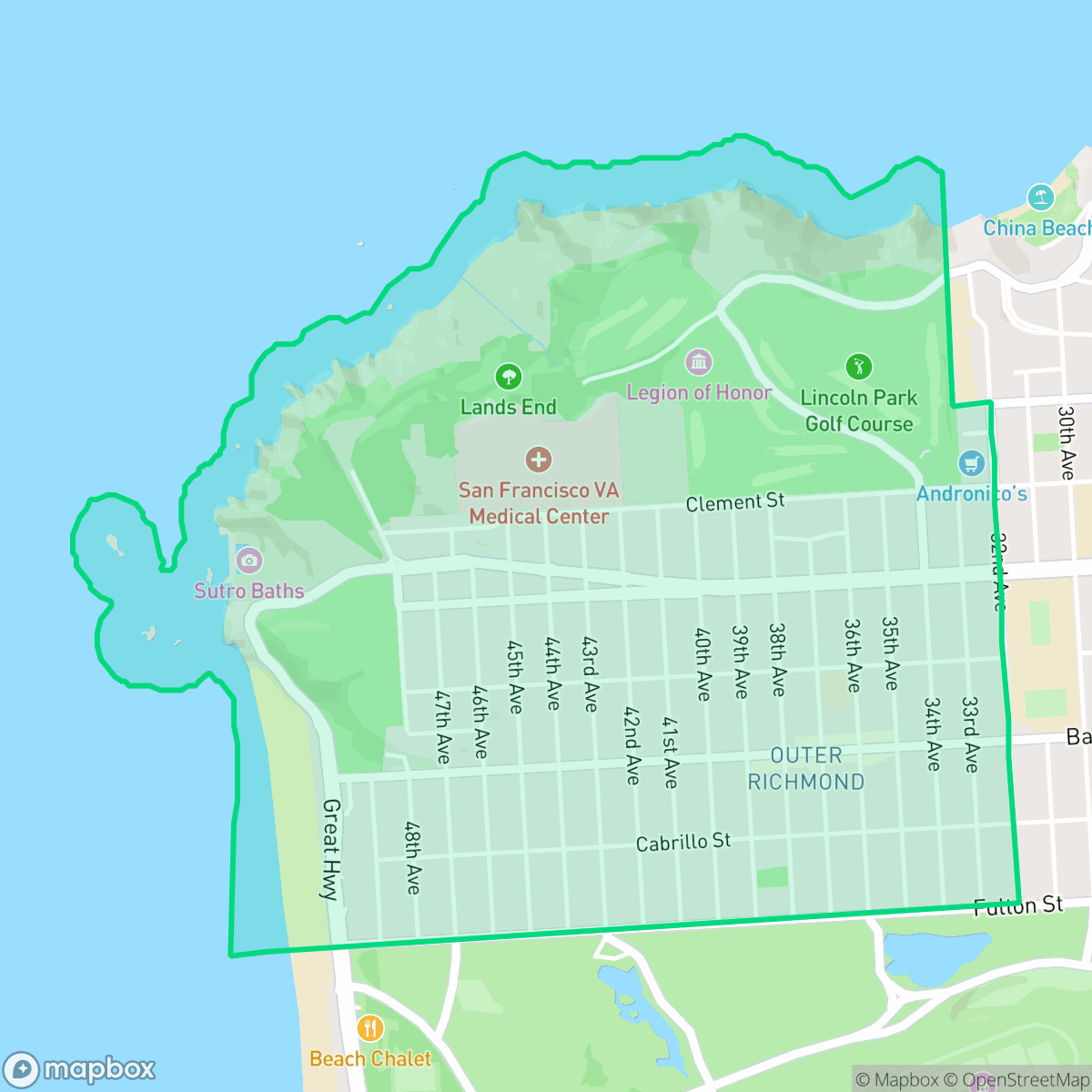
About Outer Richmond
The Outer Richmond, the westernmost section of San Francisco’s Richmond District, evolved from a windswept expanse of sand dunes and coastal scrub known as the "Outside Lands" into a vibrant coastal neighborhood. Its development was catalyzed in the late 19th century by silver magnate and former mayor Adolph Sutro, who purchased the Cliff House, established Sutro Heights, and built the massive Sutro Baths near Ocean Beach. The 1906 earthquake accelerated residential growth, transforming the remote dunes into a streetcar suburb. For decades, the neighborhood hosted Playland-at-the-Beach, a beloved seaside amusement park. Today, the Outer Richmond retains a distinct, fog-swept character, anchored by historic landmarks like the 1926 Balboa Theatre, the ruins of the Sutro Baths, and a diverse culinary scene reflecting waves of Russian and Asian immigration.
The area is characterized by a dense, low-rise urban grid of multi-story row houses. It offers a consistent, quiet environment with minimal noise pollution, making it a peaceful retreat from the city center. The neighborhood is exceptionally walkable, ensuring that daily errands and local services are easily accessible on foot. Its location provides residents with immediate access to significant green spaces and the coastline, supporting a high degree of dog friendliness and outdoor activity.
While the neighborhood offers a stable, primarily residential environment with high health insurance coverage, prospective residents should consider the trade-offs of high-density living, which results in limited privacy due to shared walls and close building proximity. The local school district faces significant fiscal challenges, which may impact families. The area is best suited for those who prioritize a quiet, coastal lifestyle and walkability over expansive private outdoor space or proximity to industrial hubs.
Neighborhood Scores Across 15 Qualities
Structures often feature shared walls or minimal separation between buildings. This density of housing is consistent with the city average for San Francisco.
Continuous sidewalks and a dense grid of marked crosswalks make navigating the area on foot easy. This level of pedestrian accessibility is slightly above the San Francisco average according to iHuus data.
Visual aesthetics range from manicured coastal estates near luxury amenities to dense, traditional urban rows. According to iHuus data, the overall visual appeal is slightly above the San Francisco average.
Expansive parklands, golf courses, and direct beach access provide abundant opportunities for pet owners. This accessibility to large green spaces and wide paths is notably higher than the city average, according to iHuus data.
Frequent access to open land and coastal park interfaces provides a more spacious feel than the dense urban core of San Francisco. According to iHuus data, the area features a mix of residential grids and managed greenery that feels significantly less built-up than the city average.
Residential blocks offer a serene, low-density environment with notable pockets of greenery and coastline access. While local dining and coffee shops are available, the neighborhood is less active than the San Francisco average, featuring more tranquil spaces than the city center.
Acoustic levels remain notably lower than the San Francisco average, characterized by infrequent traffic and distant transit sounds. According to iHuus data, the area offers a tranquil environment suitable for those seeking minimal urban noise.
Air quality in this area is lower than the San Francisco average, as residents may experience occasional days with unhealthy conditions for sensitive groups. According to iHuus data, the air quality fluctuates between acceptable and concerning levels.
Industrial activity and warehouses are entirely absent from this area, providing a cleaner environment than much of San Francisco. According to iHuus data, the neighborhood consists solely of residential, recreational, and light commercial uses.
Health insurance access is exceptionally high in this area, significantly surpassing the San Francisco city average. According to iHuus data, nearly all residents are covered by a health plan.
Voting patterns and census indicators show a strong liberal leaning that is consistent with the rest of San Francisco. According to iHuus data, the political landscape here aligns closely with the city average.
Residents live among a diverse age range of young professionals, families, and seniors. According to iHuus data, this age distribution is slightly more varied than the broader San Francisco average.
Frequent flooding is a concern in this area because portions of the neighborhood sit within a designated floodplain. According to iHuus data, this risk level is notably higher than the San Francisco city average and often necessitates flood insurance.
Address-Level Insights for Outer Richmond


iHuus Neighborhood Intelligence Insights
Get address-level neighborhood insights for Outer Richmond
- Street-level scores — see how individual blocks compare, not just neighborhood averages
- Micro-zone boundaries — identify quiet pockets, flood boundaries, and walkable clusters before you visit
- 15 dimensions in full — walkability, noise, air quality, school quality, insurance coverage, population age profile, urban/rural index, and more
- Boundary risk alerts — know if your address sits near a block boundary where scores drop, the kind of detail no listing will ever mention
- School insights — individual school ratings and insights, not just district-level data
- Compare before you commit — side-by-side data across neighborhoods, down to block precision
No credit card required
Compare with Any Neighborhood
| Dimension | Outer Richmond | Alamo Square |
|---|---|---|
| 🚶 Walkabilityavg 9.91 | ||
| 🔊 Acoustic Comfortavg 3.4 | ||
| 🤫 Privacy Indexavg 2.14 | ||
| 🎨 Visual Appealavg 6.26 | ||
| 🐕 Dog Friendlinessavg 6.55 | ||
| 🗺️ Urban-Rural Indexavg 4.07 | ||
| ✨ Neighborhood Vibeavg 6.4 | ||
| 🏥 Health Insurance Coverageavg 7.87 | ||
| 🌿 Air Qualityavg 7.78 | ||
| 🏭 Industrial Proximityavg 9.37 | ||
| 🌊 Flood Safetyavg 1.89 | ||
| 🗳️ Ideological Leanavg 9.92 | ||
| 👥 Population Age Profileavg 5.18 | ||
| 🔥 Fire Safetyavg 0.01 | ||
| 🏫 School Quality |
Outer Richmond Rankings
School Districts Serving Outer Richmond
School Insights for Outer Richmond
Below average outcomes; significant attendance and academic challenges.
School Insights
See what's really behind every school rating near Outer Richmond
- Individual school ratings — each school's own score with outcome context, not just a district average
- Enrollment & class size data — student-to-teacher ratio and how it compares to the state average
- Full demographics breakdown — ethnicity and gender composition for every school in the enrollment zone
- Every school in the district — all schools within the enrollment boundary ranked by rating, not just the closest one
- Grade levels & benchmarks — elementary through high school, with below/above state-average flags
No credit card required