Outer Parkside, San Francisco
Updated · 14,476 residents
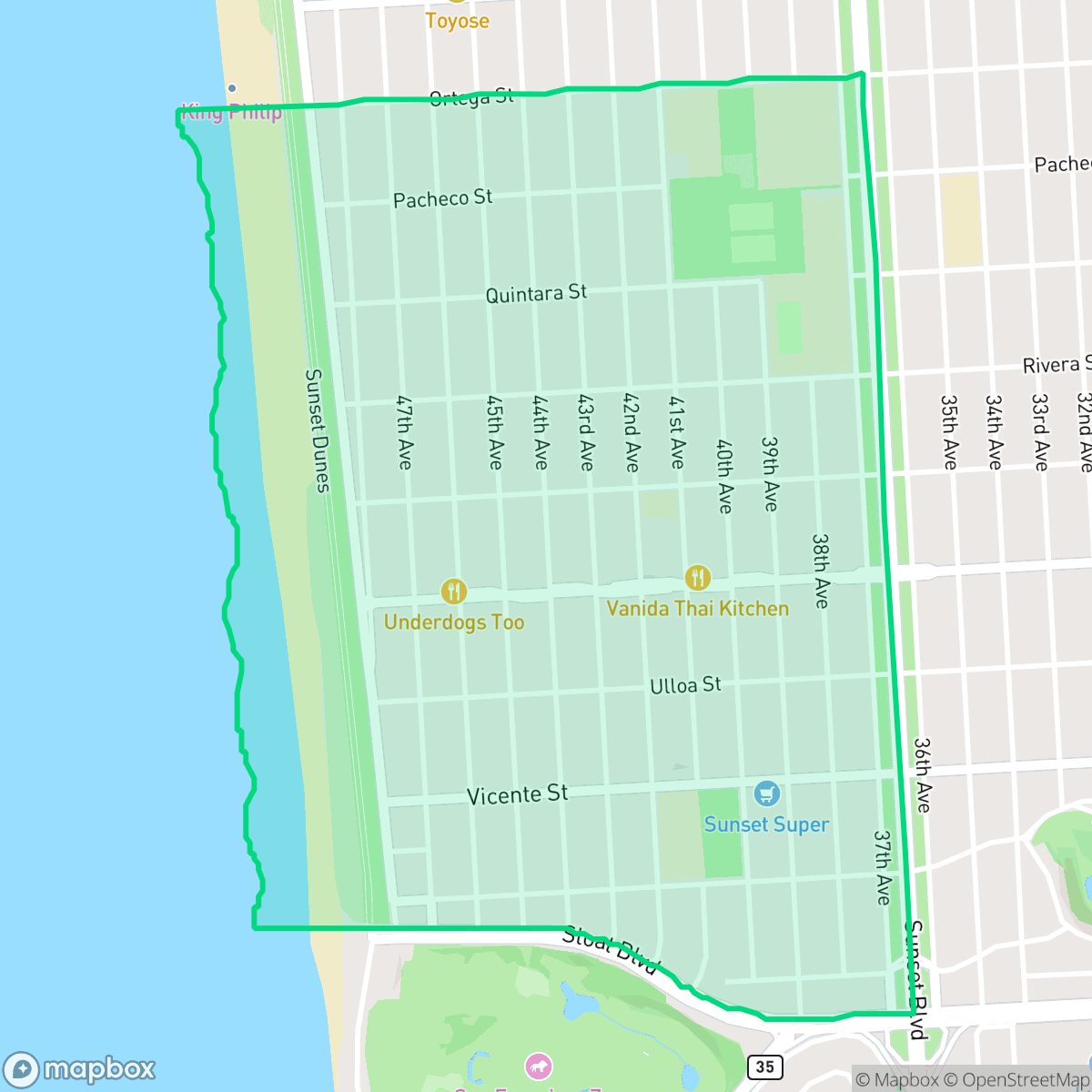
Outer Parkside is a dense, coastal neighborhood defined by its highly walkable grid and immediate proximity to Ocean Beach. Residents enjoy a quiet, residential atmosphere with high air quality and access to top-rated local schools, though the tightly packed row houses offer limited privacy.
Key Highlights
About Outer Parkside
Originally a remote, windswept expanse of sand dunes in San Francisco’s "Outside Lands," Outer Parkside began its transformation in 1905 when a syndicate led by William Crocker purchased land from Adolph Sutro’s estate. Development accelerated in the 1920s and 1930s, driven by the expansion of the L-Taraval streetcar line. Ambitious merchant-builders utilized early assembly-line construction techniques to build rows of stucco, Period Revival, and Craftsman-style homes, creating a distinct, family-friendly coastal suburb. Bordering Ocean Beach and the San Francisco Zoo, the neighborhood’s most famous local landmark is the historic Doggie Diner sign on Sloat Boulevard—a 700-pound, 10-foot-tall fiberglass dachshund head designed in 1966 and designated as San Francisco Landmark #254. Another enduring neighborhood staple is the Sloat Garden Center, which has anchored the community since 1958.
The area maintains a consistent, low-rise urban character where the dense grid layout ensures high walkability for daily errands and recreation. According to iHuus data, the neighborhood benefits from a complete lack of industrial proximity, contributing to high air quality and a peaceful residential environment. While the streets are generally quiet, residents have access to local staples like Andytown Roastery and established community hubs. The architectural landscape is dominated by uniform, attached row houses, which creates a cohesive aesthetic but results in a lower privacy index for residents living in such close quarters. This community is well-suited for families and individuals who prioritize outdoor access and school quality, as the neighborhood is home to highly rated institutions like Ulloa Elementary. While the broader school district faces financial challenges, these local schools remain strong options. Prospective residents should balance the benefits of a highly walkable, dog-friendly environment against the reality of shared walls and limited commercial density. The area offers a stable, suburban-coastal lifestyle that avoids the noise and congestion of San Francisco’s more central districts.
Neighborhood Scores Across 15 Qualities
Residential structures are often attached or positioned with very narrow gaps between them. According to iHuus data, this density results in a level of privacy that is consistent with the broader San Francisco area.
Continuous sidewalks on both sides of the street and frequent marked crosswalks make navigating the area on foot very easy. This dense, grid-based layout provides a walking experience that is slightly more accessible than the San Francisco average.
Standard middle-class row houses feature tidy but small yards and boxy rooflines. This consistent urban grid offers slightly less visual variety than the San Francisco average.
Extensive access to Sunset Reservoir and nearby beach parkland provides more recreational green space for pets than the typical San Francisco neighborhood. Wide paths and connected trails are easily accessible, though some residential blocks feature narrower sidewalks.
Residential blocks feature a balanced mix of low-rise housing and greenery, providing a more suburban character than the denser urban core of San Francisco. This layout offers a transition from a rigid street grid to large public parks and coastal spaces, according to iHuus data.
Suburban streets and green spaces dominate this area, providing a much more tranquil atmosphere than the typical San Francisco urban core. While a few local cafes and social hubs are reachable on foot, the neighborhood lacks the high-density commercial activity found in more central parts of the city.
Local traffic from nearby busy streets creates a consistent level of ambient noise. This acoustic profile is more noticeable than the average for San Francisco.
Air quality in this area remains largely clear with only infrequent periods of elevated readings. According to iHuus data, the air quality is slightly below the San Francisco average.
Industrial hazards, warehouses, and large-scale manufacturing facilities are entirely absent from this area. According to iHuus data, the neighborhood remains more secluded from industrial activity than the San Francisco average.
Health insurance access is exceptionally high among residents, significantly surpassing the San Francisco average according to iHuus data.
Voting patterns and census indicators reflect a highly progressive political environment that is consistent with the broader San Francisco area.
A balanced mix of young adults, families, and older residents defines the local demographic. According to iHuus data, this population spread is slightly more varied than the average found across San Francisco.
Located within a designated floodplain, this area carries a higher risk of flooding than much of San Francisco. According to iHuus data, residents may find that flood insurance is a typical requirement for properties here.
Address-Level Insights for Outer Parkside


iHuus Neighborhood Intelligence Insights
Get address-level neighborhood insights for Outer Parkside
- Street-level scores — see how individual blocks compare, not just neighborhood averages
- Micro-zone boundaries — identify quiet pockets, flood boundaries, and walkable clusters before you visit
- 15 dimensions in full — walkability, noise, air quality, school quality, insurance coverage, population age profile, urban/rural index, and more
- Boundary risk alerts — know if your address sits near a block boundary where scores drop, the kind of detail no listing will ever mention
- School insights — individual school ratings and insights, not just district-level data
- Compare before you commit — side-by-side data across neighborhoods, down to block precision
No credit card required
Compare with Any Neighborhood
| Dimension | Outer Parkside | Alamo Square |
|---|---|---|
| 🚶 Walkabilityavg 9.91 | ||
| 🔊 Acoustic Comfortavg 3.4 | ||
| 🤫 Privacy Indexavg 2.14 | ||
| 🎨 Visual Appealavg 6.26 | ||
| 🐕 Dog Friendlinessavg 6.55 | ||
| 🗺️ Urban-Rural Indexavg 4.07 | ||
| ✨ Neighborhood Vibeavg 6.4 | ||
| 🏥 Health Insurance Coverageavg 7.87 | ||
| 🌿 Air Qualityavg 7.78 | ||
| 🏭 Industrial Proximityavg 9.37 | ||
| 🌊 Flood Safetyavg 1.89 | ||
| 🗳️ Ideological Leanavg 9.92 | ||
| 👥 Population Age Profileavg 5.18 | ||
| 🔥 Fire Safetyavg 0.01 | ||
| 🏫 School Quality |
Outer Parkside Rankings
School Districts Serving Outer Parkside
School Insights for Outer Parkside
Below average outcomes; significant attendance and academic challenges.
School Insights
See what's really behind every school rating near Outer Parkside
- Individual school ratings — each school's own score with outcome context, not just a district average
- Enrollment & class size data — student-to-teacher ratio and how it compares to the state average
- Full demographics breakdown — ethnicity and gender composition for every school in the enrollment zone
- Every school in the district — all schools within the enrollment boundary ranked by rating, not just the closest one
- Grade levels & benchmarks — elementary through high school, with below/above state-average flags
No credit card required