Outer Mission, San Francisco
Updated · 9,829 residents
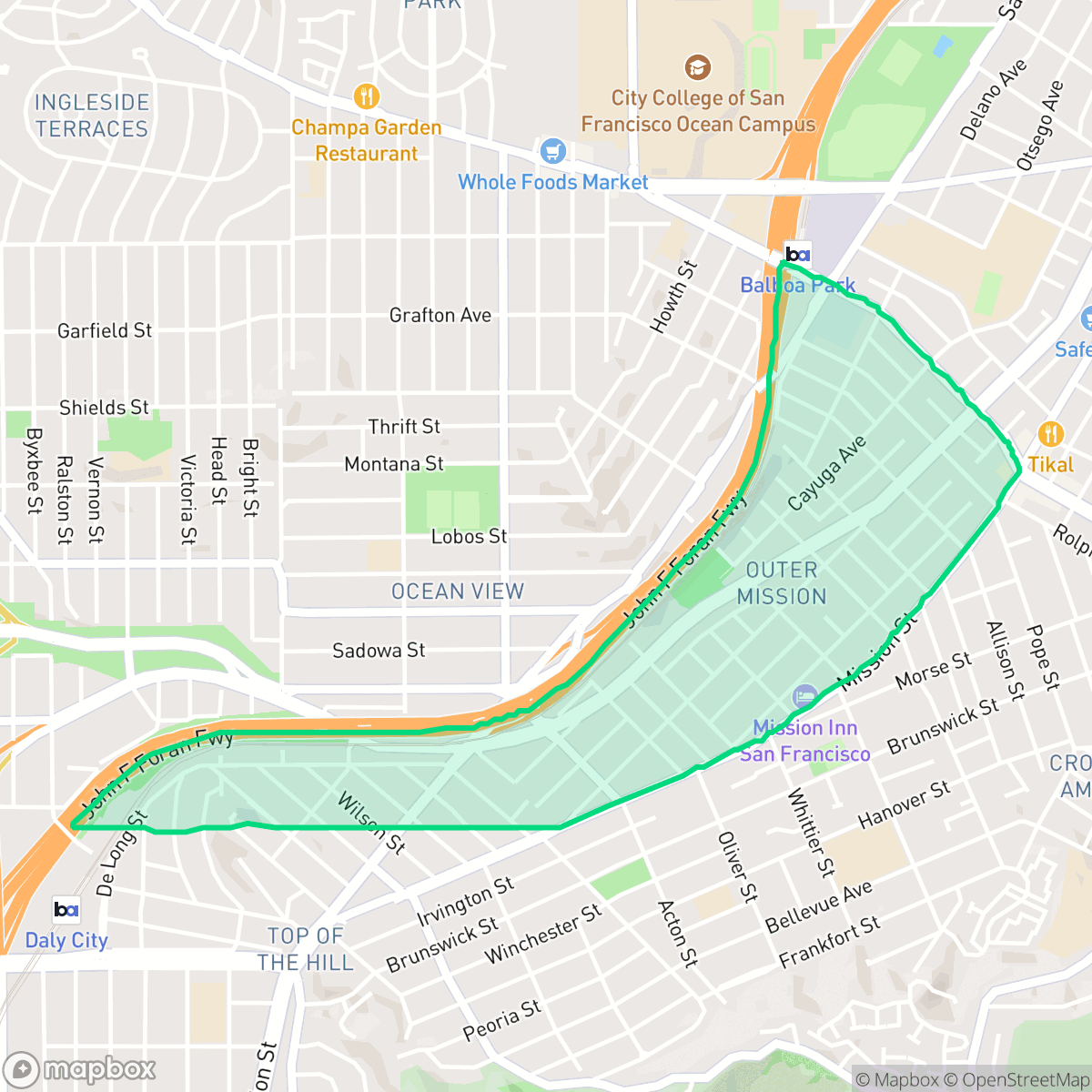
The Outer Mission is a dense, highly walkable residential neighborhood defined by its tight-knit grid of row houses and proximity to major transit corridors. While the area offers convenient access to local dining and a strong community identity, residents experience significant noise pollution from nearby highway traffic and limited private outdoor space.
Key Highlights
About Outer Mission
Platted in 1863 as attorney Harvey S. Brown’s rural "West End" subdivision, San Francisco’s Outer Mission remained dominated by truck farms and flower nurseries until the 1930s. The neighborhood began urbanizing after the 1906 earthquake when working-class Irish and Italian families built modest cottages near Mission Street and Geneva Avenue. Serviced by the Southern Pacific Railroad, the area rapidly developed into a residential enclave of Craftsman bungalows and pre-World War II rowhouses. Over the decades, the neighborhood transitioned into a diverse, family-oriented community with large Latino and Asian populations. Notable local landmarks include the historic Geneva Car Barn—a preserved Muni streetcar facility—and Cayuga Park, famous for its dense greenery and over 100 whimsical wooden statues hand-carved by long-time gardener Demetrio Braceros.
Characterized by a dense grid of streets, the Outer Mission provides residents with high pedestrian accessibility to local services and diverse dining options like Los Trinos and Reina's Restaurant. According to iHuus data, the neighborhood maintains a calm, mid-rise residential atmosphere that reflects its long-standing history as a working-class enclave. The area is well-connected, allowing for easy movement throughout the district, and it benefits from relatively good air quality despite its urban density.
This neighborhood is best suited for individuals who prioritize walkability and transit access over quiet environments. Prospective residents should be aware of the high noise levels generated by adjacent highway traffic and the limited availability of large public parks or expansive private yards. While the area offers a stable community environment, the density of the housing stock and the lack of private outdoor amenities are important factors for those considering a move to this part of San Francisco.
Neighborhood Scores Across 15 Qualities
High-density housing with shared walls or very narrow gaps between structures is common here. According to iHuus data, privacy levels are slightly below the city average due to the prevalence of wall-to-wall row houses and minimal side-yard setbacks.
Continuous sidewalks and marked crosswalks make navigating the dense residential grid easy for pedestrians. This level of walkability is nearly on par with the city average, though major highways and transit rail lines can occasionally segment the street network.
Uniform rooflines and dense, small-footprint housing characterize the area. This landscape offers a standard urban aesthetic that is slightly below the city average for visual variety.
Proximity to Balboa Park and various athletic fields provides significant space for dogs, though some dense residential pockets lack immediate street greenery. According to iHuus data, the overall level of dog friendliness is slightly below the San Francisco average.
Residential blocks offer a balance of dense housing and green space, representing a more suburban feel than the typical San Francisco urban core according to iHuus data.
A blend of lively dining corridors and quieter, suburban-style blocks characterizes the area. According to iHuus data, the neighborhood features a lower level of activity and amenity density than the San Francisco average.
Frequent aircraft noise from the nearby airport runway and heavy rail activity make this area significantly louder than the San Francisco average. Residents should expect persistent acoustic disruptions due to the proximity of major transportation corridors.
Air quality remains consistently high with only rare instances of elevated readings. This level of cleanliness is slightly above the San Francisco average according to iHuus data.
Residential and light commercial uses dominate the area without any detectable heavy industry or hazardous warehouses. According to iHuus data, the primary environmental considerations are noise and exhaust from the central freeway and nearby rail yards rather than industrial pollutants.
Health insurance access among residents is relatively high, though it sits slightly below the San Francisco average. According to iHuus data, most people in this area have access to medical coverage.
Voting patterns and census indicators reflect a deeply liberal political landscape, closely mirroring the broader San Francisco average.
A balanced mix of young adults, families, and seniors defines the local demographic. This distribution is largely consistent with the broader San Francisco population according to iHuus data.
Significant flood hazards exist here due to the area's designation as a coastal high-hazard zone. According to iHuus data, this risk is considerably higher than the San Francisco average and may lead to elevated insurance costs.
Address-Level Insights for Outer Mission


iHuus Neighborhood Intelligence Insights
Get address-level neighborhood insights for Outer Mission
- Street-level scores — see how individual blocks compare, not just neighborhood averages
- Micro-zone boundaries — identify quiet pockets, flood boundaries, and walkable clusters before you visit
- 15 dimensions in full — walkability, noise, air quality, school quality, insurance coverage, population age profile, urban/rural index, and more
- Boundary risk alerts — know if your address sits near a block boundary where scores drop, the kind of detail no listing will ever mention
- School insights — individual school ratings and insights, not just district-level data
- Compare before you commit — side-by-side data across neighborhoods, down to block precision
No credit card required
Compare with Any Neighborhood
| Dimension | Outer Mission | Alamo Square |
|---|---|---|
| 🚶 Walkabilityavg 9.91 | ||
| 🔊 Acoustic Comfortavg 3.4 | ||
| 🤫 Privacy Indexavg 2.14 | ||
| 🎨 Visual Appealavg 6.26 | ||
| 🐕 Dog Friendlinessavg 6.55 | ||
| 🗺️ Urban-Rural Indexavg 4.07 | ||
| ✨ Neighborhood Vibeavg 6.4 | ||
| 🏥 Health Insurance Coverageavg 7.87 | ||
| 🌿 Air Qualityavg 7.78 | ||
| 🏭 Industrial Proximityavg 9.37 | ||
| 🌊 Flood Safetyavg 1.89 | ||
| 🗳️ Ideological Leanavg 9.92 | ||
| 👥 Population Age Profileavg 5.18 | ||
| 🔥 Fire Safetyavg 0.01 | ||
| 🏫 School Quality |
Outer Mission Rankings
School Districts Serving Outer Mission
School Insights for Outer Mission
Below average outcomes; significant attendance and academic challenges.
School Insights
See what's really behind every school rating near Outer Mission
- Individual school ratings — each school's own score with outcome context, not just a district average
- Enrollment & class size data — student-to-teacher ratio and how it compares to the state average
- Full demographics breakdown — ethnicity and gender composition for every school in the enrollment zone
- Every school in the district — all schools within the enrollment boundary ranked by rating, not just the closest one
- Grade levels & benchmarks — elementary through high school, with below/above state-average flags
No credit card required