North Beach, San Francisco
Updated · 5,950 residents
North Beach is a highly walkable urban neighborhood defined by its dense, historic street grid and vibrant social atmosphere. While residents enjoy exceptional pedestrian access to local cafes and cultural landmarks, they should be prepared for a dense living environment with limited privacy and elevated noise levels from street traffic.
Key Highlights
About North Beach
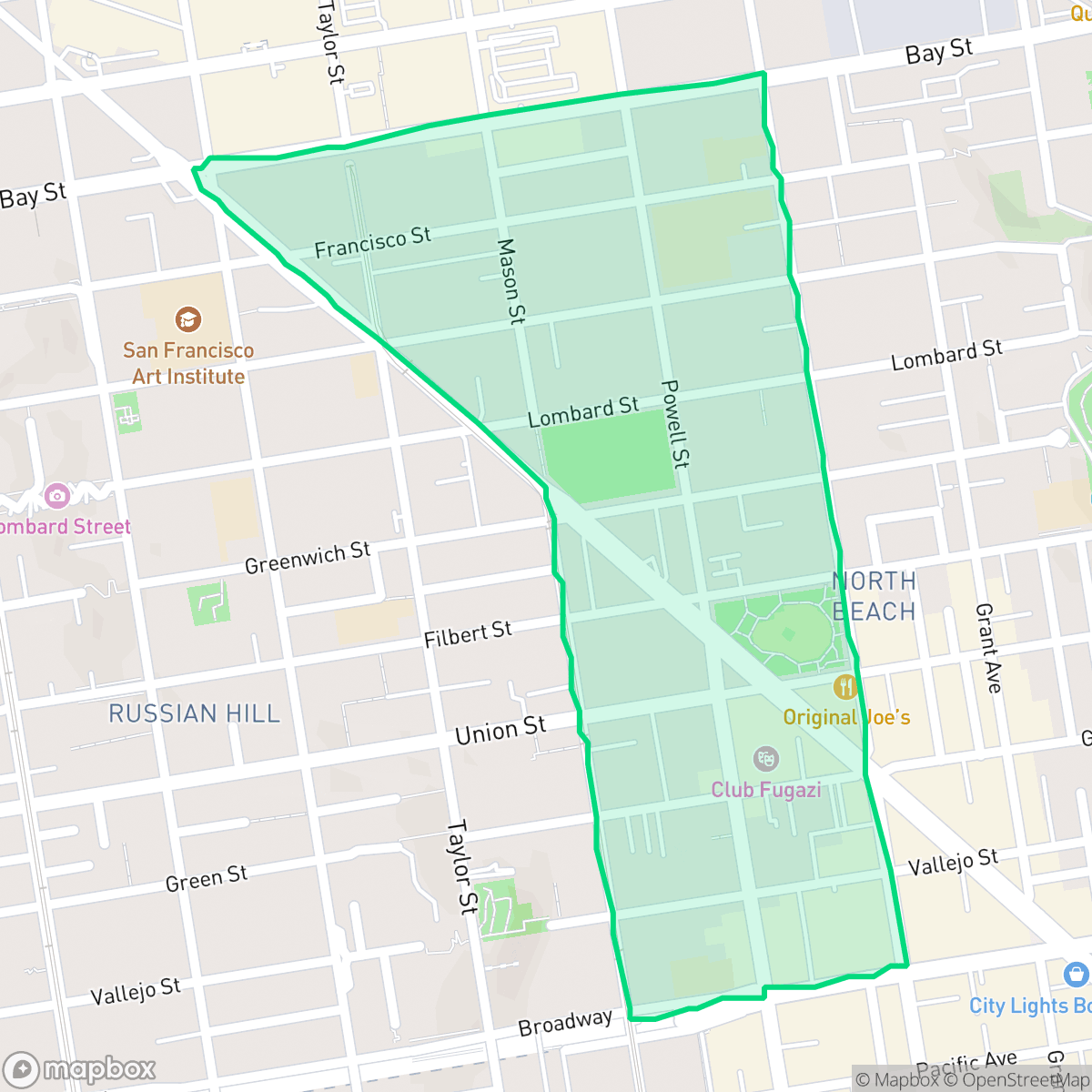
Originally a tidal cove before 19th-century land reclamation, North Beach emerged as San Francisco’s "Little Italy" following the 1906 earthquake, when Italian immigrants established a dense, culturally distinct enclave. By the 1920s, it was the epicenter of Italian-American life and the birthplace of A.P. Giannini’s Bank of Italy. The neighborhood gained international notoriety in the 1950s as the heart of the Beat Generation, anchored by landmarks like City Lights Bookstore and Caffe Trieste. It also holds historical significance for early LGBTQ+ activism, hosting the city's first lesbian bar, Mona’s 440 Club. Defined by the iconic Saints Peter and Paul Church and Washington Square Park, the area has evolved from a predominantly Italian immigrant hub into a diverse, multi-ethnic district while retaining its bohemian spirit and historic architectural character.
The area functions as a dense, pedestrian-oriented hub where daily errands are easily completed on foot. The built environment consists of tightly packed, multi-story buildings that offer limited separation between units, contributing to a lack of privacy. While the neighborhood maintains a steady level of social energy through its concentration of local restaurants and community spaces, the auditory environment is notably active due to consistent traffic hum. According to iHuus data, the area is characterized by heavy grey infrastructure and minimal natural vegetation, reflecting its status as a core urban district.
Prospective residents should consider the practical realities of living in this part of the city, including a high vulnerability to coastal flooding and a higher proportion of uninsured residents compared to the city average. The local school district, San Francisco Unified, currently faces significant fiscal and operational challenges that impact community stability. This neighborhood is well-suited for individuals who prioritize walkability and a central, active lifestyle over suburban quiet or expansive private space.
Neighborhood Scores Across 15 Qualities
High building density and shared walls result in minimal separation between residential units. This level of closeness is consistent with the broader San Francisco area according to iHuus data.
Wide sidewalks and frequent crosswalks throughout the grid make most daily errands easy to complete on foot. The neighborhood offers exceptional pedestrian-priority areas and waterfront access that is slightly above the San Francisco average, according to iHuus data.
Standard urban housing dominates the landscape, featuring mostly shared walls and boxy rooftops. This density is slightly lower than the city average for visual variety and private greenery.
Access to dog-friendly spaces is slightly below the city average, though Washington Square Park and waterfront piers provide essential walking routes. Small interior green squares and nearby piers offer adequate space for pet owners, according to iHuus data.
Heavy grey infrastructure and multi-story buildings dominate this area, resulting in a significantly higher density of pavement and much less greenery than the San Francisco average. According to iHuus data, the landscape is characterized by a tight street grid with very little open soil or natural vegetation.
Diverse dining options and local social hubs provide a consistent level of activity that aligns with the city average. According to iHuus data, the area features a concentrated mix of cafes, museums, and restaurants within a walkable landscape.
Steady traffic hum from nearby busy streets is a consistent feature, though acoustic levels are notably higher than the San Francisco average. According to iHuus data, this creates a more active auditory environment than many other parts of the city.
Air quality remains consistently high with rare instances of elevated readings. According to iHuus data, the air quality in North Beach is slightly better than the San Francisco average.
Maritime activity and piers are present near the waterfront, but the area remains free of heavy manufacturing or hazardous industrial sites. This lack of industrial presence is consistent with the rest of San Francisco.
Health insurance access is significantly lower in North Beach than the San Francisco average, according to iHuus data. This indicates a higher proportion of uninsured residents compared to most other parts of the city.
Voting patterns and census indicators align with the broader San Francisco political landscape. According to iHuus data, the area demonstrates a very strong liberal leaning that is consistent with the city average.
A balanced variety of young adults, families, and older residents characterizes the area. This demographic spread is more diverse than the typical San Francisco age profile, according to iHuus data.
Coastal hazards and wave action make this area significantly more vulnerable to flooding than most of San Francisco. Residents should prepare for elevated or potentially prohibitive flood insurance costs according to iHuus data.
Address-Level Insights for North Beach


iHuus Neighborhood Intelligence Insights
Get address-level neighborhood insights for North Beach
- Street-level scores — see how individual blocks compare, not just neighborhood averages
- Micro-zone boundaries — identify quiet pockets, flood boundaries, and walkable clusters before you visit
- 15 dimensions in full — walkability, noise, air quality, school quality, insurance coverage, population age profile, urban/rural index, and more
- Boundary risk alerts — know if your address sits near a block boundary where scores drop, the kind of detail no listing will ever mention
- School insights — individual school ratings and insights, not just district-level data
- Compare before you commit — side-by-side data across neighborhoods, down to block precision
No credit card required
Compare with Any Neighborhood
| Dimension | North Beach | Alamo Square |
|---|---|---|
| 🚶 Walkabilityavg 9.91 | ||
| 🔊 Acoustic Comfortavg 3.4 | ||
| 🤫 Privacy Indexavg 2.14 | ||
| 🎨 Visual Appealavg 6.26 | ||
| 🐕 Dog Friendlinessavg 6.55 | ||
| 🗺️ Urban-Rural Indexavg 4.07 | ||
| ✨ Neighborhood Vibeavg 6.4 | ||
| 🏥 Health Insurance Coverageavg 7.87 | ||
| 🌿 Air Qualityavg 7.78 | ||
| 🏭 Industrial Proximityavg 9.37 | ||
| 🌊 Flood Safetyavg 1.89 | ||
| 🗳️ Ideological Leanavg 9.92 | ||
| 👥 Population Age Profileavg 5.18 | ||
| 🔥 Fire Safetyavg 0.01 | ||
| 🏫 School Quality |
North Beach Rankings
School Districts Serving North Beach
School Insights for North Beach
Below average outcomes; significant attendance and academic challenges.
School Insights
See what's really behind every school rating near North Beach
- Individual school ratings — each school's own score with outcome context, not just a district average
- Enrollment & class size data — student-to-teacher ratio and how it compares to the state average
- Full demographics breakdown — ethnicity and gender composition for every school in the enrollment zone
- Every school in the district — all schools within the enrollment boundary ranked by rating, not just the closest one
- Grade levels & benchmarks — elementary through high school, with below/above state-average flags
No credit card required