Noe Valley, San Francisco
Updated · 14,251 residents
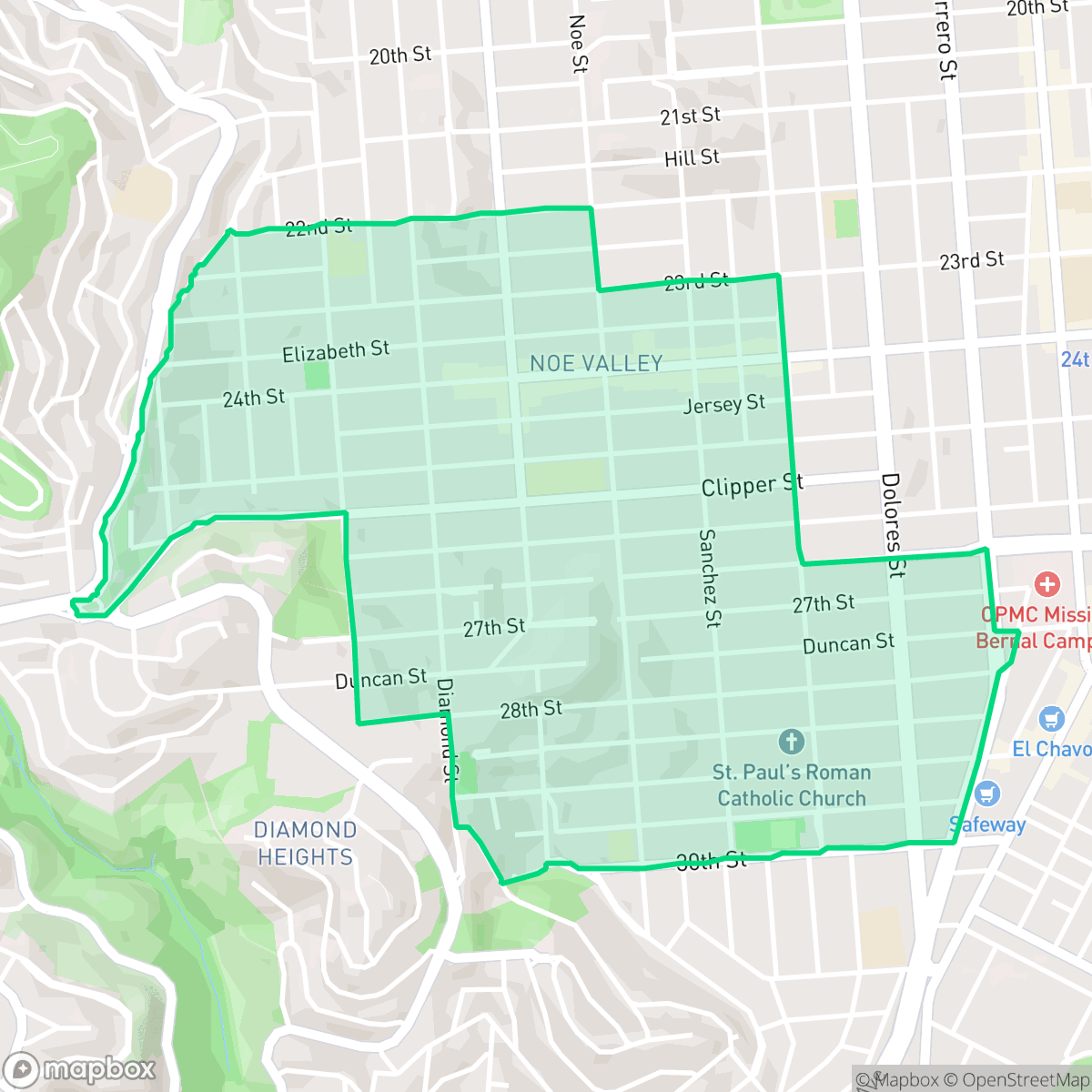
Noe Valley is a dense, highly walkable neighborhood characterized by its well-maintained row houses and a vibrant commercial corridor along 24th Street. While the area offers excellent air quality and minimal industrial presence, residents experience limited privacy due to the tightly packed housing stock and urban density. According to iHuus data, the community benefits from high health insurance coverage and a consistent ideological lean.
Key Highlights
About Noe Valley
Named after José de Jesús Noé, the last Mexican alcalde of Yerba Buena, Noe Valley originated as part of his 1840s Rancho San Miguel land grant. In 1854, Mormon immigrant John Meirs Horner purchased the tract, platting the street grid as "Horner’s Addition". The neighborhood developed rapidly in the late 19th and early 20th centuries, largely escaping the 1906 earthquake. This left an exceptionally intact stock of Victorian and Edwardian homes, including Queen Anne and Eastlake styles built by prominent developer Fernando Nelson. Historically a working-class enclave for Irish, German, and Scandinavian immigrants, its commercial heart centered along 24th Street. Notable local landmarks include the Gothic Revival-style St. Paul’s Catholic Church, completed in 1911 and featured in the film Sister Act, and Billy Goat Hill, once the site of a controversial turn-of-the-century rock quarry.
The neighborhood functions as a dense urban enclave where residents rely on a highly navigable grid of streets. The commercial heart along 24th Street provides a consistent flow of local eateries and coffee shops, contributing to a moderate level of social activity. The area maintains a clean environment with high air quality scores and a complete absence of industrial facilities, making it a stable residential choice within the city.
Living here requires adjusting to close quarters, as the prevalence of row houses and shared walls results in low privacy levels. While the neighborhood is generally quiet, road traffic remains a factor in the acoustic environment. It is well-suited for professionals and families who prioritize walkability and access to neighborhood amenities over spacious, detached living. According to iHuus, the area maintains a balanced age profile, attracting a diverse demographic that values the proximity to both urban services and local green spaces like Juri Commons.
Neighborhood Scores Across 15 Qualities
Residential structures are tightly packed with many buildings sharing walls or featuring very narrow gaps between them. According to iHuus data, this density is consistent with the rest of the city.
Extensive sidewalk networks and frequent crosswalks make navigating the street grid easy on foot. This level of accessibility is nearly identical to the broader San Francisco area, according to iHuus data.
Well-maintained homes and tiered landscaping contribute to a visual environment that is more polished than the San Francisco average. According to iHuus data, the presence of large structures and proximity to manicured parklands enhances the area's aesthetic quality.
Access to large public parks and wide sidewalks provides ample space for pet recreation. This area offers more accessible greenery and walking trails for dogs than the San Francisco average, according to iHuus data.
Residential streets and green spaces exist in roughly equal measure, providing a slightly more suburban character than the typical San Francisco urban density. This mix of low-rise housing and hilly open space offers a balanced landscape according to iHuus data.
Local social hubs and dining establishments provide a consistent level of neighborhood activity that is on par with the San Francisco average. Residents can expect a balanced environment of quiet residential pockets and lively street life, according to iHuus data.
Steady traffic sounds from nearby thoroughfares are present, though the level of acoustic disturbance is notably higher than the San Francisco average. According to iHuus data, residents can expect a consistent ambient hum throughout the day.
Air quality is generally good with infrequent periods of poor ventilation, though levels are slightly below the San Francisco average according to iHuus data.
Industrial activity and warehouse facilities are entirely absent from this area. Residents benefit from a landscape consisting strictly of residential, educational, and recreational zones, which is even more limited in industrial presence than the San Francisco average.
Nearly all residents are covered by health insurance, representing a significantly higher rate of coverage than the San Francisco average. According to iHuus data, this high level of access to healthcare is a defining characteristic of the area.
Voting patterns and census indicators reflect a deeply liberal community that is consistent with the broader trends seen across San Francisco. According to iHuus data, the political landscape here aligns closely with the city average.
A diverse range of age groups, including young professionals, families, and seniors, resides here. This demographic distribution is roughly in line with the San Francisco average according to iHuus data.
Elevated flood hazards and potential wave action exist in certain areas of the neighborhood, making it more susceptible to flooding than much of San Francisco. Residents should anticipate higher insurance premiums according to iHuus data.
Address-Level Insights for Noe Valley


iHuus Neighborhood Intelligence Insights
Get address-level neighborhood insights for Noe Valley
- Street-level scores — see how individual blocks compare, not just neighborhood averages
- Micro-zone boundaries — identify quiet pockets, flood boundaries, and walkable clusters before you visit
- 15 dimensions in full — walkability, noise, air quality, school quality, insurance coverage, population age profile, urban/rural index, and more
- Boundary risk alerts — know if your address sits near a block boundary where scores drop, the kind of detail no listing will ever mention
- School insights — individual school ratings and insights, not just district-level data
- Compare before you commit — side-by-side data across neighborhoods, down to block precision
No credit card required
Compare with Any Neighborhood
| Dimension | Noe Valley | Alamo Square |
|---|---|---|
| 🚶 Walkabilityavg 9.91 | ||
| 🔊 Acoustic Comfortavg 3.4 | ||
| 🤫 Privacy Indexavg 2.14 | ||
| 🎨 Visual Appealavg 6.26 | ||
| 🐕 Dog Friendlinessavg 6.55 | ||
| 🗺️ Urban-Rural Indexavg 4.07 | ||
| ✨ Neighborhood Vibeavg 6.4 | ||
| 🏥 Health Insurance Coverageavg 7.87 | ||
| 🌿 Air Qualityavg 7.78 | ||
| 🏭 Industrial Proximityavg 9.37 | ||
| 🌊 Flood Safetyavg 1.89 | ||
| 🗳️ Ideological Leanavg 9.92 | ||
| 👥 Population Age Profileavg 5.18 | ||
| 🔥 Fire Safetyavg 0.01 | ||
| 🏫 School Quality |
Noe Valley Rankings
School Districts Serving Noe Valley
School Insights for Noe Valley
Below average outcomes; significant attendance and academic challenges.
School Insights
See what's really behind every school rating near Noe Valley
- Individual school ratings — each school's own score with outcome context, not just a district average
- Enrollment & class size data — student-to-teacher ratio and how it compares to the state average
- Full demographics breakdown — ethnicity and gender composition for every school in the enrollment zone
- Every school in the district — all schools within the enrollment boundary ranked by rating, not just the closest one
- Grade levels & benchmarks — elementary through high school, with below/above state-average flags
No credit card required