Nob Hill, San Francisco
Updated · 18,713 residents
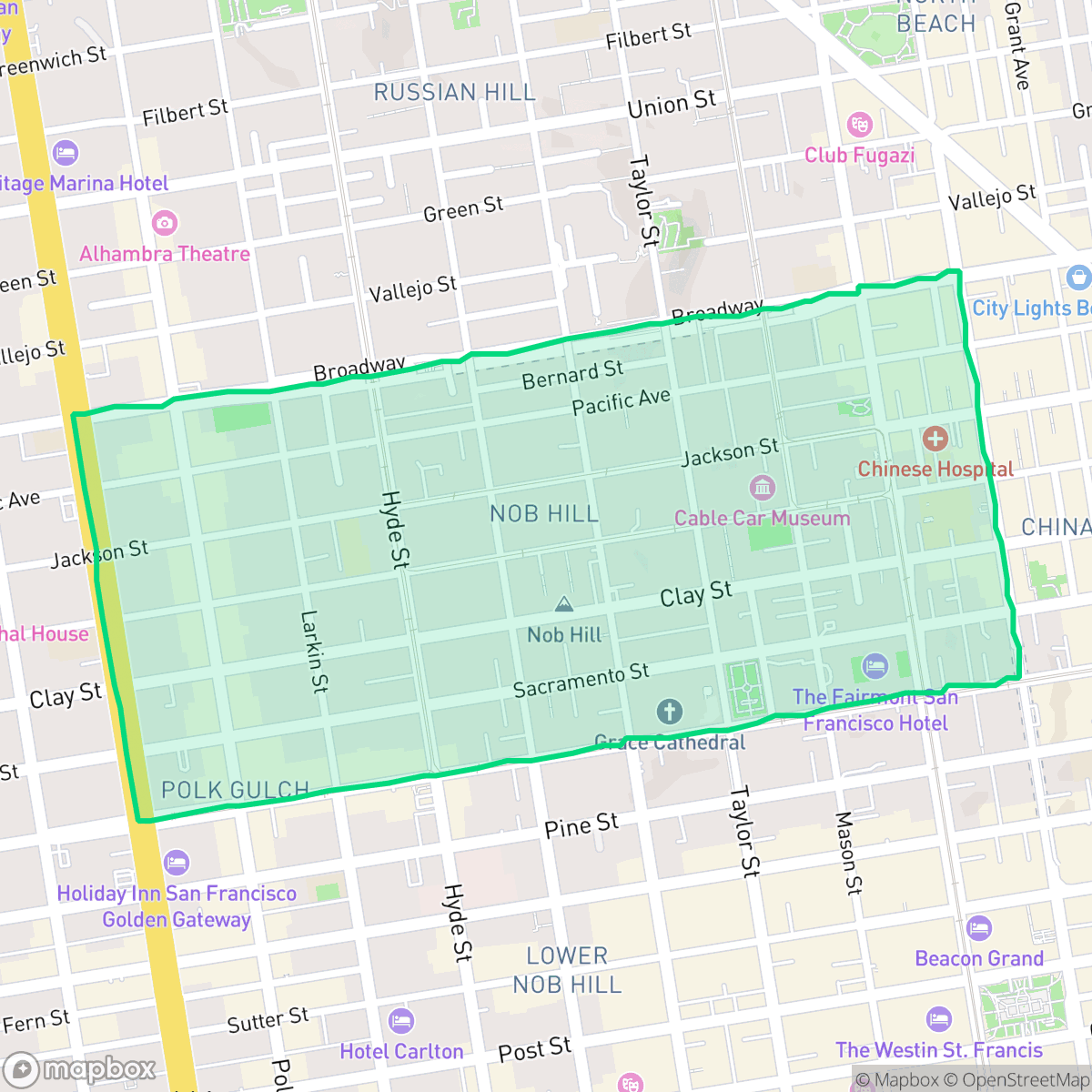
Nob Hill is a hyper-dense, highly walkable neighborhood characterized by its steep streets and continuous urban grid. While the area offers excellent access to local amenities and a vibrant mix of residential and commercial spaces, residents experience significant street noise and limited access to private outdoor green space.
Key Highlights
About Nob Hill
Originally called California Hill, Nob Hill rose to prominence in the late 19th century following the introduction of the cable car, which made its steep slopes accessible. The neighborhood became the exclusive enclave of the "Big Four" railroad tycoons—Leland Stanford, Mark Hopkins, Charles Crocker, and Collis P. Huntington—whose massive mansions earned the hill its nickname (short for "nabob"). Although the devastating 1906 earthquake and subsequent fires destroyed these grand Victorian estates, the neighborhood rebuilt. Today, Nob Hill’s wealthy legacy is preserved in its luxury hotels, such as the Fairmont and the Mark Hopkins, which stand on the former sites of the tycoons' estates. Other defining landmarks include the French Gothic-style Grace Cathedral, the historic Pacific-Union Club (housed in the rebuilt James Flood Mansion), and Huntington Park, all centered around the iconic, rumbling California Street cable car line.
The neighborhood functions as a dense, mixed-use urban environment that prioritizes pedestrian access. According to iHuus data, the area maintains perfect walkability due to its consistent grid layout and well-maintained sidewalks. It is free from heavy industrial activity, offering a clean, purely residential and commercial atmosphere that remains centrally located within the city.
Living here involves specific trade-offs, particularly regarding privacy and acoustic comfort. The high-density, row-style housing means buildings are often separated by less than two meters, and traffic noise averages around 61 decibels. While the area lacks significant green space or parks for pets, it provides access to a variety of local services. Prospective families should note that while some schools like Gordon J. Lau Elementary perform well, the broader school district is currently managing significant fiscal and operational challenges.
Neighborhood Scores Across 15 Qualities
Residential units are situated in very close proximity with many buildings sharing walls or separated by narrow alleys. This level of density is roughly consistent with the average found across San Francisco.
Wide, continuous sidewalks and frequent marked crosswalks throughout the dense grid make navigating the area on foot exceptionally easy. This level of accessibility is slightly above the San Francisco average according to iHuus data.
Dense urban housing dominates the landscape, characterized by flat rooflines and shared walls. This visual profile is slightly below the city average due to a lack of private luxury amenities or expansive greenery.
Predominantly concrete surfaces and dense building footprints offer few natural verges, though proximity to Jefferson Square provides essential relief for pet owners. According to iHuus data, the availability of open greenery is below the city average.
Continuous street walls and multi-story buildings create a highly dense environment with very little open greenery. According to iHuus data, this level of urban density is significantly higher than the San Francisco average.
Social activity is notably higher than the San Francisco average, characterized by a dense concentration of diverse dining and local cafes. Residents can access various social hubs and established eateries throughout the district, according to iHuus data.
Frequent noise from nearby transit corridors and flight paths contributes to a level of acoustic disturbance that is slightly higher than the San Francisco average, according to iHuus data.
Air quality remains consistently clean with very few instances of poor air. This level of clarity is slightly better than the San Francisco average, according to iHuus data.
Industrial facilities, warehouses, and heavy manufacturing sites are entirely absent from this area. This neighborhood maintains a purely residential and light commercial fabric that is notably cleaner of industrial encroachment than the San Francisco average, according to iHuus data.
Health insurance access is significantly lower than the San Francisco average, according to iHuus data. Residents may encounter limited local access to employer-sponsored or subsidized healthcare options within the immediate area.
Voting patterns and census indicators reflect a deeply liberal political identity that is consistent with the broader San Francisco area, according to iHuus data.
Residents occupy a balanced range of life stages, including young professionals, families, and seniors. This demographic spread is slightly more varied than the city average according to iHuus data.
Address-Level Insights for Nob Hill


iHuus Neighborhood Intelligence Insights
Get address-level neighborhood insights for Nob Hill
- Street-level scores — see how individual blocks compare, not just neighborhood averages
- Micro-zone boundaries — identify quiet pockets, flood boundaries, and walkable clusters before you visit
- 15 dimensions in full — walkability, noise, air quality, school quality, insurance coverage, population age profile, urban/rural index, and more
- Boundary risk alerts — know if your address sits near a block boundary where scores drop, the kind of detail no listing will ever mention
- School insights — individual school ratings and insights, not just district-level data
- Compare before you commit — side-by-side data across neighborhoods, down to block precision
No credit card required
Compare with Any Neighborhood
| Dimension | Nob Hill | Alamo Square |
|---|---|---|
| 🚶 Walkabilityavg 9.91 | ||
| 🔊 Acoustic Comfortavg 3.4 | ||
| 🤫 Privacy Indexavg 2.14 | ||
| 🎨 Visual Appealavg 6.26 | ||
| 🐕 Dog Friendlinessavg 6.55 | ||
| 🗺️ Urban-Rural Indexavg 4.07 | ||
| ✨ Neighborhood Vibeavg 6.4 | ||
| 🏥 Health Insurance Coverageavg 7.87 | ||
| 🌿 Air Qualityavg 7.78 | ||
| 🏭 Industrial Proximityavg 9.37 | ||
| 🌊 Flood Safetyavg 1.89 | ||
| 🗳️ Ideological Leanavg 9.92 | ||
| 👥 Population Age Profileavg 5.18 | ||
| 🔥 Fire Safetyavg 0.01 | ||
| 🏫 School Quality |
Nob Hill Rankings
School Districts Serving Nob Hill
School Insights for Nob Hill
Below average outcomes; significant attendance and academic challenges.
School Insights
See what's really behind every school rating near Nob Hill
- Individual school ratings — each school's own score with outcome context, not just a district average
- Enrollment & class size data — student-to-teacher ratio and how it compares to the state average
- Full demographics breakdown — ethnicity and gender composition for every school in the enrollment zone
- Every school in the district — all schools within the enrollment boundary ranked by rating, not just the closest one
- Grade levels & benchmarks — elementary through high school, with below/above state-average flags
No credit card required