Mount Davidson Manor, San Francisco
Updated · 1,731 residents
Mount Davidson Manor is a quiet residential enclave defined by its classic 1920s Spanish-Mediterranean architecture and exceptional walkability. Residents benefit from immediate access to the diverse dining scene along Ocean Avenue and the recreational space at Aptos Park. While the neighborhood offers a dense urban feel with tightly spaced homes, it maintains a strong sense of community and high health insurance coverage for its inhabitants.
Key Highlights
About Mount Davidson Manor
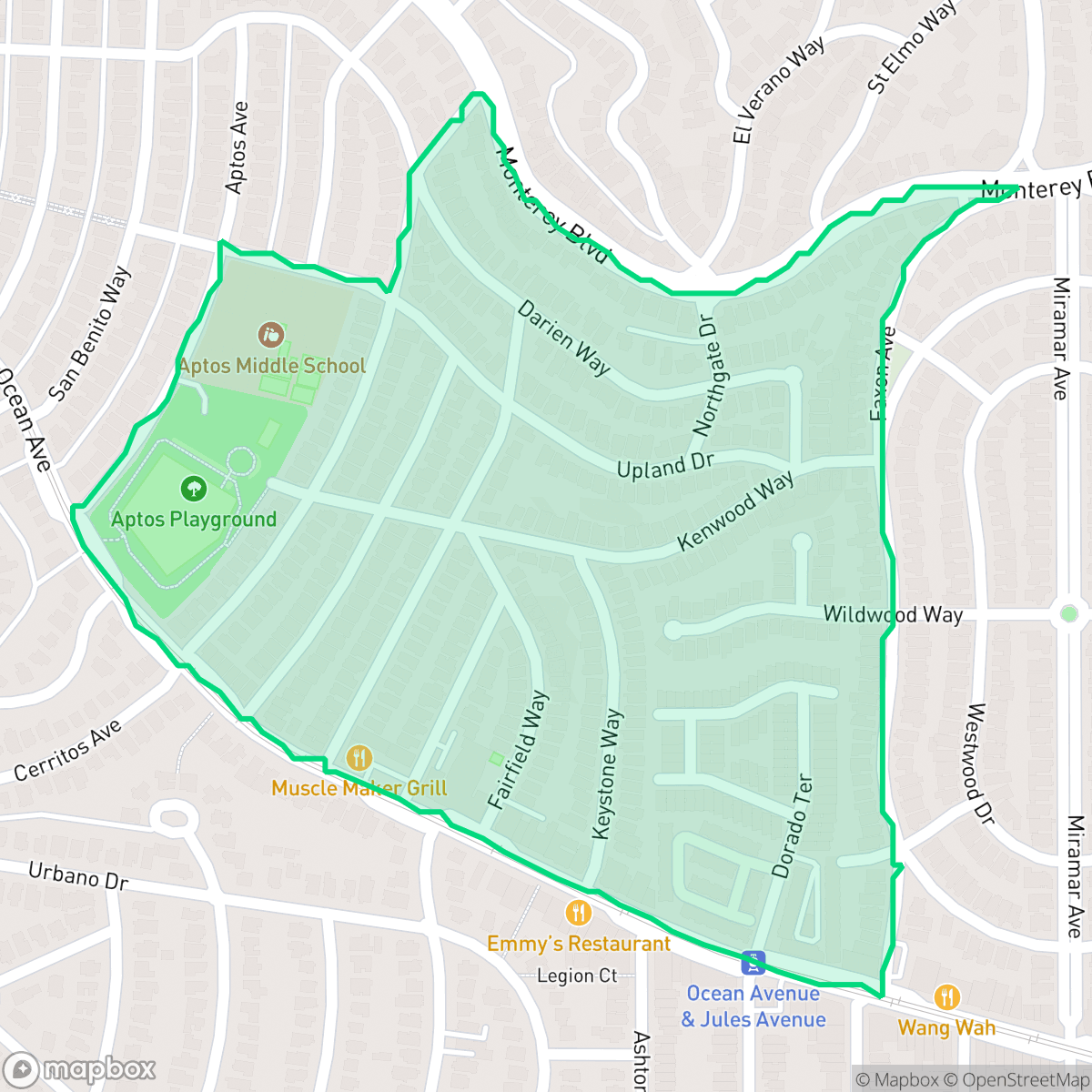
Developed starting in 1923, Mount Davidson Manor is a quiet residential neighborhood in southwestern San Francisco bounded by Ocean Avenue and Monterey Boulevard. The community's growth was catalyzed by the 1918 opening of the Twin Peaks Tunnel, which connected the city's western lands to downtown. Prominent builder Fernando Nelson purchased 50 acres of the former Sutro Forest, cleared the trees, and designed the tract's streets, sewers, and utilities. Nelson and other developers transformed the area into a planned suburb of detached, single-family homes. The neighborhood is architecturally defined by its well-preserved 1920s and 1930s Spanish-Mediterranean and Spanish Revival-style homes, characterized by red-tiled roofs and detailed craftsmanship. Residents enjoy close proximity to the commercial corridor of Ocean Avenue and nearby Aptos Park.
The area serves as a vibrant residential hub where suburban tranquility meets the convenience of city living. The local streetscape is characterized by a high degree of walkability, allowing residents to easily navigate between their homes and the commercial corridor on Ocean Avenue. This corridor hosts a variety of local eateries, such as Champa Garden and Pho Ha Tien, which contribute to the neighborhood's active and diverse culinary environment. Public green spaces, including the baseball diamond at the local park, provide essential outdoor outlets for families and pet owners alike. Prospective residents should note that the neighborhood features a high density of single-family homes, which results in limited private outdoor space and reduced privacy between properties. According to iHuus data, the area experiences a moderate level of road traffic noise, though it remains free from industrial activity. While the broader school district faces significant fiscal challenges, the local middle school maintains a strong academic rating, making the area a notable consideration for families prioritizing educational access within a dense, well-connected urban setting.
Neighborhood Scores Across 15 Qualities
Homes are situated in close proximity with narrow side yards and minimal separation between structures. This density provides more privacy than the San Francisco average, though many properties still feature shared property lines or very small gaps between neighbors.
Continuous sidewalks on both sides of nearly every street and clear pedestrian crossings make navigating the area easy. According to iHuus data, the pedestrian infrastructure here is slightly superior to the San Francisco average.
Residential streets feature consistent mid-century architecture with boxy rooflines and compact yards. This level of visual variety is slightly lower than the San Francisco average.
Access to green space for walking dogs varies, with some areas providing sidewalk verges and nearby baseball fields. Overall, opportunities for pet exercise are slightly below the San Francisco average according to iHuus data.
Residential streets and green spaces are distributed in roughly equal measure, providing a more suburban character than the denser city average. According to iHuus data, the area features a mix of single-family homes and multi-story residential structures alongside established commercial centers.
Local dining and cafes provide a noticeable social presence that is slightly more active than the San Francisco average. Residents can access a diverse mix of neighborhood hubs, including various bakeries and eateries, amidst a blend of suburban streets and green spaces.
A steady hum of local traffic from a nearby busy street is noticeable. According to iHuus data, acoustic comfort here is higher than the San Francisco average.
Air quality remains consistently high with rare instances of elevated readings. This level of cleanliness is slightly above the San Francisco average, according to iHuus data.
Industrial activity and warehouses are entirely absent from this area. According to iHuus data, this neighborhood maintains a higher level of separation from industrial zones and heavy manufacturing than the San Francisco average.
Health insurance accessibility is exceptionally high here, significantly surpassing the San Francisco average. According to iHuus data, nearly all residents maintain comprehensive medical coverage.
Voting patterns and census indicators reflect a political landscape that is very similar to the broader San Francisco area.
Residents live among a balanced mix of young adults, families, and older individuals. According to iHuus data, this demographic spread is slightly more varied than the typical San Francisco profile.
Flood risk in this area is significantly higher than the San Francisco average due to its location within a 100-year floodplain. According to iHuus data, residents may find that flood insurance is a typical requirement for properties here.
Address-Level Insights for Mount Davidson Manor


iHuus Neighborhood Intelligence Insights
Get address-level neighborhood insights for Mount Davidson Manor
- Street-level scores — see how individual blocks compare, not just neighborhood averages
- Micro-zone boundaries — identify quiet pockets, flood boundaries, and walkable clusters before you visit
- 15 dimensions in full — walkability, noise, air quality, school quality, insurance coverage, population age profile, urban/rural index, and more
- Boundary risk alerts — know if your address sits near a block boundary where scores drop, the kind of detail no listing will ever mention
- School insights — individual school ratings and insights, not just district-level data
- Compare before you commit — side-by-side data across neighborhoods, down to block precision
No credit card required
Compare with Any Neighborhood
| Dimension | Mount Davidson Manor | Alamo Square |
|---|---|---|
| 🚶 Walkabilityavg 9.91 | ||
| 🔊 Acoustic Comfortavg 3.4 | ||
| 🤫 Privacy Indexavg 2.14 | ||
| 🎨 Visual Appealavg 6.26 | ||
| 🐕 Dog Friendlinessavg 6.55 | ||
| 🗺️ Urban-Rural Indexavg 4.07 | ||
| ✨ Neighborhood Vibeavg 6.4 | ||
| 🏥 Health Insurance Coverageavg 7.87 | ||
| 🌿 Air Qualityavg 7.78 | ||
| 🏭 Industrial Proximityavg 9.37 | ||
| 🌊 Flood Safetyavg 1.89 | ||
| 🗳️ Ideological Leanavg 9.92 | ||
| 👥 Population Age Profileavg 5.18 | ||
| 🔥 Fire Safetyavg 0.01 | ||
| 🏫 School Quality |
Mount Davidson Manor Rankings
School Districts Serving Mount Davidson Manor
School Insights for Mount Davidson Manor
Below average outcomes; significant attendance and academic challenges.
School Insights
See what's really behind every school rating near Mount Davidson Manor
- Individual school ratings — each school's own score with outcome context, not just a district average
- Enrollment & class size data — student-to-teacher ratio and how it compares to the state average
- Full demographics breakdown — ethnicity and gender composition for every school in the enrollment zone
- Every school in the district — all schools within the enrollment boundary ranked by rating, not just the closest one
- Grade levels & benchmarks — elementary through high school, with below/above state-average flags
No credit card required