Monterey Heights, San Francisco
Updated · 833 residents
Monterey Heights is a quiet, residential enclave on the slopes of Mount Davidson known for its exceptionally high walkability and proximity to local services. While the neighborhood offers a peaceful environment free from industrial activity, residents experience limited privacy due to the tight spacing of homes and narrow lot boundaries.
Key Highlights
About Monterey Heights
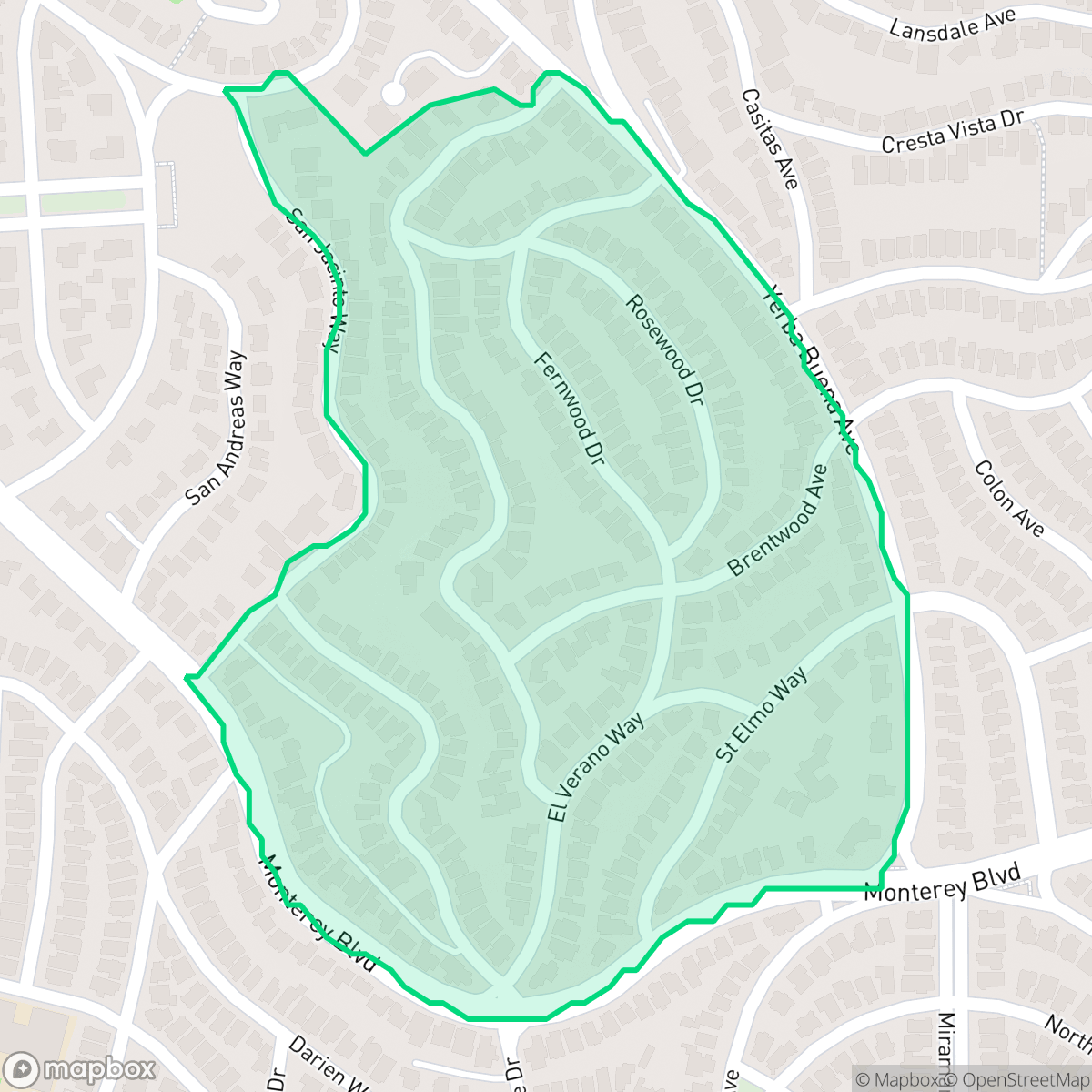
Nestled on the southern slope of Mount Davidson, Monterey Heights is a small San Francisco neighborhood bordered by Yerba Buena Avenue and San Jacinto Way. Development began in the 1920s with grand, custom-built Tudor and Spanish Revival homes, many designed by prominent architects like Harold G. Stoner and Charles F. Strothoff. A notable early landmark was "Casa Emydio" on Brentwood Avenue, a Spanish-style bungalow built and raffled off in 1927 to fund the construction of St. Emydius Church. Development paused during the Great Depression but resumed between 1938 and 1942, introducing split-level homes. Characterized by its quiet, winding "woods" streets—such as Ravenswood, Maywood, Fernwood, and Rosewood—the neighborhood is historically unique in San Francisco for its high concentration of multi-car garages.
The area functions as a dense suburban pocket that balances residential tranquility with accessibility. It is characterized by a consistent, walkable street grid that allows residents to navigate the neighborhood easily on foot. With high air quality and a complete absence of industrial noise or activity, the environment remains focused on residential living. According to iHuus data, the neighborhood maintains a strong sense of community stability, reflected in near-universal health insurance coverage among its residents.
Prospective residents should note that the neighborhood presents specific trade-offs regarding privacy and pet ownership. The high density of single-family homes results in close proximity between neighbors, and the limited availability of public green spaces and narrow sidewalks makes it less ideal for dog owners. While the area provides a stable, quiet setting, families should be aware of the broader challenges facing the San Francisco Unified School District, which currently contends with significant fiscal and operational instability.
Neighborhood Scores Across 15 Qualities
Residential spacing offers more separation than the typical San Francisco neighborhood, though some properties feature closely positioned homes with narrow side yards. According to iHuus data, residents can expect a level of buffer between neighbors that is higher than the city average.
Continuous sidewalk networks and clear pedestrian crossings make navigating the neighborhood on foot very easy. According to iHuus data, the level of walkability here is slightly above the San Francisco average.
Standard tract housing defines the landscape with boxy rooflines and tidy but small yards. According to iHuus data, the visual variety in this area is slightly lower than the San Francisco average.
Narrow sidewalks and a lack of accessible public parks make this area less ideal for dog owners. According to iHuus data, the availability of green verges is below the San Francisco average.
Frequent open land and scattered greenery provide a more open, semi-rural atmosphere than the dense urban core of San Francisco. According to iHuus data, this area features a much higher ratio of open space and woodland compared to the city average.
Local services and green spaces provide a more active atmosphere than the San Francisco average. This area offers a consistent mix of residential streets and accessible community destinations according to iHuus data.
Steady traffic sounds from nearby thoroughfares are noticeable, though acoustic levels remain significantly calmer than the city average according to iHuus data.
Air quality remains consistently clear with only infrequent periods of elevated readings. This level of air cleanliness is slightly above the San Francisco average according to iHuus data.
Industrial activity is entirely absent from this area, making it more residential than most other parts of San Francisco. According to iHuus data, there are no detected warehouses, factories, or heavy industrial facilities within the neighborhood boundaries.
Health insurance access is exceptionally high among residents, significantly surpassing the San Francisco city average according to iHuus data.
Voting patterns and census indicators reflect a deeply liberal political landscape that is nearly identical to the broader San Francisco average.
A balanced mix of young adults, families, and older residents characterizes the local demographic. According to iHuus data, this population distribution is slightly more varied than the typical San Francisco profile.
Address-Level Insights for Monterey Heights


iHuus Neighborhood Intelligence Insights
Get address-level neighborhood insights for Monterey Heights
- Street-level scores — see how individual blocks compare, not just neighborhood averages
- Micro-zone boundaries — identify quiet pockets, flood boundaries, and walkable clusters before you visit
- 15 dimensions in full — walkability, noise, air quality, school quality, insurance coverage, population age profile, urban/rural index, and more
- Boundary risk alerts — know if your address sits near a block boundary where scores drop, the kind of detail no listing will ever mention
- School insights — individual school ratings and insights, not just district-level data
- Compare before you commit — side-by-side data across neighborhoods, down to block precision
No credit card required
Compare with Any Neighborhood
| Dimension | Monterey Heights | Alamo Square |
|---|---|---|
| 🚶 Walkabilityavg 9.91 | ||
| 🔊 Acoustic Comfortavg 3.4 | ||
| 🤫 Privacy Indexavg 2.14 | ||
| 🎨 Visual Appealavg 6.26 | ||
| 🐕 Dog Friendlinessavg 6.55 | ||
| 🗺️ Urban-Rural Indexavg 4.07 | ||
| ✨ Neighborhood Vibeavg 6.4 | ||
| 🏥 Health Insurance Coverageavg 7.87 | ||
| 🌿 Air Qualityavg 7.78 | ||
| 🏭 Industrial Proximityavg 9.37 | ||
| 🌊 Flood Safetyavg 1.89 | ||
| 🗳️ Ideological Leanavg 9.92 | ||
| 👥 Population Age Profileavg 5.18 | ||
| 🔥 Fire Safetyavg 0.01 | ||
| 🏫 School Quality |
Monterey Heights Rankings
School Districts Serving Monterey Heights
School Insights for Monterey Heights
Below average outcomes; significant attendance and academic challenges.
School Insights
See what's really behind every school rating near Monterey Heights
- Individual school ratings — each school's own score with outcome context, not just a district average
- Enrollment & class size data — student-to-teacher ratio and how it compares to the state average
- Full demographics breakdown — ethnicity and gender composition for every school in the enrollment zone
- Every school in the district — all schools within the enrollment boundary ranked by rating, not just the closest one
- Grade levels & benchmarks — elementary through high school, with below/above state-average flags
No credit card required