Mission, San Francisco
Updated · 55,692 residents
The Mission is a highly walkable, dense urban neighborhood known for its vibrant culinary scene and bustling street life. While it offers unparalleled access to local amenities and public parks, residents should expect high-density living with limited privacy and notable noise levels from city traffic.
Key Highlights
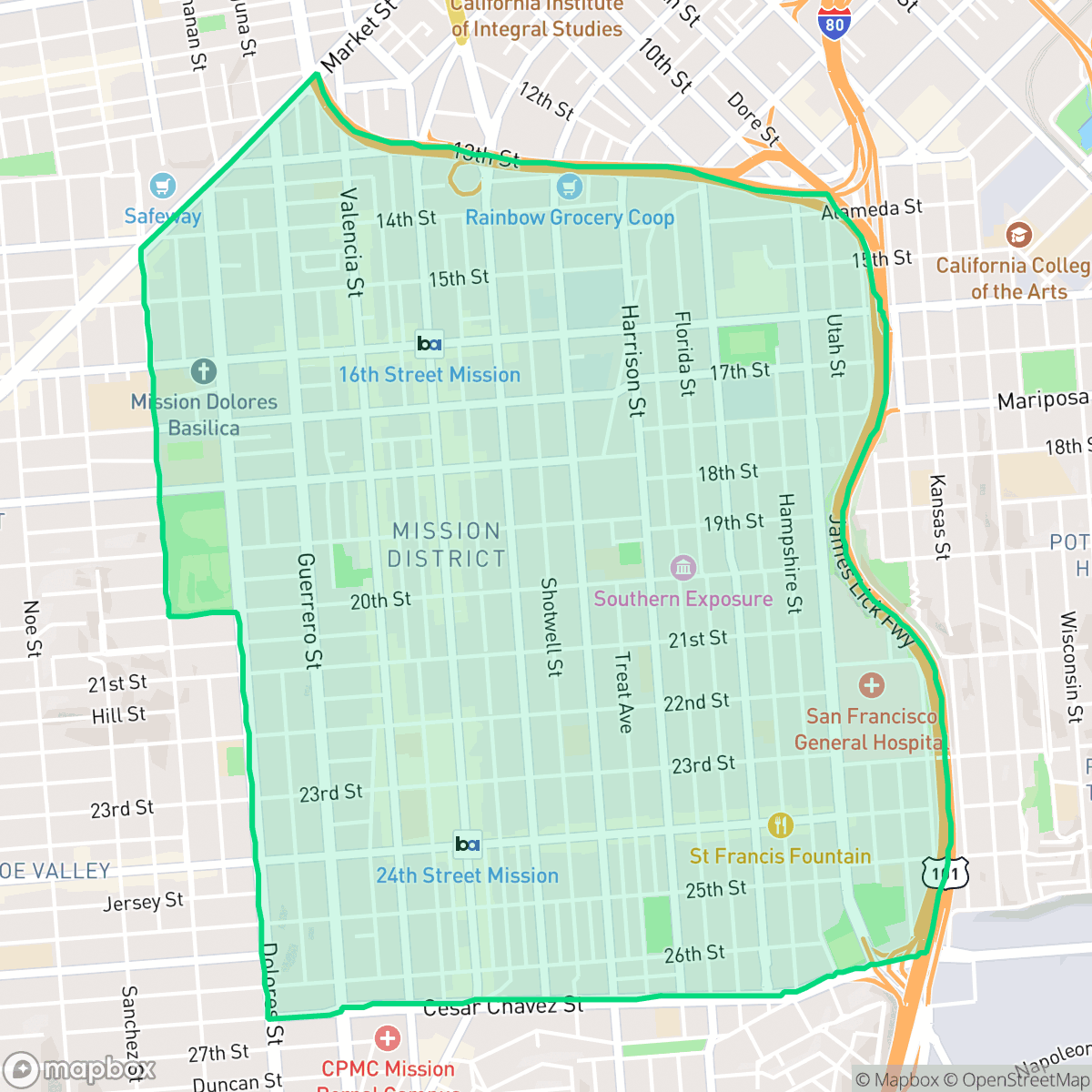
About Mission
Named after the 1776 Mission San Francisco de Asís (Mission Dolores)—the city's oldest surviving structure—San Francisco’s Mission District evolved from a 19th-century working-class enclave of German, Irish, and Italian immigrants into a vibrant center of Chicano and Latinx culture by the mid-20th century. The neighborhood’s architectural tapestry includes ornate Victorian and Edwardian flats, Mission Revival landmarks like the Women's Building, and historic theaters like the Roxie. This cultural identity is vividly expressed through a world-renowned outdoor mural tradition, concentrated in corridors like Balmy and Clarion Alleys, and celebrated at public spaces like Mission Dolores Park. From its roots as a diverse immigrant gateway to its role as a hub for artistic and social activism, the Mission remains one of the city's most historically layered and culturally defining neighborhoods.
The neighborhood functions as a dense, high-energy urban center where the grid-like street layout supports exceptional walkability. Residents benefit from a diverse array of dining options, ranging from long-standing local eateries to trendy cafes, all accessible within a short walk. The area is characterized by its compact, multi-unit housing and a lack of private green space, though it is anchored by the popular Mission Dolores Park, which serves as a vital community hub for recreation and social gatherings.
Prospective residents should note that the high-density environment results in limited privacy and shared walls between homes. According to iHuus data, the area experiences elevated noise levels primarily due to road traffic. While the neighborhood offers strong health insurance coverage and a high level of civic engagement, families should carefully evaluate the local school options, as the surrounding district faces significant fiscal and operational challenges. The area is best suited for individuals or couples who prioritize immediate access to urban amenities and a lively atmosphere over quiet, suburban-style seclusion.
Neighborhood Scores Across 15 Qualities
Residential structures are characterized by shared walls and very narrow gaps between buildings. This level of density and lack of separation is consistent with the broader San Francisco average.
A dense, continuous grid of sidewalks and frequent marked crosswalks makes navigating the area on foot very easy. This level of pedestrian connectivity is on par with the rest of San Francisco.
Visible architecture consists primarily of dense, multi-unit housing and consistent row house rooflines. This urban landscape matches the city average for visual variety, lacking widespread luxury estates or private amenities like pools.
Access to dog-friendly spaces depends heavily on proximity to major hubs like Dolores Park or Duboce Park. Many blocks feature a dense urban grid with limited greenery, making the area slightly less pet-friendly than the San Francisco average.
Extremely dense building clusters and significant pavement coverage dominate the landscape, resulting in a much more built-up environment than the San Francisco average. Limited private green space and narrow street grids define this area according to iHuus data.
High concentrations of diverse dining, social hubs, and cultural landmarks create a level of activity that is notably higher than the San Francisco average. According to iHuus data, the area features a dense mix of mid-rise urban blocks and lively social corridors ranging from waterfront spots to park-adjacent eateries.
Frequent acoustic disturbances from nearby transit corridors and heavy traffic are common in this area. According to iHuus data, noise levels are more significant here than the typical levels found across San Francisco.
Air quality remains consistently high with rare instances of elevated readings. This level of air cleanliness is typical for the city of San Francisco, according to iHuus data.
Industrial presence is minimal across most of the area, although some warehouse-style structures and increased traffic are detectable near the southeastern highway corridor. Aside from these specific pockets, the district lacks heavy manufacturing or hazardous industrial sites, making it very similar to the rest of the city.
Health insurance access is exceptionally high among residents, remaining notably above the San Francisco average according to iHuus data.
Voting patterns and census indicators reflect highly progressive political leanings that are slightly more pronounced than the San Francisco average, according to iHuus data.
Residents live alongside a diverse blend of young professionals, families, and older adults. This age distribution is slightly more varied than the typical San Francisco profile, according to iHuus data.
Properties in this area are located within a designated floodplain, which may necessitate flood insurance. This level of vulnerability to flooding is slightly higher than the San Francisco average, according to iHuus data.
Address-Level Insights for Mission


iHuus Neighborhood Intelligence Insights
Get address-level neighborhood insights for Mission
- Street-level scores — see how individual blocks compare, not just neighborhood averages
- Micro-zone boundaries — identify quiet pockets, flood boundaries, and walkable clusters before you visit
- 15 dimensions in full — walkability, noise, air quality, school quality, insurance coverage, population age profile, urban/rural index, and more
- Boundary risk alerts — know if your address sits near a block boundary where scores drop, the kind of detail no listing will ever mention
- School insights — individual school ratings and insights, not just district-level data
- Compare before you commit — side-by-side data across neighborhoods, down to block precision
No credit card required
Compare with Any Neighborhood
| Dimension | Mission | Alamo Square |
|---|---|---|
| 🚶 Walkabilityavg 9.91 | ||
| 🔊 Acoustic Comfortavg 3.4 | ||
| 🤫 Privacy Indexavg 2.14 | ||
| 🎨 Visual Appealavg 6.26 | ||
| 🐕 Dog Friendlinessavg 6.55 | ||
| 🗺️ Urban-Rural Indexavg 4.07 | ||
| ✨ Neighborhood Vibeavg 6.4 | ||
| 🏥 Health Insurance Coverageavg 7.87 | ||
| 🌿 Air Qualityavg 7.78 | ||
| 🏭 Industrial Proximityavg 9.37 | ||
| 🌊 Flood Safetyavg 1.89 | ||
| 🗳️ Ideological Leanavg 9.92 | ||
| 👥 Population Age Profileavg 5.18 | ||
| 🔥 Fire Safetyavg 0.01 | ||
| 🏫 School Quality |
Mission Rankings
School Districts Serving Mission
School Insights for Mission
Below average outcomes; significant attendance and academic challenges.
School Insights
See what's really behind every school rating near Mission
- Individual school ratings — each school's own score with outcome context, not just a district average
- Enrollment & class size data — student-to-teacher ratio and how it compares to the state average
- Full demographics breakdown — ethnicity and gender composition for every school in the enrollment zone
- Every school in the district — all schools within the enrollment boundary ranked by rating, not just the closest one
- Grade levels & benchmarks — elementary through high school, with below/above state-average flags
No credit card required